Tag Archives: spiritual maturity

Never Forget Redemption!

Another Easter.

Is this our response on the Monday after Easter?  Many of us participated in several Lenten season activities that concluded with the celebration of Resurrection Sunday.   Now it’s time to put away the bunny baskets and hide the remainder of the candied eggs from our children (and ourselves).  But there is one thing we don’t want to put away until next year.  Recognition of God’s redemption.

For we believers, Resurrection Sunday is much more than the culmination of the 40-day Lenten season.  It’s more than a Sunday on the calendar in the spring.  Resurrection Sunday is celebrated in memory of the extraordinary price Jesus paid for not only our freedom (from sin, from death, from destruction) but also the greatest gift any person can ever receive (and Christ can only give)—eternal life.  Eternal life begins on earth and culminates when we return home to be with Jesus (John 17:3).

For God so [greatly] loved and dearly prized the world, that He [even] gave His [One and] only begotten Son, so that whoever believes and trusts in Him [as Savior] shall not perish but have eternal life. (John 3:16, Amplified)

Just as the birth of Christ was orchestrated by God, so it was with His crucifixion and glorious resurrection (Genesis 3:15). Our understanding of God’s redemptive plan is critical knowledge that must be DAILY applied, integrated, and assimilated into our hearts, our minds, and our spirit (John 17:17-26).

The Best Plan

God (Father, Son, and Holy Spirit) fashioned a plan whereby “He Himself” would become human and finally resolve the problem of sin (1 Peter 2:24). But why did this plan require Jesus Christ to take on flesh and blood?

Therefore, since [these His] children share in flesh and blood [the physical nature of mankind], He Himself in a similar manner also shared in the same [physical nature, but without sin], so that through [experiencing] death He might make powerless (ineffective, impotent) him who had the power of death—that is, the devil. (Hebrews 2:14, Amplified)

Only Christ could satisfy the “righteous requirements” of the law (Romans 8:4).   The Mosaic Law demanded that blood be shed, in the form of an animal sacrifice for the “forgiveness of sin” (Hebrews 9:22). This process of sacrifice was repeated continuously, generation after generation, until Christ’s once-for-all sacrifice (Hebrews 9:23-28).

Christ would be able to share in our humanity. He would be able to understand our weaknesses and temptations. As a partaker of flesh and blood, He “might become a merciful and faithful high priest in service to God, and that He might make atonement for the sins of the people” (Hebrew 2:17).

Christ’s defeat of Satan would free believers from sin’s power (Romans 6:6-7).  It is in the destruction of Satan’s power that we are now able to walk in newness of life (Romans 6:4).  We can live victoriously in and for Christ.

 Our Part in the Plan.

God’s salvation does not require us to lay down our physical life for Him but God does ask us to die, spiritually, to the control which our flesh, the world and Satan exert upon us.

The Apostles gave us hints as to the best way to live in the remembrance of redemption.  These are great scripture to use during your time of devotion and meditation.

Paul stated:  I have been crucified with Christ [that is, in Him I have shared His crucifixion]; it is no longer I who live, but Christ lives in me. The life I now live in the body I live by faith [by adhering to, relying on, and completely trusting] in the Son of God, who loved me and gave Himself up for me. (Galatians 2:20, Amplified)

Peter reaffirmed this thought in his letter to God’s scattered elect: Therefore, since Christ suffered in the flesh [and died for us], arm yourselves [like warriors] with the same purpose [being willing to suffer for doing what is right and pleasing God], because whoever has suffered in the flesh [being like-minded with Christ] is done with [intentional] sin [having stopped pleasing the world],  so that he can no longer spend the rest of his natural life living for human appetites and desires, but [lives] for the will and purpose of God. (1 Peter 4: 1-2).

How can we continue remembrance of God’s plan of redemption in 2025?  We can include in our daily devotions activities that recognize and acknowledge God’s gift of redemption.  Scripture memorization, meditation, and journaling are great starters.   Being intentional in our efforts will ensure we never forget what Jesus Christ has done and continues to do for us! (2 Corinthians 1:9-10)

Obedience: Our Journey to the Cross

Obedience and the Journey to the Cross

Obedience and the Journey

Obedience is defined as discerning what God wants and choosing to seek that outcome.  Our response of obedience flows from a heart that hears God’s voice and feels God’s love.  It is a matter of choosing and turning to Him versus the lust of the eyes, the lust of the flesh, or the pride of life (1 John 2:16).

The hallmark of obedience is modeled by our Lord and Savior, Jesus Christ especially as He journeyed to the Cross.  Jesus demonstrated for us “perfected” obedience by His humility, His faithfulness, and His submission to God’s will.

Obedience is both the outcome of our faith walk and the means by which spiritual maturity is accomplished.  We “perfect” (bring to fruition) our obedience through the Holy Spirit and practicing spiritual disciplines that conform us to the image of Christ (Romans 8:29).  We daily accept the “obedience challenge” by exercising our freedom in Christ rather than being disobedient slaves to sin.

The most difficult part of our obedience journey is our willingness to “let go.”  Letting go requires releasing those things that cause us to be independent of God and operate outside His will. Letting go demands that we pray often, wait expectantly, and trust unequivocally.

When we “let go and let God”, the results are always more than we can accomplish in our own power (1 Corinthians 2:9).  Much of the difficulty in “letting go,” lie in our inability to “let go of our ego.”

What’s with the ego?

Ego, in this case, is not an exaggerated sense of self-importance but the use of “fleshly” knowledge and “human” effort to accomplish God’s purpose. This is often the case when we endeavor to live righteous and holy lives in our own power.  Some of us attempt to do this by “works”:  we visit the sick, feed the hungry, and do all the things we think will please the Lord.

Some of us become “masters of spiritual disciplines”:  we read our Bible every day, fast and pray, and tithe.  Regardless of our approach, we “miss the mark” using fleshly methods to create spiritual outcomes.  In Philippians 3:4-5, the Apostle Paul, confesses his attempt to live holy by operating out of his flesh.

 Even though I, too, have reason for confidence in the flesh. If anyone else has reason to be confident in the flesh, I have more: circumcised on the eighth day, a member of the people of Israel, of the tribe of Benjamin, a Hebrew born of Hebrews; as to the law, a Pharisee; as to zeal, a persecutor of the church; as to righteousness under the law, blameless. 

Interestingly the pronoun “I”, in the passage above, in Greek means “ego.”  Paul’s failure was not due to lack of works or poor self-discipline; nor was it the result of a poor attitude or “stinking thinking.”   Paul attempted to do the work and will of God in his own strength.  What was the best solution for Paul’s dilemma?   He declared his faith and dependence on Jesus Christ (Philippians 3:7-9). Paul “let go his ego” and chose to obediently follow God.

Meditation during Holy Week

As we approach Good Friday and Resurrection Sunday, let us consider our journey through the lens of obedience.  To help us, we will set aside time with the Lord to meditate on Philippians 3:8 (NRSV).

I regard everything as loss because of the surpassing value of knowing Christ Jesus my Lord. For his sake I have suffered the loss of all things, and I regard them as rubbish, in order that I may gain Christ. 

When we meditate, we invite the Holy Spirit to join us.  There can be no meditation without His presence.   We are not daydreaming but focusing our thoughts on God’s Word.  Below are three (3) simple methods of meditation you can try.[1]

Meditation method #1:   Emphasize different words in the text.

Meditation method #2:   Rewrite the text in your own words.

Meditation method #3:   Formulate a principle from the text.  What does it teach?

Don’t rush this exercise.  Spend time re-reading and focusing on each word.  Give attention to the verse, each phrase, and words included in this scripture.  Remember, all Scripture is the inspired word from God (2 Timothy 3:16).  Take time to hear not only what God is saying to Paul but also, what God is saying to you.

Journal what you learn from your meditation—about God, the Gospel, your ego, and yourself.  Ask the Holy Spirit to show how you can practice obedience as you daily journey to the Cross.

[1] Spiritual Disciplines for the Christian Life, Donald S. Whitley.

Spiritual Sight: A Deeper Perspective, Part 2

Seeing with Spiritual Eyes, Part 2

Looking beyond what we can see

The ability to see has been associated with many things in the biblical record.  It has been linked to wisdom (Job 42:5), to salvation (Ephesians 1:18), and to discernment (John 7:24). This is by no means an exhaustive list, but it helps to expand our understanding of spiritual sight. Spiritual sight help us to “look beyond what we can see”.

To see or not to see

The prophet Jeremiah was a heartbroken prophet with a heartbreaking message. He labored for more than 40 years proclaiming a message of doom to the stiff-necked people of Judah.

Hear this now, O foolish people, Without understanding, Who have eyes and see not, And who have ears and hear not: (Jeremiah 5:21-29)

Despite Jeremiah’s many warnings, they did not see that their behavior was headed for a collision with the judgment of God. Judah continued to worship idols, disobey God’s covenant, and practice social injustice. Their lack of vision and refusal to surrender to God’s will resulted in exile to Babylon for 70 years. Judah’s loyalty had become divided and had blinded her to the things of God.

How would we evaluate our current world and the choices being made?  Who has eyes and sees not and ears yet hears not?

Barriers to seeing spiritually

The “usual suspects” stand as barriers to using our spiritual sight. They are our flesh, the world, and Satan.

Our flesh is the natural or “unredeemed” part of us that take us away from the purpose of God. Our flesh sees with natural eyes and refuses to obey the leading of the Holy Spirit. Paul the Apostle notes that it is impossible for the natural man to see with spiritual eyes (1 Corinthians. 2:13-16).

The world is that which is contrary to the things of God. It includes the lusts of the flesh, the lust of the eye, and the pride of life (1 John 2:16).  We are told by the Apostle John, that those who love the world do not love God (1 John 2:15). Divided loyalty ultimately leads to disobedience (Titus 1:16).

Satan does what Satan always does:  he discourages, he deceives, and he destroys. Of all the barriers, Satan is the greatest challenge. Why? Because most people don’t believe he exists. He remains the unseen “puppeteer behind the curtain”. But be assured he is very real. Look for him where there is conflict, confusion, and chaos (James 3:16). However, to see him, we will need our spiritual sight.

Our flesh, the world, and Satan keep us from viewing the world as it really exists.  In addition, the postmodern, 21st century worldview has created a “distorted” picture of what we see.  This is especially true with identifying sin.

Our “spiritual sensibilities” are slowly being dulled.  The ultimate goal, of course, is complete spiritual blindness.

How do we gain spiritual sight?

First and foremost, we need to follow the leading of the Holy Spirit.  Jesus shared with His Disciples the importance of the Holy Spirit in guiding them in all truth (John 16:13-14).  Each day it is important that we invite the Holy Spirit to join us through reading scripture, meditation, and prayer.  As we do, we train our spirit man to “listen for the Spirit’s voice” as He communicates with us.

Secondarily, we can practice the presence of the Holy Spirit.  Practicing the Holy Spirit’s presence acknowledges the fact that God, in all His fullness, is always with us (Psalm 139:7-12).  Because of that, we should not limit this practice to our devotion and prayer time only but also include it in our “normal rhythm of life.

Finally, we must be intentional in our pursuit of the knowledge of God and our growth in Jesus Christ (2 Peter 3:18). Seeing with spiritual sight is not a natural attribute for believers. Therefore, it must be developed.

Give all diligence

The Apostle Peter describes this process as “giving all diligence to add to our faith” (2 Peter 1:5-8). Diligence translated means earnestness in accomplishing, promoting, or striving after anything. Peter describes the results for believers who lack that diligence: “They are short-sighted, even to blindness…” (2 Peter 1:9)

Let us make a commitment today to develop our spiritual sight. While it’s been said that “the eyes are the windows of the soul”, it is more important to believe that spiritual sight will “keep your soul.”  (Matthew 6:22-24).

Spiritual Sight: A Deeper Perspective, Part 1

Seeing with Spiritual Eyes Part 1

An invitation

When I begin my daily devotions, I open with Psalm 119:18:  Open my eyes, that I may see wondrous things from Your law. My favorite teacher, Alistar Begg, often begins his bible study sessions with this prayer, “Make the book come alive to me.”

Our intent is the same though our approach may differ. We invite the Holy Spirit to join us as our Teacher, as we seek God’s instruction for our life.   Doing this, we are better able to navigate in this post-modern world where there are no absolutes nor acceptable standards of rightness.

As we examine our current society, it appears what is right or wrong is left to the judgment of the individual. In the absence of a common standard of right and wrong, anything goes.

The Heart wants what the Heart wants

People reject a standard for truth because of their greater desire to do “that which seems right in their own eyes”. But what is right?

A recent Barna Research study, The End of Absolutes: America’s New Moral Code, found no agreement on the definition of morality today.

What is it based on? Where does it come from? How can someone know what to do when making moral decisions? According to a majority of American adults (57%), knowing what is right or wrong is a matter of personal experience. This view is much more prevalent among younger generations than among older adults. Three-quarters of Millennials (74%) agree strongly or somewhat with the statement, “Whatever is right for your life or works best for you is the only truth you can know,” compared to only 38 percent of Elders. And Millennials (31%) are three times more likely than Elders (10%) and twice as likely as Boomers (16%) and Gen-Xers (16%) to strongly agree with the statement.  

People want “what they want” including freedom to choose what fits their preference and lifestyle, even if it means disobedience to God.  [1]

The need to see spiritually

What then are we to do? It is critical that we as followers of Jesus Christ, develop an “eye” for what is truth versus what is error (1 John 4:1).  We began this discussion in our series on spiritual discernment.  However, during these end times, we must be even more intentional, vigil, and alert by honing our “spiritual sight”.  (1 Pet. 1:13).

This 21st century challenge is similar to what the Disciples and the early Church faced. They encountered a society that was “hostile” to the things of God and where men “leaned to their own understanding” (Prov. 3:5).

The Disciples had to develop a “new view” of the world. Jesus taught them that view in the Sermon on the Mount (Matthew 5-7). It was the “Kingdom view”. Believers would have to “see” things differently than the rest of the world.  They would learn to develop their spiritual sight.

Through the leading of the Holy Spirit, the Disciples ultimately proclaimed the gospel of Jesus Christ. They participated in ushering in the Kingdom of God.  We have that same opportunity today.

Time to Practice

I invite you to “a deeper perspective” of God’s Word by using your spiritual sight. Following are (3) scriptures to read and meditate on this week. Feel free to use different translations and paraphrases. Get your journal out as you read and invite the Holy Spirit to join you.

Jeremiah 5:21-29

Matthew 6:22-23

1 Corinthians 2:13-16

Answer these questions for each scripture you read:

  1. How does this scripture relate to my personal walk with God?
  2. How does it influence my view of 21st century society?
  3. What “new” insight did the Holy Spirit reveal to me in this scripture?

[1] Spiritual Discernment:  Light for Darkened Eyes

Jesus: The One for the 21st Century

Jesus: The One for the 21st Century

Is Jesus the One for the 21st century?

Yes, He is! I say that not based on my feelings or opinion but on what God has said about Who He is and how He operates in this fallen world.  I continue to use the phrase, “fallen world” to direct our attention to the condition that has led us to the pain and suffering we are experiencing in the world.  And that condition is sin.

It is easy to wonder why God isn’t more active in resolving the difficulties we face in our world.  Know this!  God cares and engages in every aspect of our lives (Matt. 10:29-31).  However, man’s “free will” allows him to choose those things that, many times, are outside God’s will and not in the best interest of others (which includes the world).

We often look to God to “zap the bad” and make it disappear.  Unfortunately, that isn’t how it works in a fallen world.  That’s why it is valuable to draw near to God (James 4:8) so that we can better understand His ways and His works.   When we do that, we can begin to understand why Jesus is the One for today.

What are our options?

So what have been our “options” to address the challenges of 21st century living?  We’ve tried to legislate, to mandate, and to regulate, just to name a few.  New beliefs, creeds, and convictions, offer no long-term solution to the various world crises we face.  No person, political platform, nor social movement has moved us closer to “the good life”, harmony or peace.  These are not the right solutions for our sin problem.

Why not choose Jesus?  Choose Him not for solving all the problems we experience during difficult time.  Nor for miracles Jesus can perform to address our human needs.  But choose Jesus because He is the One.  He is the One God has ordained to address the issue of sin and to give us life—life now and life in eternity.

Jesus knew.

Jesus knew He was the One.  As He arrived in Nazareth, He entered the synagogue on the sabbath day and stood up to read (Luke 4:16-21).  He read from the Old Testament book of Isaiah that prophesied of the abundant life that would be available to those who would believe and follow the promised Messiah (Isa. 61:1-2).

The Spirit of the Lord is upon Me, Because He has anointed Me to  preach the gospel to the poor; He has sent Me to heal the brokenhearted, To proclaim liberty to the captives and  recovery of sight to the blind,  To set at liberty those who are oppressed; to proclaim the acceptable year of the Lord.

Jesus concluded His reading with a statement meant to remove any doubt as to who He was (Luke 4:21). “Today this Scripture is fulfilled in your hearing.”  Jesus was the promised Messiah. Jesus was the One.

Recognizing The One

Are we poor in spirit?  Disappointed, distraught, and discouraged? Are we brokenhearted, blinded, and held captive by the world’s promise of a better life?

In our humanity, we are continually looking for someone or something to manage the challenges we face.  In God’s economy, believers understand that Jesus is The One.

  • Who better to guide us and to help us through the challenges that lie ahead than The One who is omniscient! The all-knowing One who can see today, tomorrow and into eternity.
  • Who better to protect us than the one who is omnipotent? All powerful. Not like the impotent idols we think will secure our life: wealth, status, or relationships.  All these and more, we foolishly depend on to make us feel safe and secure.
  • Who better to provide for both our spiritual and physical needs than the One who is omnipresent—”everywhere present”. Where can we go that Jesus is not with us? (Ps. 139:7-10)

Jesus is the great I Am.  Bread of life (John 6:35).  Light (John 8:12).  The Door (John 10:9).  The Good Shepherd (John 10:11, 14).  Resurrection and Life (John 11:25).  The Way, Truth, and Life (John 14:6). The Vine (John 15:1, 5).

Jesus is the One!  He is the One we need right now for the challenges we are facing.  Jesus is the Only One.

Living the Beatitude Life: A Heart to See God

A Heart to See God

Intentional teaching

“Blessed are the pure in heart, for they shall see God.”  As a little girl, Matthew 5:8 was one of the first memory verses I was taught.  I can’t explain the reason for the choice of this verse.  Perhaps my mother felt it would help tame my mischievous spirit.  She was very intentional when it came to her children.  Little did I realize that my mother’s guidance would lead to a fuller vision of God and His Kingdom.

Jesus was also intentional in His teachings.  The Beatitudes, both in unity and individually, radically flew in the face of how the world defined happiness, satisfaction, and success: poor in spirit, mourners, meek, merciful, hungry and thirsty.

Jesus’ purposefulness is seen in His presentation of each of the beatitudes, especially with the placement of this sixth beatitude, “Blessed are the pure in heart.”  Today’s beatitude is no exception to this teaching pattern.  It redefines purity and the resulting blessedness of “seeing God.”

Jesus knows what’s needed.

Jesus has to this point shared with His Disciples key behaviors of those who enjoy the “happiness and satisfaction” of living by kingdom rules.

In reading this beatitude today, one might comment on its simplicity in meaning and presentation.  However, in the context of the 1st century, Jesus’ statement was revolutionary.  Jesus presented it to a nation literally obsessed with purification laws and procedures (Leviticus 11-15).

Imagine the shock of hearing Jesus.  “No one, not even Moses, has ever seen Jehovah God!”    “Purity of heart and nothing else?”   This alone was sufficient reason for the scribes and the Pharisees (who benefited from the current religious system) to desire Jesus’ death.

The heart’s role in purity.

The heart is key in sustaining a faithful walk with God.  Its condition (pure or unpure) affects our thoughts, behaviors, and actions.   In the Old Testament, the Lord described the heart, the seat of man’s affection, as “deceitful above all things and desperately wicked” (Jeremiah 17:9).  David understood the importance of purity of heart as he pleaded with God to create a clean heart and renew a right spirit within him (Psalms 51:10).

Who are the “pure in heart”?

  • Those who mourn the impurity of their hearts to the extent that they do what is needed to cleanse and purify it (Matthew 4:17; 1 John 1:9).  When standing in the presence of Holy God, we understand our personal depravity and the need for forgiveness (Romans 3:23).
  • Those who accept God’s lordship in their lives. They place Jesus as the center of their life.  The pure in heart “see” God spiritually.  They operate in His presence, under His authority, and to His honor and glory (Coram Deo).

“Seeing God” in this beatitude allows us to recognize and acknowledge God’s sovereign acts of mercy and grace in this fallen world we live in (Matthew 5:45).  We are able to see “His Hand” both physically (Acts 17:28) and spiritually (Romans 6:6-9).

Our 21st century challenge

Seeing God is a challenge for people living in the 21st century.  Nonbelievers are blinded by Satan who keeps them from seeing the possibilities that Christ offers (John 3:3; 2 Corinthians 4:4).    Beatitude living is at enmity with a world that neither recognizes nor accepts the authority of God, the lordship of Christ, or the leading of the Holy Spirit.

Unfortunately, we believers aren’t always the best witnesses for Beatitude living.  Satan convinces many of us that purity of the heart is impossible.  Again, a trick by Satan to frustrate and discourage our efforts to live holy. We fail to understand that it is the work of the Holy Spirit who will always lead us to purity.  God is not seeking perfection but progress:  a sincere effort to grow and love others.

As children of God, we have everything we need to live pure and holy lives (2 Peter 1:3; 1 John 3:2-3).  Our pursuit of purity can become “second nature”.    How?   By spending more time with God:  reading His Word, meditating, and prayer.  The more we do this, the more we will see God.

“Blessed [anticipating God’s presence, spiritually mature]

are the pure in heart [those with integrity, moral courage, and godly character],

for they will see God.” (Amplified)


New Year. New Beginnings?


New Year. New Beginnings?

The New Year

The new year has arrived with festive gatherings and events.  Some of us have, as is our habit, made “traditional” New Year’s resolutions (which will be quickly abandoned in 30 days or less).

It is my prayer as we prepare for 2025 with new beginnings, that we also evaluate our spiritual growth and progress.  Are we growing closer to God or are we subtly drifting away?

In 2024, where did we spend our time and our resources?  Did we invest in things eternal (Matthew 6: 19-20) or put our hope in things that reflect the values of this world: power, influence, and material wealth?

As we move into this new year, let us remember that we are new creatures in Christ (2 Corinthians 5:17).  Let’s let go of those “old things”.  Let’s rediscover and embrace our identity in Christ.

“If anyone is in Christ, he is a new creation.”

Christ’s work of redemption presents us with the opportunity to experience a new beginning with God. No longer separated by sin, we can now be reconciled with God and enjoy peace with our fellowman (Romans 5:1). To experience this new beginning, we must first possess a clear understanding of our new identity in Christ (1 John 5:4).

Identity is the condition of being a specific person or thing. Our personal identity is the result of the people, places, and things we connect or associate with. This is also true of our spiritual identity. What is feeding our identity in the 21st century?

While personal identity looks at outward influences, spiritual identity, however, looks at two things: (1) the Person of Jesus Christ and (2) the Place of the Cross.

“Old things have passed away.”

Jesus Christ took on our physical identity (in his fleshly body) so that we can become partakers of his spiritual identity (Hebrew 12:14-15). This divine incarnation resulted in the perfect sacrifice required to satisfy the penalty for sin.  In exchange, we have eternal life and are now children of God (Romans 8:16).

In the shadow of the Cross, we leave our old nature and become crucified with Christ (Galatians 2:20). We die to sin and its hold upon our life (Romans 6:11). It is in His resurrection, that we received new life for our new beginning.

 “Behold, all things have become new.”

Let’s flip the switch in 2025 and consider what God has invested in us.  Our responsibility is to daily live out the new identity Christ has provided. Once we fully grasp that, we are positioned to receive “all the fullness of God” (John 1:16).

Our hope and assurance rests fully on the completed work of Jesus Christ.  HE IS our New Beginning (Colossians 1:18).

Psalms for Thanksgiving 2024

Thanksgiving 2024

On Thursday,  we will celebrate Thanksgiving—again.  As we prepare to join with friends and family during this time of gratitude and appreciation, my question is “what are we thankful for this year?”

For an answer, the Holy Spirit guided me to the Psalms.  The Psalms are recognized for their ability to capture the feelings and emotions of people “doing life”.  With that in mind, I’d like to share three psalms, Psalms 105-107, in gratitude for Thanksgiving 2024.

Begin with the end in mind

The opening lines of Psalms 105-107, “Oh give thanks to the LORD,” links together this trilogy of songs which praise God for His goodness and mercy to Israel.  Psalm 105 and 106, possibly originated by command of David to Asaph on the occasion when the ark of the covenant was first brought to Jerusalem (2 Samuel 6:12-19); Psalm 107 most likely were written during the post-Exilic period, that timeframe after the seventy-year period of Babylonian captivity.

As I read these psalms today, it is evident that their strength and intensity lie in their ability to present events of the past clearly and unabridged.  By communicating them to future generations, the nation of Israel would make sure that they would never forget what God had done for them and would result in unending praise to Him.

Psalm 105 remembered and praised God for His eternal faithfulness.

“He remembers His covenant forever, The Word which He commanded, for a thousand generations” (Psalm 105:8).  Israel’s covenant relationship with God gave them “favor” as the seed of Abraham and children of Jacob.  That covenant guaranteed God would both protect and provide for His own people.  It began in time past and is still promised to the nation of Israel in the 21st century.  God is “not a man that He should lie…as He spoken it, He will make it good” (Num. 23:19).

God’s faithfulness is extended to believers today through Jesus Christ, the Mediator of a new covenant, that those who are called may receive the promise of the eternal inheritance (Heb. 9:15).  He will do everything He promised and more (Ep. 3:20).

Psalm 106 remembered and praised God for His certain forgiveness.

“We have sinned…committed iniquity…done wickedly.  Nevertheless He saved them for His name’s sake…” (Psalm 106:6-8)   Israel’s history is replete with accounts of their disobedience and turning away from Jehovah God.  Sometimes it took the form of idolatry; other times it was willful wickedness and rebellion.  Wherever they found themselves, the nation of Israel quickly forgot God and adopted the sinful patterns of their neighbors (v. 13).But God always extended mercy to them.

Believers today are blessed that we can ask God for forgiveness of our sins and He will faithfully and instantaneously forgive (1 John 1:9).  There is no need for the blood of bulls and goals or heifers (Hebrews 9:13-14).  Jesus paid it all that we might freely receive forgiveness.

Psalm 107 remembered and praised God for His great works of deliverance.

“Let the redeemed of the LORD say so, Whom He has redeemed from the hand of the enemy…and He delivered them out of their distresses.  And He led them forth by the right way…” (Psalm 107:2-7).

In God’s faithfulness and because of His forgiveness, He would continually show Himself strong on behalf of His people (2 Chronicles 16:9).  His works of deliverance would save them from their enemies (vv. 1-3), their sinful consequences (vv. 4-22) and the other storms in their national life (vv. 23-29).  And with that deliverance, came unmerited blessings—“wildernesses would be turned to pools of water and dry land into watersprings.”

Today, God continues to be our strength and very present help in time of trouble (Ps. 46:1).  He has delivered us, does deliver us, and we trust will still deliver us” (2 Cor. 1:10).

Your Thanksgiving Psalm

This Thanksgiving, create your own psalm in honor of God’s love and provision.  Know that He loves you with an everlasting love (Jer. 31:3).

Sing praise to our Lord and Savior Jesus Christ, who demonstrated His love for us.  Even while we were in sin, He died for us that we might have everlasting life (Rom. 5:8).    Praise the Lord and give thanks!

Living the Beatitude Life: An Introduction

Living the Beatitude Life: An Introduction

A Return n to the Familiar.

Last week we shared our thoughts on peacemaking.  We used the Sermon on the Mount, more specifically, The Beatitudes, that are found in the Gospel of Matthew (Matthew 5:3-12).   Why did we choose them for our teaching?

While the behaviors outlined in the Beatitudes may not conform to the current “worldview”, they are none the less valid and profitable.  The Beatitudes are foundational truths for righteous living that transcend time.

21st century living through the lens of the Beatitudes is a challenge, to say the least.  They are counterculture, counter-intuitive, and just plain hard.  While living the “Beatitude life” may appear difficult, it is worth the effort in the end.

The key to living the Beatitude Life is in our understanding their benefits.   For the next few weeks, we will examine the Beatitudes and the “blessings” available to us right now.

“Nothing new under the sun.”

We believe the teachings contained in the Beatitudes are relevant and desirable for 21st century believers.  The behaviors described in the Beatitudes represent what life “in Christ” looks like in relationship to God and with our fellowman.

In Ecclesiastes 1:9, Solomon stated that “there was nothing new under the sun”.  He was not referring to the normal changes that occur over time in society.  We are continually learning and integrating new technology and innovation into our world.

What has not changed is the heart of man (Jeremiah17:9).  The influence of the world, of sin and the pulling of our flesh continues (1 John 2:16-17).  Time has not lessened the need for God’s plan of salvation.  Justification, regeneration, and sanctification—are needed as much in AD 2024 as they were needed in 1 AD.  The need will continue until Christ returns.

Supernatural power needed.

Once we become new creatures in Christ (2 Corinthians 5:17), we no longer are expected to live by the world’s dictates.  Instead, we are to pursue a righteous lifestyle like that demonstrated by Jesus Christ.

The behaviors chronicled in the Beatitudes, however, are not developed in the flesh.  They are supernaturally enabled.  Some believe the Beatitudes are behaviors we should strive to achieve.  No amount of striving can accomplish each of these controversial behaviors.  They are only possible through the infilling of the Holy Spirit.

Without the presence of the Holy Spirit, the Beatitudes make no sense, especially to the unredeemed world.  It is this third person of the Godhead that is responsible for the transforming work needed to live out the behaviors described in the Beatitudes (Philippians 2:13).

Stormie Omartian clarifies our response to the Holy Spirit’s power.

Know that once we have received Jesus, we can’t continue to live our old sinful lifestyle. Now that we have His Holy Spirit living in us, guiding us, and transforming us, we have no excuse.

Beatitude living is “supernatural living” that flows from a life lived in obedience to and trust in God.  Our behavior is reframed to see God and others with the eyes of Christ.

We’re not home yet.

The Beatitudes remind us that this world is not our final place of residency.   The kingdom of heaven is the reward that Jesus wants us to focus on.  In an age of instant gratification, rewards that come later are not usually sought after.

Knowing that we are “strangers and pilgrims” in this world, we must turn our attention to things that have eternal value (Colossians 3:1-2).  Therefore, we live in this world with different expectations on how life is to be lived.  Unfortunately, many believers, like unbelievers, focus on “life in this time” rather than “eternity with God”.

The Beatitudes are “rules of engagement” for followers of Christ. They are intimidating and antagonistic to accepted practices and beliefs of the world. True satisfaction and peace are only possible through Jesus Christ.  It is through Christ’s “blessedness” that true satisfaction and peace can be experienced—both now and through eternity.

Although and Yet: A Prayer of Faith


Although and Yet: A prayer of Faith

Wickedness leads to judgment

The Prophet Habakkuk lived and prophesized in the reign of king Manasseh, when wickedness abound.  Destruction by the Chaldeans was imminent.  God would use them as an instrument of His judgment.

If God were to assess the moral condition of our nation, would we be prepared to receive His punishment? The “sins of Judah” resulted in its fall.  Disobedience is a slippery slide that leads to a continuum of sins (James 1:13-15).  Where are we as a nation on that slide?

What’s in a name?

Before being taken into captivity, Judah would experience the loss of all its material wealth and property.  All the blessings of God (Deut. 28:1-14) would be eliminated because of the wickedness and rebellion of Judah (Deut. 28:15-68).

How was Habakkuk to respond to God’s pending punishment on the nation of Judah? Habakkuk is an unusual name which means “to embrace or cling”. In the final chapter of this book, his name becomes apparent as Habakkuk chooses to cling firmly to God regardless of what happens to his nation.

Although and yet.  These two conjunctions reflect how devoted Habakkuk was to his God and the trust he would need to navigate through the dark days that lie ahead.

Habakkuk’s declaration

In the final chapter of the book, Habakkuk concludes with a prayer confessing his continuing trust in the rightness of God’s dealing with Judah (Hab. 3:17-18).

Though the fig tree may not blossom,

Nor fruit be on the vines;

Though the labor of the olive may fail,

And the fields yield no food;

Though the flock may be cut off from the fold,

And there be no herd in the stalls—

Yet I will rejoice in the Lord,

I will joy in the God of my salvation.

May I digress and spend a moment on the grammar Habakkuk used in this prayer.  Though is a conjunction meaning “in spite of the fact that”.   When used at the beginning a phrase, clause, or sentence, it offers a contrast to the main sentence.   Yet is also conjunction that means, in this context, “nevertheless.”  What are you saying, Habakkuk?  Put it in 21st century language we can understand!

In spite of rising costs and inflation,

And drought burned crops and dying cattle in the fields,

In spite of fires, floods, and ravaging storms,

And our shrinking GNP and personal investment accounts,

In spite of doing more with less

And receiving little in return

Nevertheless, I will rejoice in my Lord!

I will be joyful and trust in God.

He is my salvation!

That is the kind of faith we need today. Our world continues to shift from the familiar to the unrecognizable.  These lead to uncertainty and fear.  How will we respond?  Take a moment and write your own declaration of faith.  What is your “in spite of” and your “nevertheless”?

Habakkuk’s faith

Habakkuk concludes his prayer by living up to his name.  He praises God’s wisdom even though he doesn’t fully understand God’s way.  Habakkuk chooses to cling firmly to God regardless of what happens to his nation.

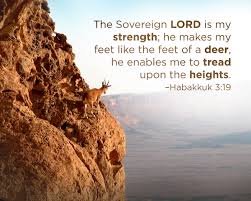
That faith and trust is captured in his closing statement (Hab. 3:19, NLT):

The Sovereign Lord is my strength!

He makes me as surefooted as a deer,

able to tread upon the heights.

In the King James version of this verse, two different words are used for “make”.

  • “He will make my feet like hinds’ feet” or “to transform into”.
  • “He will make me to walk upon my high places” or “tread, bend, or march”.

The deer in this verse was not the domesticated goat we see on farms today but was a wild mountain goat that was equipped the move through the rugged terrain of the mountains.  Narrow openings and ledges, crooks, and jagged rocks.  This is where the deer lived, yet they moved confidently knowing they were created for that world.

Application for us.  Our sovereign God has created us for such a time as this.  He is transforming us and bending us so that we will be able to not only survive but thrive.  But our ability to walk upon “our high places” is dependent on our faith and trust in God—even if we don’t understand His ways.  We must live by faith (Hab. 2:4).  If we do, then we too will be able to walk on our high places (Hab. 3:19).