What I Learned in 2020

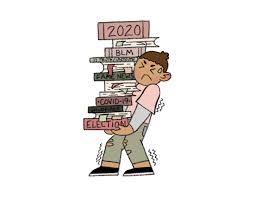
To depict the many challenges we faced in 2020What’s Different

In the past, my annual reflections on “what I learned” were typical for believers in Christ.  They were my experiences and observations as I progressed on my spiritual journey.  They included such things as how I experienced God’s goodness and what I would work harder on in the new year.  I always finished the year hoping I had deepened my relationship with Him.

So what’s different this year?  Everything is different!  Why?  Because 2020 was very different.  As my pastor said a few weeks ago, “There is no such thing as a ‘new normal’.  There is no normal.  Everything is dynamic.”  Life as we knew it has changed.  We now live in a constant state of change.

What I learned in 2020 requires that I go deeper than I normally would in order to fully express the range of emotions and responses to everything that has been happening around us. It’s been said “life will make you bitter or better”.  With 2020, the jury is still out.

2020 Responses:  We Long for Many Things

Most responses to 2020 have ranged from anger (dumpster burnings of 2020 in effigy) to appreciation for the opportunities presented as a result of the pandemic Stay at Home directives.

The variance in these responses may stem from our ability to accept, absorb, or assimilate the changes that are taking place.

Some people respond by retaliating for what they see as a loss of control or threat to their personal freedom.  Remember the initial responses to the pandemic?  The battle over wearing masks?  We are no longer able to “do what we want to do” without considering the impact of our choices on others.

We now more fully understand “our connectedness” and dependence on each other.  We will need each other to successfully navigate the world as it is in “a state of becoming”.  There is a saying that, “You can’t be a winner in a losing organization.”  That statement is never more true than right now.

A Year of Grieving

2020 has also given us much to grieve over.  The loss of life due to the pandemic is unbelievable.  I pray that we never become comfortable with the rising number of deaths within our nation and the world.  So complacent that we forget that each “number” represents a person, a family, a life no longer present with us.

Let us also continue to pray and support those who serve during these horrific times.  The medical professionals, public employees, and service providers who daily risk their lives for us.

A Year without Relationship

I think we grieve the most over our “disrupted relationships”.  We desperately miss being with our families and friends.   No hugs.  No kisses.  We’re left with Zoom calls, online worship, and elbow bumps, if we’re lucky.

This longing to be with others is evidenced by our nation’s inability to deal effectively with the coronavirus.  We desire to be with one another so much that we are willing to literally die for it (or cause someone else to die).

While we desire to be with family and friends, our relationship with others has suffered in 2020.  We have separated ourselves into tribes based on our political views and class distinctions.  We have set aside the basics we learned in kindergarten–play nice and share.  We are at war with each other!  But why?  Over what?  There will be no winners in the end—-only pain, anger, and resentment.

This is unfortunate especially since we so desperately need each other during these tumultuous times.  It is now that we need “to put on bowels of mercy, kindness, humbleness of mind, meekness, longsuffering…and love” (Col. 3:12-14).

So what have I learned?

God is faithful (Deut. 7:9; Heb. 10:23)  and is able to see us through whatever problems we face.  Actually that isn’t something new I’ve learned.  However, 2020 revealed God’s faithfulness in a new context.

That context included a deadly pandemic, social injustice, economic upheaval, and civil unrest.  2020 was like a dystopia movie.  A dystoria is an imagined place or state in which everything is bad, typically a totalitarian or environmentally degraded one.

But God was everything He said He would be.  He was my provider (Phil. 4:19).  He was my  protector (Ps. 46:1-3).  Jesus was my peace–something we still need in 2021.  God’s presence was my comfort and assurance through all the madness of 2020.

You and I are living proof of God’s faithfulness in that we now stand on the other side of 2020.  And how did we get here?  How did we get to the other side?  God brought us through (Is. 43:2).

God’s Plan of Salvation 

There is so much I have learned (and continue to learn from 2020).  But the most important thing I’ve learned is to see life through the reality of God and His plan of salvation.  

God is purposefully executing His plan of salvation for mankind.   Eternal God is sovereignly exercising His purpose in the midst of our history.  Regardless of today’s  current events or who is currently in leadership, they must all defer to the rule and reign of God (Daniel 2:21).

God’s plan for mankind didn’t end with the arrival of Jesus Christ.  God is still manifesting His plan and we are part of that plan right now.  It is our privilege to join God as He manifests His purpose in the world.

So what have you learned in 2020?  I can’t wait to hear from you.

After Christmas 2020

After Christmas 2020

For many of us, Christmas is our favorite time of the year.   We exchange cards that reflect our feelings about this very special  season.  Many cards speak of the love, joy, and peace of Christmas.  Others extend season’s greetings and happy holidays.

With Christmas comes the hope of “peace on earth and good will toward men.”  We need both after 2020.

However,  after the cards are sent, the tree comes down, and gift giving ceases, what will we do with Christmas? What happens to the spirit of Christmas?

The Spirit of Christmas

What exactly is  “this spirit” we talk about so much this time of year? It is a shift in our usual behavior that is extended to others, especially to people we may not know personally.

It is exhibited in more generosity and kindness than normally seen.  This includes but is not limited to the following.

    • Unmerited forgiveness and grace extended to irritable neighbors and estranged relationships
    • Abundant care and concern seen in special collections, gifts and other acts of human philanthropy
    • Indiscriminate displays of kindness and brotherly love for others

Unfortunately, many people confuse the spirit of Christmas with   commercialism we see in advertising  and media.  This spirit often leads to dissatisfaction, materialism, and greed.  The Apostle John described this as the “lusts of the eye” (1 John 2:16).

However, we who are in Christ have crucified the flesh with its affections and lusts (Gal 5:24).  As believers, we have exchanged the spirit of Christmas for the “Spirit of Christ” (Luke 4:18).

The True Source

It is also important that we understand the “True Source” of the spirit of Christmas—Jesus Christ.

For God so loved the world that He gave His only begotten son that whoever believes in Him shall not perish but shall have everlasting life (John 3:16).

Christ came that our joy might be full (John 15:11).  He is our peace (Eph. 2:14).

After Christmas 2020

The COVID-19 experience has generated unbelievable acts of charity and kindness.  For these, we are grateful.  Extension of such graces will be critical as we move into 2021.

Financial uncertainty  and loss of jobs will increase hunger and homelessness in our communities.  Increases in COVID-19 deaths will require us to extend “comfort and mercies” to those in need ( 2 Cor. 1:3-4).

Organizations who are on the front line of this pandemic will need our special prayers AND financial support to provide assistance and relief.

The Spirit of Christ

The spirit of Christmas can only temporarily address the challenges we face in 2021.  We need a long-term, effectual solution.

As Christ’s ambassadors (2 Cor. 5:20) we can extend  “the Spirit of Christ”–His grace and love–throughout the year.    This includes sharing His good news  to those experiencing hopelessness and despair.

After Christmas 2020,  how can we extend the spirit of Christ?

I Hate to Wait: Advent 2020

I Hate to Wait-Advent 2020What goes on in our mind while we are waiting?  Why are we so anxious?  Why is waiting so difficult?   What is waiting really about?

Waiting is the action of staying where one is or delaying action until a particular time or until something happens.  It is the act of staying in one place or remaining inactive in expectation for something.

There are many views with regard to our “waiting tolerance.”  Some are unique to specific generational differences while others are common to all people regardless of age, socio-economic factors, or gender.

Much of our anxiety can be eased based on the quality of the item one is waiting for.  However, we still can feel a level of frustration that cannot be eliminated.

Psychology of Waiting

In a paper written by David Maister, The Psychology of Waiting Lines, he provides some insight into the psychology of waiting.  The main point is that the actual time spent waiting may have little to do with how long the wait feels.  What appears common is the whole issue of what to do with the time a person spends while waiting—the “unoccupied time”.

Unoccupied time is the window where the anxiety of waiting is the greatest.  It is the time we spend in the present until the desired outcome occurs. Give people something to occupy their time, and the wait will feel shorter.  How do you spend the unoccupied time while waiting?

“And now, Lord, for what do I wait? My hope is in thee.”

On a spiritual level, when one is waiting for healing, a word from the Lord, or emotional/financial release, the psychology of waiting takes on a distinctive difference.   Our normal perspective on waiting changes in lights of who we’re waiting for (God) and our level of confidence in the final outcome (also God’s).

In today’s text (Ps. 39:7), David is crying out to God in a time of trouble.  His initial frustration in waiting is later transformed into “hope” by declaring his trust in God, who has always shown Himself faithful to his people and His Covenant.   David knows God will continue to do so, even when God’s specific plan for the future might not be fully understood.  Comfort in waiting is based on an overwhelming confidence or hope in God personally.

Hope in the Waiting

While researching the topic of waiting ,  I was re-directed to the word “hope”.  Hope is one of the four principles we explore during Advent season in which we commemorate mankind’s waiting for Emmanuel, the promised Messiah.  Hope focuses attention on both “what awaits us” (Lam. 3:26; Ps. 37:34) and “the object of our wait” (Ps. 130:5-6).

In both the Old and New Testament the connection to hope and waiting is built on both a personal relationship and reliance on God.

Waiting in the secular world often causes frustration and anxiety.  However, when we are anchored to God, waiting is filled with patience, encouragement, and enthusiasm (Acts 1:4).

Those who wait on God have the assurance that their waiting is for a specific purpose, which God is orchestrating.
Why do I hate to wait?

There are many reasons we have a problem with waiting.  Do any of these characteristics impact your waiting on God?

  • Impatience. We want what we want now.  Impatience is the inability to control one’s desire for action (Numbers 20:10-12).
  • Pride. We operate with an inflated opinion of what’s the best answer or solution to our problem or situation.  Pride is the conceited sense of one’s superiority (Hosea 7:8-10)
  • Independence.  “I am the master of my fate: I am the captain of my soul.”  Independence is the need to control one’s affairs apart from outside influences (Luke 15:12-16), even God.
  • Stubbornness. Who can talk a fool out of his folly? Stubbornness entails the trait of being difficult to handle or overcome (Proverbs 26:3-5)
Experiencing God in the Wait

As believers, we are not exempt from suffering and experiencing tragedy, yet we can face the future expectantly, waiting for the movement of God in our life.

We may have to wait a while for the full experience of the good that God intends for is, but be assured, God is fully committed to everyone who makes a faith commitment to him.

“Therefore the LORD waits to be gracious to you; therefore he exalts himself to show mercy to you.  For the LORD is a God of justice; blessed are all those who wait for him”.  Isaiah 30:18 

God, Time, and Waiting

God, Time, and Waiting

Scripture teaches us that, “a thousand years in God’s sight are but as yesterday” (Ps.90:4, RSV).  Therefore, in waiting for God, we may as well throw our watches away.  It is both frustrating and silly, to try to hold the Creator of the universe to our schedules and timelines. If we want to move “with” God in our life, we must learn to wait.

Man’s Time

What is the socially acceptable time to wait?  In college, if the  professor was delayed, we were instructed to wait for fifteen minutes before leaving.  In most restaurants, you most likely can expect to wait before being seated.  The time wait is generally dependent on time of day, the popularity of the restaurant and the quality of the food. Regardless of “acceptability”, we still, at one time or another, are required to wait.

One of the biggest frustrations for individuals living in the 21st century is waiting.  Americans spend roughly 37 billion hours each year waiting in line. The dominant cost of waiting is an emotional one: stress, boredom, that nagging sensation that one’s life is slipping away.

Generations wait differently

Our willingness to wait varies.  This “waiting tolerance” may be based on generational differences, expectations, and the attraction of the desired outcome.

Baby Boomers, who tend to be more intentional in planning, are fairly comfortable with waiting based on the value of the outcome—waiting is tied to worth.  This is seen in their loyalty to career/employers and investment in relationship building.

For Generation X and Y, waiting is generally acceptable when it is connected to the availability of the desired item, vis-à-vis waiting for the latest IPhone or designer tennis shoe.

For Generation Z, born into a world that screams “instant gratification”, waiting is viewed as a negative—denoting that something is “broken” or “wrong” therefore interfering with receipt of their desired outcome.

All generations hate to wait—the difference lies in “what” or “who” is causing the delay—that even includes God.

Spiritual waiting:  Timeless

What is the “spiritually” acceptable time to wait? Are the rules different?

If we are waiting for God—His intervention or direction—let me answer the second question first.  Yes, the “rules” are different because God is spirit—everlasting, eternal and immortal (John 4:24).

God exists not in the confines of human time but in eternity where there is no time (Is. 57:15).  Time simply put is duration.  Our earthly time pieces mark change in duration that indicate the passage of time.  Eternity, in contrast, expresses the concept of something that has no end and/or no beginning.  God has no beginning or end. He is outside the realm of time (2 Pet. 3:8).

Moses’ simple yet profound analogy (Ps. 90:4) helps us better understand the timelessness of God.  “For a thousand years in Your sight are like a day that has just gone by, or like a watch in the night.” A second is no different from an eon; a billion years pass like seconds to the eternal God.

Waiting for God

In answer to the second question,“What is the “spiritually” acceptable time to wait?”  My answer is simple—as long as God tells you to wait.  The thing about waiting for God is that there is no set or agreed upon time when an answer might be forthcoming.  You can move ahead of God, but you risk missing or delaying the desired purpose God has for your life (Eph. 2:10).

Waiting for God is where our faith comes into play.  We must believe and trust that God loves us and will always do what is best for us.  What we see as a delay is really God’s “best timing” for our life.

What makes the waiting for God “acceptable” (I struggle for a better word) is that God is always worth the wait (Lam. 3:26).  This Advent pray for more patience and knowledge on how to wait for God.

Waiting: Advent 2020

Advent waiting Advent has begun.  For the secular world, this season will be spent  waiting for Christmas.  And how will the world wait for its arrival?  By catching all the sales, looking for the best deals, and insuring their credit limit will survive the endless gift lists for friends and family.  However, this year’s waiting will look and feel different.  

The coronavirus with its financial impacts will make Christmas look a little less “glitzy” and a lot more basic.   Add to that the public health mandates, opportunities to share Christmas cheer will be less frequent if not at all.

Advent 2020

For believers Advent marks a different kind of waiting.  While it is a time of celebrating Christ’s first arrival, it is also a time “to reset Jesus Christ as the center of our lives and at the center of our church.”

In the Renovare podcast, “Waiting in the Darkness:  Why we Need Advent this Year,  this time is also described as “making room” in our lives for Jesus.

Waiting for Christ

Advent is a time when we not only wait to celebrate and commemorate the birth of Jesus Christ but we also joyfully anticipate Christ’s “imminent” return for His Church (2 Tim. 4:8).

Imminent comes from the Latin word meaning “to overhang”.  To say that something is imminent is to say that it is hanging over you and about to fall, in a metaphorical way.  Christ will return but we don’t know when.  So we wait for his return.

Remember what the angels told the disciples at the ascension of Christ:

You Galileans!—why do you just stand here looking up at an empty sky?  This very Jesus who was taken up from among you to heaven will come as certainly—and mysteriously—as he left.  (Acts 1:11, The Message)

In the Gospels, Jesus spoke with certainty about His Second Coming or the Second Advent (Matt. 16:27; 24:44; John 14:1-3; Luke 21:34-36).

How are we to wait?

In James 5:7,  the brother of Jesus gives us our first hint as to how we are to wait.

Behold, the farmer waits for the precious fruit of the earth, being patient over it until it receives the early and the late rain.  (NRS)

We are to wait with patience.  James uses the illustration of the farmer and his need to wait on that which he has no control and yet is  critical for his future provision—rain.

It is the same with believers as we await Christ’s return.  We don’t know when it will happen, but we know we desperately need Him both now and through eternity.

While you wait read:   2020 ADVENT DEVOTIONAL READINGS 

Learning to wait

And so we wait.  We wait for the hope of One whose return is imminent yet unknown specifically when.  We hope in the midst of what appears hopeless, because God alone can resolve what ails the world.  So we patiently wait for his return (Prov. 20:22). 

I contend that waiting—godly waiting–is a spiritual discipline that every believer should cultivate and embrace versus accept with great resignation.   Advent season is the perfect time to practice what will result in a priceless gift from God.  The joy of waiting.

Holiday Season 2020

Holiday season reflects God's purpose

Symbols of the holiday season are everywhere.  We are ready for that golden-brown turkey, giblet dressing and cranberry sauce.  Christmas decorations appear at the mall, at our favorite grocery store, and in our neighborhoods.

Most importantly, the holidays are about enjoying relationships.  Friends and family gather to share stories and to “love on each other.”  Everyone is invited to come and enjoy time together.  However, this year relationships will feel different.  Holiday season 2020, specifically, will be very different in the midst of the pandemic.

This season will be different

As the number of people infected with the virus increase, our nation struggles to find ways to “fatten the curve”.  How do you do that during the holidays?  We are warned to wear our masks, practice social isolation—”stay at home” and exercise social distancing—”stay apart”.

The holiday season is most often depicted by images of merriment and joy.  However, this year those images have been replaced with news broadcasts showing long lines to food pantries and food giveaways.  The financial impact of the pandemic has become the face of poverty.  Joblessness, hunger, and homelessness are new experiences for many who have previously lived comfortably.  To our shame, it is far too familiar for others.

My favorite representation of Thanksgiving is the plenteous cornucopia, bursting forth with ripened fruit from its wide and ample opening.  It is this image that has caused me to evaluate my own personal fruitfulness.  Especially during this “season of COVID-19”.   If I am “rooted and built up in Him” (Col. 2:7), am I bringing forth fruit pleasing to Him?  Am I fruitful?

A season for reflection

Fruit is the product of fruitfulness.  It is used metaphorically of work or deeds (Eph. 2:10; Phil. 1:11; 2 Pet. 1:8).  While works are evidence of Christian activity, it does not always tell the whole story.  Jesus’ teachings often encouraged listeners to look beyond what they could see with their physical eyes and to examine the motives and intentions behind the deeds (Matthew 7:16-20).

You will know them by their fruits. Do men gather grapes from thorn bushes or figs from thistles?  Even so, every good tree bears good fruit, but a bad tree bears bad fruit.  A good tree cannot bear bad fruit, nor can a bad tree bear good fruit.  Every tree that does not bear good fruit is cut down and thrown into the fire.  Therefore, by their fruits you will know them.

Fruitfulness is not “busyness for the Lord” but “transformed living” resulting in the mind of Christ (Phil. 2:5).  Fruitfulness reflects the heart and mind of our beloved Lord and Savior, in whose image we are to be daily conformed (2 Cor. 3:18).

A season for fruitfulness

God has placed us in this historic moment to reflect the heart and mind of Christ.  We were created for such a time as this (Esther 4:14).   It is our responsibility to align ourselves with God’s purpose and perform that which He has given us to do.

    • Am I doing all I can to share the grace and love of Jesus with those in need?
    • How can I demonstrate Jesus’ compassion during this season of COVID?
    • How can I personally help others who are “weary and hopeless”?

We can be Jesus’ eyes that see the needs of others.  We can be Jesus’ hands that move beyond sympathy to action.  As Jesus’ disciples, let us no longer live for ourselves but live for Him who saved us (2 Cor. 5:15).   God has “seeded” us into history to be fruitful.  It is here we are to take root, grow, and be fruitful.

Discovering our fruitfulness

This holiday season will look and feel very different in the midst of the pandemic.  Let us do our part to make it the beginning of something better.  Something that lasts beyond the holiday season.  Let it be the beginning of REAL LOVE for God and for others, even our enemies.  Amid the pandemic, let us create a world that honors God, that celebrates Jesus, and that brings real “comfort and joy”.

God is still speaking

 God is still speaking

E.F. Hutton was one of the most respected financial firms in the United States during the latter part of the 20th century.  It was known for being cutting edge and innovative including it’s iconic marketing campaigns. The slogan “when E.F. Hutton talks, people listen,” became a cultural touchstone.  It is even more important for believers that when God speaks, we listen!

The writer of Hebrews opens their letter with the clear declaration that although God spoke to man in the past through His prophets, He was changing His method of communications.  God was doing a new thing.  God would now speak through His Son, Jesus Christ.

This new way was the gospel message of Jesus Christ.  Jesus offered a more excellent, effectual, and eternal way of providing salvation to mankind.  In the progression of Hebrews, the writer proves that Jesus is superior to angels, a High Priest superior to Melchizedek, and the Mediator of a superior covenant (The New Covenant).

Warnings along the way

The warnings through Hebrews 10 attempted to address the spiritual erosion of the believers in receipt of this letter.  Their behaviors constituted real dangers that could seriously damage their ability to serve and remain faithful to Christianity.  They included negligence, unbelief, spiritual immaturity, and drawing back.

Their actions, once viewed as exemplary, were now approaching indifference.  This resulted in several reminders to the readers concerning their ministry responsibilities in outreach (Heb. 13:1-2, 16), teaching (Heb. 5:11-13), and worship (Heb. 10:25).

Are we experiencing warnings along our Christian walk?  Have we become lax in our commitment to our spiritual giftedness?  Are we sloppy in our worship and praise?  Are we negligent in our service to the Lord, regardless of how small or large it might be?  Has our witness become “silent” for fear of rejection or reprisals?  Are we indifferent to the needs of our community and fellow man?

A Call to Faithfulness and Endurance

In Hebrews 11 the writer exhorts their readers to faithfulness and endurance.  They connect with their audience by sharing the experience of the heroes of Old Testament history.

The writer first spends time sharing the importance of faith.  Its value and worth can be summarized in that faith is:(1) based on confident convictions, (2) certainty about unseen hopes and realities, and (3) is honorable, in that the saints were commended for it.  (Heb. 11:1-2)

Since the readers are presented with “so great a cloud of witnesses” who demonstrated faith and endurance, they can also be expected to do the same (Heb. 12:1).

The final warning

The author concludes the basic argument of this epistle (the excellency of Jesus Christ) with a final admonition and warning (Heb. 12:25-29).  The warning points to the danger of refusing God.

This final warning cautions against apostasy or behaviors which may lead in that direction. This was discussed in earlier warnings to the readers who were in danger of “falling away” (Heb. 6:4-8) and “drawing back” (Heb. 26-39).  Although they had initially accepted the gospel of Jesus Christ, they were still in danger of “turning away” (apostrepha) from or rejecting God’s new way of relating to His people.

We are receiving a kingdom

The author, knowing the tendency of their readers to spiritual weakness, uses Old Testament examples and contrasts to warn their readers to “see to it that they do not refuse Him who speaks” (v. 25). The warning is this.  If the Israelites did not escape God’s wrath as He spoke on earth, how much worse the punishment would be as God speaks from heaven?  (Heb. 12:25)

God sent His Son Jesus to speak for Him (Heb. 1:2).  More importantly, Jesus would provide a “more excellent way” to God through His substitutional death and sacrifice.  The power of sin would finally be broken. Jewish sacrifices and offerings were temporary.  They could never offer the promises and privileges of the Gospel. Jesus offered the power of heaven and the permanence of eternity in Mt. Zion (Heb. 12:26-27).

The writer closes this warning with a message of hope.  The message is this–believers were “receiving a kingdom which could not be shaken” (Heb. 12:28).  The verb receiving is in present tense meaning the action is a “fact of reality occurring in actual time”, historically and remaining even into the present.  This meant believers were part of God’s kingdom that would never change and were partakers of His generous grace (Heb. 3:14).

Within this new community “believers are to serve God with reverence and godly fear” (CSB, awe).  A believer who departs from God’s magnificent privileges invites God’s retribution (Heb. 12:29; Heb. 10:29).

The Message of Hebrew for the 21st Century 

The warnings contained in Hebrews are also appropriate for believers today.  Especially if we desire to remain faithful to the gospel and hope to persevere during this period of history when our faith is constantly under fire.

There are many factors which threaten our ability to “hold fast” our profession of faith (Heb. 10:23). Many are “heart-issues”.

    • The hardened heart. Our refusal to accept the teaching and guidance of God’s Word.  “Today, when you hear his voice, do not harden your hearts as in the rebellion.”  (Heb. 3:15)
    • The darkened heart. Our continuance in sinful behavior although delivered by Jesus Christ.  “If we sin willfully after we have received the knowledge of truth, there remains no more sacrifice for sin.”  (Heb. 10:26)
    • The misguided heart.  Our lack of wisdom and truth needed to discern right from wrong.  “Take care, brethren, lest there be in any of you an evil, unbelieving heart, leading you to fall away from the living God.  But exhort one another every day, as long as it is called “today,” that none of you may be hardened by the deceitfulness of sin.” (Heb. 3:12-13)
    • The divided heart.  Our lack of faithfulness resulting in the choice of the world over God.  “Do not be led away by diverse and strange teachings; for it is well that the heart be strengthened by grace, not by foods, which have not benefited their adherents.” (Heb. 13:9)

Be not discouraged by the admonitions of Hebrews.  Its writer has also included many promises for believers that desire Christ and choose to serve in the kingdom of God.  These promises are built on the excellency of Jesus Christ–the same yesterday, today, and forever (Heb. 13:8).   They are the “more excellent way” (Heb. 5:9; 6:19; 7:19; 7:22; 8:1-2,10).  God is still speaking.  Are we listening?

Making the Right Choice

Maing the Right Choice

The warnings included in the letter of Hebrews were written to believers who were being tempted to return to the Jewish religion and traditions.  In their actions, they were not only choosing Judaism but in their choosing they were also rejecting the gospel of Jesus Christ.

Such is the case in all decisions we make.  When we say “yes” to one thing we simultaneously are saying “no” to its alternatives. In addition, with each decision there are consequences.  Good or bad.  Right or wrong.  Regardless, there are consequences.

Such is the case with this fourth warning.  The choice to return to Judaism contained dangerous consequences which the author attempts to convey in this fourth exhortation.    

Danger! Danger!

The writer of Hebrews has been diligent to warn of the dangerous behaviors being exhibited by the readers of this letter.  Behaviors that are leading to spiritual erosion. They include neglect, unbelief, and spiritual immaturity.

Hebrews 10:26-39 contains the fourth warning to the readers of this critical epistle.   This exhortation deals specifically with the “danger of drawing back”.

The writer continues this serious discussion which first began in Hebrews 6:4-8 with the danger of “falling away” (from Christianity).[1]   This verb is found only here in the New Testament.  The writer is picturing people who have been numbered among the followers of Christ but now leave that company.

Dangerous behaviors and consequences

The behaviors and consequences of “falling away” and “drawing back” are a real and present danger to believers.  We are to take these warnings seriously.   They highlight our need to remain steadfast and faithful (Heb. 10:38).

Behaviors and consequences (are)

Hebrews 6:4-8 

“Falling away” 

Hebrews 10:26-39 

“Drawing back”

Intentional

“with knowledge”

“Those who have were once enlightened, who tasted…who shared” (vv. 4 and 5)

“If we sin willfully after we have received the knowledge of truth” (v. 26)

“Recall the former days…after you were enlightened” (v. 32)

Irreversible

“unable to restore”

“It is impossible to renew to repentance” (v. 4)

“no longer remains a sacrifice for sins” (v. 26)

Irreverent

“of God’s grace and Jesus’ sacrifice”

“They are recrucifying the Son of God and holding Him up in contempt” (v. 6)


“a certain fearful expectation of judgment and fiery indignation” (v. 27)

“Trampled the Son of God…the blood counted a common thing…insulted the Spirit of grace.” (v.29)

 Apostasy by any other name

The writer’s admonition begins with calling out the willful sin of the readers (Heb. 10:26).  Our sins are often the result of our deliberate choice to impose our desire over God’s leadership (James 1:13-15).

This warning deals with the sin of apostasy, an intentional falling away, or defection. Apostates are those who move toward Christ, hear and understand his gospel, and are on the verge of saving belief, but then rebel and turn away. This warning against apostasy is one of the most serious warnings in all of scripture.[2] 

The fourth warning is contained in the final verses of this chapter (Hebrews 10:38-39).

Now the just shall live by faith; But if anyone draws back, My soul has no pleasure in him. But we are not of those who draw back to perdition, but of those who believe to the saving of the soul. 

“The just shall live by faith” is a quotation from Habakkuk 2:1-4.  Who are the “just”?  The just (RSV, my righteous one) in this passage is the person God accepts as righteous who will live by faith. In this verse, the writer is drawing attention to the fact that faith and drawing back are opposed to each other.

To “draw back” means to withdraw self or to shrink from declaring.  It is clear that God is not pleased with the one who draws back (Heb. 10:38). It is important for believers to go forward in the path of faith. To draw back offers the worst consequence–perdition which in some translations is interpreted to mean destruction.  The best choice is to persevere in our faith and be saved.

21st Century Danger

We continually make choices.  Some are simple.  Others may be more complex.  As we make our choices, we, as believers, must also be mindful of potential consequences.  This is especially true of those that affect our spirit man and our walk of faith.  Are we making decisions that cause us to “draw back”?  How are we to respond?

We are to remember when we first came to faith and the gratitude we exhibited in the gift of salvation (Heb. 10:32).  We boldly witnessed the goodness and greatness of God.  We eagerly served and engaged in God’s work (Heb. 10:33).

It is important to know “that we have a better and an enduring possession in heaven” (Heb. 10:34). We should include in our daily routine the reading of Scripture that reminds us of our eternal rewards and destination (Eph. 1:13-14).

Let us refuse to “cast away our confidence” (Heb. 10:35).  To “cast away” conveys the thought of a reckless rejection of what is valuable. Only Jesus Christ holds the pearl of great price (Matt. 13:45-46).

Through Jesus, we have received all spiritual blessings (Ep. 1:3) and great and precious promises (2 Pet. 1:4).  These enable us to endure struggles, reproaches, and tribulations (Heb. 10:32-33).  Because of this, believers can boldly proclaim, “We do not draw back to prediction but are of those who believe to the saving of the soul”.  (v. 39)


[1] Such cannot be brought back to repentance. Notice that he does not say cannot be forgiven or cannot be restored to salvation or the like. It is repentance that is in mind, and the writer says that it is impossible for these people to repent. This might mean that the repentance that involves leaving a whole way of life to embrace the Christian way is unique.  It cannot be repeated.  There is no putting the clock back.

[2] The MacArthur Study Bible


A Call to Maturity

Last week we introduced spiritual maturity as a process, a pathway, or a goal. Regardless of the means of achieving spiritual maturity, the result is to be a believer whose faith is founded on the Gospel and who is committed to ongoing growth (transformation).

Faith and growth work together to develop spiritual maturity in the believer which is critical in moving God’s kingdom forward.  Therein lies the urgency for a call to maturity by the writer of Hebrews.

Dull of hearing

It has been said that to make progress on a bike, you must keep moving forward.  There is no reversal nor standing still.  This is a good analogy in describing the dilemma the author of Hebrews faced.

Although these believers had been trained in the “elementary truths of God’s Word” (NIV, Heb. 5:12), they were not moving forward “on to maturity” (Heb. 6:1).   They had become “dull of hearing” (Heb. 5:11).

Hearing is difficult, not only for this audience but also for any audience.  Interestingly, the verb “to hear” (akouo) provides the root for the verb that means “to obey” (hypakouo) (Heb. 5:9; 13:17).  There could be any number of reasons why this group had become “dull of hearing”.

Distractions, fear of persecution, or loss in confidence of their leaders.  The writer of this letter does not say.  However, we do know the outcome.

The readers had apparently pulled back from their bold witness to outsiders and from exhorting and encouraging one another.  Through lack of use, faculties grow dull and the members regress to a former condition of immaturity.[1]

The writer’s dilemma

In Hebrews 5:11-6:3, the writer contrasts immaturity with maturity.  They use familiar “educational language” of that day to describe the believers’ lack of progress.  The Apostle Paul uses similar language in 1 Cor. 3:1-3.  “Milk” and “solid food” were common terms for referring to levels of educational development.  Here “milk” is an image of the “elementary truths of the God’s Word” (v. 12), while “solid food” is the “word of righteousness” (v. 13) which is the believer’s capacity  to distinguish between good and evil (v.14).

The writer’s dilemma is this.  Although these believers have previously received adequate teaching for their ministry work and purpose (Heb. 6:1-2), their failure to grow spiritually hindered them from understanding more complex teachings about Jesus Christ.  Specifically, Jesus’ excellency as High Priest.  A more excellent priesthood than the order of Melchizedek (Heb. 5:9; 6:20).

Immaturity leads to failure

The exhortations found in Hebrews are appropriate for us today.  Distractions and lack of spiritual discipline keep us stuck in the same position as when we first came to a saving knowledge of Jesus Christ.

Statistics support the fact that believers today spend little to no time on spiritual formation.  It should not be surprising that these behaviors have resulted in believers who are “unskilled in the word” (v. 13) and churches who feel ill equipped to lead new generations to Christ.

Our failure to be spiritually mature results in our inability to accomplish God’s purpose for our life and for His Kingdom.  These include:

The ability to persevere.  Lack of maturity impairs our ability to remain faithful to God’s purpose for our life.  We are created specifically for God’s “good work” (Eph. 2:10).  This is true whether we work in ministry or in the secular world.  Our “stick-to-it-ness” is critical as we live in a world hostile to Jesus.

The ability to discern.  When we become “sluggish” and “dull of hearing”, we risk becoming disobedient.  In a postmodern world, it is difficult to distinguish between what is right and what is wrong (Is. 5:20-24; 2 Tim. 3:1, 3b, 5).  Unable to discern, we become targets for Satan’s deception. “To think between vice and virtue is a line clear and unmistakable is to embrace an illusion.”[2]

The ability to witness.  We have a clear mandate from Jesus to witness to a dying world (Matt. 28:19-20).  It would be impossible for believers to look around our world and not acknowledge that “the fields are ripe and ready for harvest” (John 4:35).  An informed and bold witness is needed as much in the 21st century as it was in the 1st: “Jesus is the way, the truth, and the life” (John 14:6).  We are in a battle for the souls of men.

Go on to maturity

When we became Christians, we received everything we needed for life and godliness through the knowledge of God who called us to glory and virtue (2 Pet. 1:3).  It is our responsibility to build upon the basics of that faith and move forward to maturity.

The Apostle Peter directs us to make every effort (with all diligence) to supplement our faith with virtue, knowledge, steadfastness, godliness, brotherly affection, and love.” (2 Pet. 1:4-8)

Being effective and fruitful in the knowledge of the Lord Jesus is the essence of spiritual maturity.  God is our resource, and all growth comes by grace through Him, but we are responsible to “go on to maturity” (Heb. 6:1).

[1] Letter to the Hebrews, Fred B. Craddock

[2] Ibid.

The Danger of Spiritual Immaturity

At the beginning of this series, I asked if you were “helping or hindering your spiritual journey”.  I posed three questions, which now fit nicely with today’s warning on the danger of spiritual immaturity.

First, where are you in your current faith walk?   Secondly, what would motivate you to seriously consider the five (5) warnings?  And finally, where does Jesus Christ fit in your life today?

It is now time to move these questions from their previous position as the backdrop for this series to the focal point for our exploration of spiritual immaturity.  We begin this journey by contrasting it with its opposite–spiritual maturity.

What is spiritual maturity? 

As I researched this topic of spiritual maturity, there were varying views and opinions as to its definition.  For some it is a process; for others it is a pathway to follow.  And still others see spiritual maturity as the goal of the believer’s life. That being the case I offer several views for your consideration.

Commitment to Transformation

Dallas A. Willard, an American philosopher known for his writings on Christian spiritual formation, describes spiritual maturity as taking place “when we are drawn close to a life with Jesus. We, by the grace of God, behave differently because we have been transformed.”

This transformation occurs as believers intentionally build and live their lives as disciples of Jesus Christ in the Kingdom of God.  This transformation occurs as believers commit to grow, commit to change, and commit to learn. 

Using Willard’s description, spiritual maturity is a process.  One that never ends until we reach heaven and are face-to-face with our Savior (1 Cor. 13:12). Using this description, the question I would ask is this.  As 21st century believers, do we behave differently?

Building on the Foundation of the Gospel 

Ligonier Ministries, founded by the late Dr. R.C. Sproul, exists to proclaim, teach, and defend the holiness of God in all its fullness to as many people as possible.   In “Four Essentials of Spiritual Maturity”, author and contributing writer Kent Hughes outlines four key areas needed for spiritual maturity.

While these essentials are directed to pastors, they also outline key responsibilities for believers who desire to be spiritually mature.  They include:

    1. Christ-focused exposition of the Word—Christ is the source and sustainer of spiritual maturity
    2. Cautious “striving” to accurately present the Word—described as “struggling in preaching the gospel mystery”
    3. Commitment to the Christian community—”to comprehend with all the saints” (Eph. 3:18-19)
    4. Christian maturity demonstrated—the believer is a living testimony of what love and devotion for God should look like

Using Hughes’ description, spiritual maturity is a pathway.  One that is to be passionately pursued (2 Tim. 2:15).  That pathway includes leading people to Christ.  Using this description, the question I would ask is this.  As 21st century believers, are we intentional in building our lives on the foundation of God’s Word?

Passion to Persevere

Lastly, I present the viewpoint that spiritual maturity is a goal.  The specific goal is the believer’s capacity to persevere.  The believer is both able to weather the storms of life while also proclaiming the glory of the Lord.

Oswald in his book, Spiritual Maturity, describes it this way:

Spiritual maturity is not a level of growth Christians achieve but the passion to press on in Christ. As we embrace God’s Providence, the work of the Holy Spirit, the character  Christ desires, the terms of discipleship, hardship, and more, we can move from infancy toward the fruitful maturity we were created to enjoy.

Pastor Andy Stanley, senior pastor and founder of North Point Ministries shares a similar viewpoint: “Spiritual maturity is measured in terms of persevering faith not perfect behavior.”  

The Apostle Paul also describes spiritual maturity in terms of the early churches’ ability to persevere.  Faced with fierce and continuous persecution for their faith, they were told not to “faint” in their work for Christ (2 Cor. 4:1, 14-17; Gal. 6:9; Col. 3:15).  That is perhaps the reason the writer of Hebrews included spiritual maturity as important for this group.

Using this description, the question I would ask is this.  As 21st century believers, are we able to persevere? While we may not face religious persecution, how we respond to the current state of our world, i.e., health pandemic, economic uncertainty, and civil unrest, can be an indicator of our ability to “hold fast our faith” (Heb. 10:23).

Now is the Time 

God needs spiritually mature, 21st century disciples who will represent His Kingdom.  These disciples must be willing to proclaim, defend, and teach the gospel of Jesus Christ.  Especially in a post-modern world that is hostile to Christianity.

Most importantly, 21st century disciples must show and share the love of Christ–even to those who may hate us (Luke 6:27-36).  We no longer can depend only on our pastor to provide outreach to the lost and to the disenfranchised.  Neither can we wait for the church’s mercy ministry to provide for the homeless and the impoverished.  The “them” is now “us”—our family, our neighbor, and our co-worker.

The physical church is temporarily “ON HOLD” for many of us.  Other churches may be operating at a reduced capacity.  But God is calling us today to be what He designed us to be—The Church (1 Pet. 2:4-6).  As the Master Builder, God places His living stones just where He wants us to be (1 Cor.12:18). Spiritual maturity is not an option—it is a necessity for the world we live in today!

Next week we will explore the “Failure of Spiritual Immaturity”.