Tag Archives: Biblical truth

On the Road to God’s New Thing

The Road to New Things

A road by any other name

A road is literally defined as a wide way leading from one place to another. We often think of roads as access to new opportunities of commerce or development, such as the road to success.

A road can also describe a series of events or a course of action that will lead to a particular outcome. In the book, The Road Less Traveled, M. Scott Peck uses “road” figuratively to describe the sometimes hard and often painful process of change. Peck uses the “road less traveled” as a illustration of the journey this requires.

Jeremiah’s  road

In Jeremiah 31, the prophet speaks to the people of God in Babylon to prepare them for a “road”—both literally and figuratively—that would return them to their own land after their 70-year exile.

Jeremiah’s message is clear. They are not to be afraid or lose heart. They are to be focused with a firm resolution to rebuild the nation of Israel.

In Jeremiah 31:22,  Israel is called to refrain from falling back into their old rebellious habits as God creates “a new road”  to their salvation—a “new thing” that had never been done before (or since).

How long wilt thou go about, O thou backsliding daughter? for the LORD hath created a new thing in the earth, A woman shall compass a man.  

Failure on the road

Israel is warned against potential backsliding which is interpreted as “faithless”. In the past both Israel and Judah had consistently failed to “holdfast” to God and depend solely on Him for their every need. (Job 27:6) The results was always disastrous as proven by the conquest of both nations.

Where are we placing our faith? Is it in people—elected officials, family members, or friends?  Are we dependent on things—bank accounts, social status, or professional affiliations? Do we believe only in ourselves—our intellect, looks, or personality? When Jesus returns, will He find  us faithfully following Him on the new road? (Luke 18:8)

With God on the road to new things

Israel is encouraged to trust God, Who would create a “new thing”—interpreted as strange and surprising—in the earth. God would create a woman who would “compass” or protect man.

Many interpreters understand this “new thing” to be the incarnation of Jesus Christ.  A woman, the Virgin Mary, enclosed in her womb the Might One. This was to be their incentive.

They would know that with their return from exile came the promise of not only their physical restoration but also the spiritual blessing of the Mighty God (Is. 9:6). God would not cast off His people but bless them. This was to be their assurance.

What is the road for us today?

How do we  to live in the knowledge of this “new thing”?  Knowing the blessings of being in Christ (Ephesians 1:3-14).

We live attentively in God’s presence. God is creating new opportunities for us.  However, we must listen for His voice and watch where He is working. (2 Chronicles 16:9)

We live expectantly in God’s provision. God has provided all that we need to live godly lives and to accomplish His purpose in our lives. (2 Peter 1:3-8)

We live faithfully in God’s purpose. As the elect of God we live by faith. We do not backslide or “draw back unto perdition” but trust that He who began this “good work in us” is able to complete it. (Philippians 1:6)

Our journey to understanding “new things” has hopefully provided incentive and inspiration to walk in the divine purpose God has created for our lives. When we as believers trust God and understand God’s reason for “new things”, we can move forward joyfully in faith and confidence.


What I Learned in 2024: What Time is it?


What time is it?

A New Year Begins.

Welcome to 2025!  As is my habit with WordBytes in January, I’d like to share with you my key learnings from 2024.

I am a learner by nature.  I especially LOVE to read and study God’s Word.  Through writing WordBytes and daily journaling, I capture my thoughts and share my emotions with the Lord.  I write, scribble, cut and paste; highlight,  and redline.  I use many symbols to capture what God is revealing to me in our time together.  My journal is my personal creative mess!

As I read my quarterly journals for 2024, there emerged several key themes that I’d like to share in this year’s learning.  All revolved around the idea of “time”.   Not the time we use to calculate intervals of a day (chronos time), but the appointed time in the purpose of God (karios time).

2024 was the “karios time” to receive the message God wanted to share with me, not only for my spiritual growth and development, but also to build my resilience for 21st century living (Esther 4:14).

A Time for examination.

2024 was a time to examine myself and see if I was still in the faith (2 Corinthians 13:5). Was my heart “divided”?  Was I attempting to serve God AND the world?  Who and what dominated my time and my resources?  Was I being conformed to the image of Christ? (Romans 8:29)

In his book, Resilient: Restoring Your Weary Soul in these Turbulent Times, John Eldredge reminded me of this fact.

Maturity is no longer optional, dear ones; wholeheartedness is no longer something we can go without.  Those vulnerabilities in us prove treacherous in this world, like a faulty bridge or a bow that is not properly strung.

With all the distractions and competition for my attention, was I still faithfully following Christ? I needed to daily acknowledge Jesus as Lord of my life and totally commit to follow Him.

A Time to surrender.

Surrender is an unpopular word usually associated with defeat.  But with God, surrender takes on a new meaning.  Surrendering to God, makes possible, what is impossible without Him.

I foolishly believed that my efforts shaped me into the person God created me to be.  It is the Holy Spirit within me that does the work (Philippians 2:13).

In his book, Absolute Surrender, A.W. Tozer, shares this thought about my role in surrendering.

A life of absolute surrender has its difficulties.  I do not deny that.  Yes, it has something far more than difficulties: it is a life that with man is absolutely impossible.  But by the grace of God, by the power of God, by the power of the Holy Spirit dwelling in us, it is a life to which we are destined, and a life that is possible for us, praise God!

It is my honor to surrender “everything and everyone” to the Lord.  I have come to the reality that without Jesus, I can do nothing (John 15:5).  God alone knows where I am, where I need to be, and what it will take to get me to where He wants me to be.  It is my job to surrender.

A Time to go deeper into God’s love.

As a child, I was taught the song, “Jesus loves me”.  However, I did not fully understand the depth of that love until I experienced the joy and pain of living in this fallen world.  Through both good and bad times, I have experienced the love of the Good Shepherd, Jesus Christ (Ephesians 3:16-20)

As I read W. Phillip Keller’s book, A Shepherd Looks at Psalm 23, I was amazed at the uncanny similarities between the work of the shepherd and Jesus’ work in the life of human sheep.

It is a tragic truth, that many people who really have never come under God’s direction and management claim that “The Lord is my shepherd”.  They hope that by merely admitting that he is their Shepherd, they might somehow enjoy the benefits of His care and management without paying the price of forfeiting their own fickle and foolish way of life.

Jesus is my Good Shepherd (John 10:14) who loves me and cares for me even in my disobedience, and my foolishness. Jesus makes me lie down, restores my soul, and leads me. His love for me is extraordinary.

MOMENTS OF MINDFULNESS

Time to reflect on today’s session.  Feel free to share your remarks at https://www.itwministries.org.

What have you learned in 2024?   What things will you leave behind that won’t be helpful in your 2025 journey?  What things has God revealed that will help you achieve a richer life in Christ in 2025? 

Living the Beatitude Life: An Introduction

Living the Beatitude Life: An Introduction

A Return n to the Familiar.

Last week we shared our thoughts on peacemaking.  We used the Sermon on the Mount, more specifically, The Beatitudes, that are found in the Gospel of Matthew (Matthew 5:3-12).   Why did we choose them for our teaching?

While the behaviors outlined in the Beatitudes may not conform to the current “worldview”, they are none the less valid and profitable.  The Beatitudes are foundational truths for righteous living that transcend time.

21st century living through the lens of the Beatitudes is a challenge, to say the least.  They are counterculture, counter-intuitive, and just plain hard.  While living the “Beatitude life” may appear difficult, it is worth the effort in the end.

The key to living the Beatitude Life is in our understanding their benefits.   For the next few weeks, we will examine the Beatitudes and the “blessings” available to us right now.

“Nothing new under the sun.”

We believe the teachings contained in the Beatitudes are relevant and desirable for 21st century believers.  The behaviors described in the Beatitudes represent what life “in Christ” looks like in relationship to God and with our fellowman.

In Ecclesiastes 1:9, Solomon stated that “there was nothing new under the sun”.  He was not referring to the normal changes that occur over time in society.  We are continually learning and integrating new technology and innovation into our world.

What has not changed is the heart of man (Jeremiah17:9).  The influence of the world, of sin and the pulling of our flesh continues (1 John 2:16-17).  Time has not lessened the need for God’s plan of salvation.  Justification, regeneration, and sanctification—are needed as much in AD 2024 as they were needed in 1 AD.  The need will continue until Christ returns.

Supernatural power needed.

Once we become new creatures in Christ (2 Corinthians 5:17), we no longer are expected to live by the world’s dictates.  Instead, we are to pursue a righteous lifestyle like that demonstrated by Jesus Christ.

The behaviors chronicled in the Beatitudes, however, are not developed in the flesh.  They are supernaturally enabled.  Some believe the Beatitudes are behaviors we should strive to achieve.  No amount of striving can accomplish each of these controversial behaviors.  They are only possible through the infilling of the Holy Spirit.

Without the presence of the Holy Spirit, the Beatitudes make no sense, especially to the unredeemed world.  It is this third person of the Godhead that is responsible for the transforming work needed to live out the behaviors described in the Beatitudes (Philippians 2:13).

Stormie Omartian clarifies our response to the Holy Spirit’s power.

Know that once we have received Jesus, we can’t continue to live our old sinful lifestyle. Now that we have His Holy Spirit living in us, guiding us, and transforming us, we have no excuse.

Beatitude living is “supernatural living” that flows from a life lived in obedience to and trust in God.  Our behavior is reframed to see God and others with the eyes of Christ.

We’re not home yet.

The Beatitudes remind us that this world is not our final place of residency.   The kingdom of heaven is the reward that Jesus wants us to focus on.  In an age of instant gratification, rewards that come later are not usually sought after.

Knowing that we are “strangers and pilgrims” in this world, we must turn our attention to things that have eternal value (Colossians 3:1-2).  Therefore, we live in this world with different expectations on how life is to be lived.  Unfortunately, many believers, like unbelievers, focus on “life in this time” rather than “eternity with God”.

The Beatitudes are “rules of engagement” for followers of Christ. They are intimidating and antagonistic to accepted practices and beliefs of the world. True satisfaction and peace are only possible through Jesus Christ.  It is through Christ’s “blessedness” that true satisfaction and peace can be experienced—both now and through eternity.

Although and Yet: A Prayer of Faith


Although and Yet: A prayer of Faith

Wickedness leads to judgment

The Prophet Habakkuk lived and prophesized in the reign of king Manasseh, when wickedness abound.  Destruction by the Chaldeans was imminent.  God would use them as an instrument of His judgment.

If God were to assess the moral condition of our nation, would we be prepared to receive His punishment? The “sins of Judah” resulted in its fall.  Disobedience is a slippery slide that leads to a continuum of sins (James 1:13-15).  Where are we as a nation on that slide?

What’s in a name?

Before being taken into captivity, Judah would experience the loss of all its material wealth and property.  All the blessings of God (Deut. 28:1-14) would be eliminated because of the wickedness and rebellion of Judah (Deut. 28:15-68).

How was Habakkuk to respond to God’s pending punishment on the nation of Judah? Habakkuk is an unusual name which means “to embrace or cling”. In the final chapter of this book, his name becomes apparent as Habakkuk chooses to cling firmly to God regardless of what happens to his nation.

Although and yet.  These two conjunctions reflect how devoted Habakkuk was to his God and the trust he would need to navigate through the dark days that lie ahead.

Habakkuk’s declaration

In the final chapter of the book, Habakkuk concludes with a prayer confessing his continuing trust in the rightness of God’s dealing with Judah (Hab. 3:17-18).

Though the fig tree may not blossom,

Nor fruit be on the vines;

Though the labor of the olive may fail,

And the fields yield no food;

Though the flock may be cut off from the fold,

And there be no herd in the stalls—

Yet I will rejoice in the Lord,

I will joy in the God of my salvation.

May I digress and spend a moment on the grammar Habakkuk used in this prayer.  Though is a conjunction meaning “in spite of the fact that”.   When used at the beginning a phrase, clause, or sentence, it offers a contrast to the main sentence.   Yet is also conjunction that means, in this context, “nevertheless.”  What are you saying, Habakkuk?  Put it in 21st century language we can understand!

In spite of rising costs and inflation,

And drought burned crops and dying cattle in the fields,

In spite of fires, floods, and ravaging storms,

And our shrinking GNP and personal investment accounts,

In spite of doing more with less

And receiving little in return

Nevertheless, I will rejoice in my Lord!

I will be joyful and trust in God.

He is my salvation!

That is the kind of faith we need today. Our world continues to shift from the familiar to the unrecognizable.  These lead to uncertainty and fear.  How will we respond?  Take a moment and write your own declaration of faith.  What is your “in spite of” and your “nevertheless”?

Habakkuk’s faith

Habakkuk concludes his prayer by living up to his name.  He praises God’s wisdom even though he doesn’t fully understand God’s way.  Habakkuk chooses to cling firmly to God regardless of what happens to his nation.

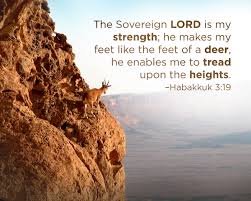
That faith and trust is captured in his closing statement (Hab. 3:19, NLT):

The Sovereign Lord is my strength!

He makes me as surefooted as a deer,

able to tread upon the heights.

In the King James version of this verse, two different words are used for “make”.

  • “He will make my feet like hinds’ feet” or “to transform into”.
  • “He will make me to walk upon my high places” or “tread, bend, or march”.

The deer in this verse was not the domesticated goat we see on farms today but was a wild mountain goat that was equipped the move through the rugged terrain of the mountains.  Narrow openings and ledges, crooks, and jagged rocks.  This is where the deer lived, yet they moved confidently knowing they were created for that world.

Application for us.  Our sovereign God has created us for such a time as this.  He is transforming us and bending us so that we will be able to not only survive but thrive.  But our ability to walk upon “our high places” is dependent on our faith and trust in God—even if we don’t understand His ways.  We must live by faith (Hab. 2:4).  If we do, then we too will be able to walk on our high places (Hab. 3:19).

Meeting the Holy Spirit: Myths, Lies, and Misunderstandings about the Holy Spirit


Myths, Lies, and Misunderstandings about the Holy Spirit

Danger ahead…MLMs

As we discussed last week, myths, lies, and misunderstandings (MLMs) are dangerous to the life and spiritual welfare of both believers and nonbelievers.  This is especially true as it relates to the Holy Spirit.

Top MLMs about the Holy Spirit

Though not exhaustive, here are my top MLMs concerning the Holy Spirit.  The source of this list are frequent questions I have received concerning the third person of the Trinity.

Myth: The Holy Spirit is for Super Christians.  He is not for everyone.”

Unfortunately, this myth has been around for quite some time due to religious and denominational differences.  The devastating result of this myth is that people question whether they are indwelled by the Holy Spirit.  In addition, this myth gives the perception that Christians receive the Holy Spirit based on their merit.

When we accept Jesus Christ as our Savior, Jesus gifts us with the Holy Spirit (Gal. 3:14).  While we can’t control the Holy Spirit, we can, however, hinder His work.  We can quench the Holy Spirit by refusing His guidance or grieve Him by continuing to do sinful acts.

As we surrender our will to God’s will, we will receive greater filling by the Spirit.  “Filling” means we empty ourselves of self and make room for MORE of HIM.  This results in the Fruit of the Spirit (Gal. 5:22-23) and conforming to the image of Christ (Rom. 8:29).

Lie: The Holy Spirit is actually our inner spirit guiding us on the path to our true purpose and destiny.”   

It’s a path alright.  A path to nowhere. This is perhaps the most egregious lie designed by the devil.  It denies the reality of God.  Satan’s MO is to always have man look to himself as the primary source of power and control.  This is a “self-directed” belief (lie) that keeps people from coming to the “glorious gospel of Christ” (2 Cor. 4:4).

This strategy of Satan is intended to keep us bound, broken, and discouraged.  We fail to reach God’s designed purpose for our lives.  Why?  Because we attempt to do what only God can do through His Holy Spirit in us (John 15:5; Eph. 3:20).

Misunderstanding:  “The Holy Spirit is like an angel that God sends to help people.”

This belief reflects a lack of understanding of who God is and the work of the Trinity.  First and foremost, God is one God with three distinct, eternal, coexistent persons.  God is the Creator of all things (Genesis 1).  Jesus, who is God’s only begotten Son is also God.  And finally, the Holy Spirit, who is God’s Spirit is also God.

Regarding these three manifestations of our one, God, we must recognize their distinctions, but not separate them from one another. We will never understand all that God wants us to know about him without having full knowledge of each representation of him. [1]

Without a correct knowledge of God, we risk “being tossed to and fro by every wind of new teaching and influence, when people try to trick us with lies so clever they sound like the truth” (Eph. 4:14, NLT).  The best approach to deal with MLMs is to know the truth.   Be alert to myths, lies, and misunderstandings that threaten our walk of faith.

Click here to learn how to correct my top MLMs

including books to help you in your spiritual journey

to draw closer to the Holy Spirit.

[1] Lead Me, Holy Spirit:  Longing to Hear the Voice of God, Stormie Omartian

Meeting the Holy Spirit: Myths, Lies, and Misunderstandings


Myths, Lies, and Misunderstandings

Guard against error!

Living in the 21st century requires that we be diligent and equip ourselves with correct information (Prov. 4:7).  This guards us against error, especially, with regard to our spiritual beliefs.

Error often presents itself in the form of myths, lies, and misunderstandings (MLMs).  This includes what we know about the Triune God:  Father, Son, and Holy Spirit.  Today we will examine MLMs and how they can negatively impact our ability to have a correct view of God.

MLMs—the what and the why?

Myths, lies, and misunderstandings can be credited to many different things.

  • Myths are widely held but false beliefs or ideas. Myths are upheld to misrepresent the truth and to maintain certain beliefs.
  • Lies are statements that one knows are false, with the intent to deceive.
  • Misunderstandings stem from a failure to understand something correctly. A misunderstanding can be caused by an incorrect conception or a misinterpretation. It can also be mistakes of meaning or intent.

Myths and misunderstandings can be attributed to a general lack of knowledge.  Even within our churches, discussions on the Holy Trinity are limited.  Congregations need to be better informed on our relationship with each member of the God Head and how each of them impacts our lives.

Lies, of course, can be assigned to the father of lies, Satan.  Satan has done an excellent job in intentionally deceiving people about who God is.  We tend to make God smaller than He really is, to fit our human view.  We compare our limited abilities with God’s infinite power.  We do this to justify our decisions and behaviors (Jer. 17:9).

God is the true source for victorious living.  It is in Him that we live and breathe and have our meaning (Acts 17:28).  Our personal relationship with God provides us with courage and hope amid our struggles.    It strengthens our faith and points us to the One who will sustain us in the most difficult of times.  Therefore, we are able to persevere and do not “faint” (2 Cor. 4:17).

How to deal with MLMs?

What is the best approach to deal with myths, lies, and misunderstandings?  Seek out and know the truth through spiritual discernment The primary source of that truth is the Bible.  The Holy Spirit leads us in all truth (John 16:13).

In this postmodern era, relativism offers the view that there is no absolute truth; truth is relative based on individual perceptions and considerations. Satan uses this thinking to continue his campaign to “blind our eyes” about God, His Son, and the Holy Spirit (2 Cor. 4:4).

We must seek truth in all we do and boldly denounce MLMs that keep others in darkness (Eph. 5:11).  Myths, lies, and misunderstandings intent is always the same:  to deceive, mislead, and misrepresent.

Next week we will explore MLMs about the Holy Spirit.

Meeting the Holy Spirit: From Head to Heart, Part 2

From Head to Heart, Part 2

A transformative relationship.

To move the Holy Spirit from head to heart, we need a personal relationship with Him.  With the indwelling of the Holy Spirit, we begin that relationship that will end with us being conformed to the image of Christ (sanctification).

Conforming to Christ’s image is God’s desire for us.  It is where our transformative relationship begins (Rom. 8:29).  We as believers cannot accomplish sanctification.  It is the sovereign work of the Holy Spirit.  We can, however, help or hinder His work in us.  It is important that we cooperate with the Holy Spirit. 

What does the relationship look like?

Our relationship with the Spirit begins with letting the Holy Spirit fill us with His mind.  Warren Wiersbe, noted theologian and teacher, gives insight into how our relationship with the Holy Spirit should operate.

It is not enough for us to have the Spirit; the Spirit must have us! Only then can He share with us the abundant, victorious life that can be ours in Christ. We have no obligation to the flesh, because the flesh has only brought trouble into our lives. We do have an obligation to the Holy Spirit, for it is the Spirit who convicted us, revealed Christ to us, and imparted eternal life to us when we trusted Christ. Because He is “the Spirit of Life,” He can empower us to obey Christ, and He can enable us to be more like Christ.[1]

Our personal relationship with the Holy Spirit requires that we empty ourselves OF OURSELVES.  Then there is room for the filling of the Holy Spirit.   Through His filling, we receive His power, His truth, His wisdom, and His love.  Over time, our relationship with the Holy Spirit will begin to “squeeze out” things of this world and the flesh.  Our desire for things “eternal” will take priority (Psa. 27:4).  Our decisions and behaviors will reflect the Spirit’s presence in our life (good fruit).

It’s all about the right perspective.

As we attempt to “find our voice” and “discover who we are”, we might lose sight as to our real purpose in life, which can only be defined by God (Eph.2:20).   The Holy Spirit helps us with our perspective.  He is our Helper.  He helps us to be who God created us to be. “God wants to lead you to places you cannot get to without Him, and He does that by the power of His Spirit.”[2]

[1] Warren Wiersbe, “To Be Series”.

[2] Stormie Omartian, Lead Me, Holy Spirit:  Longing to Hear the Voice of God.

A New View of Surrender, Part 2


A New View of Surrender, Part 2

What, why, when, how… to surrender?

It is not easy for us to surrender.  It is, therefore, important to understand how surrendering operates in our daily lives.  This is where we will begin today.

As we stated earlier in this study, to surrender means to give up power, control, or possession of a thing.  For believers, that thing is us!  Spiritual surrender is the relinquishing of our will to the will of God.  Each day we are tempted by our flesh, the world, and Satan to give up power, control, or possession of our life (1 John 2:15-17).  That’s why it is important to be alert and watchful to decisions that lead us to death or to obedience (Rom. 6:16).

Why surrender?

This question, for me, was a game changer!  To truly understand “why” surrender, it is important to understand what it means to be “filled by the Spirit”.   While the definition of “filling” or “indwelling” of the Holy Spirit may vary based on one’s denomination, I will share the most common understanding by theologians.

The filling of the Spirit refers to a continual process of spiritual growth and maturity, where believers are constantly controlled by the Holy Spirit in their mind, emotions, and will. It is not a feeling or emotional experience, but rather the yielding of one’s life to the Lord. The filling of the Spirit empowers us to live the surrendered life.

When to surrender?

At the moment of salvation, we surrender to the Holy Spirit who brings us to repentance (John 16:8).  The Holy Spirit regenerates our spirit and we become new creatures in Christ (2 Cor. 5:16-17).  It is at that time that the Holy Spirit takes permanent residence in our life (1 Cor. 3:16).

We continue this process of surrender so that we will “act more like Jesus” or “be conformed” to His image (Rom. 8:29).   This is only possible through our obedience to the Holy Spirit.

How to surrender?

As we stated earlier, the Holy Spirit’s filling is the yielding of our life to the Lord.  Key to this definition is the word, yielding.  Yielding implies an act of cooperation by us as recipients of the Spirit.  Unlike our initial salvation, it is a continual process in our spiritual growth.  This is the daily work of surrender (2 Cor. 3:18).

I offer three “R’s of Surrender” to help us practice this critical element in our Christian walk.

    • Repentance.  Continually examine our life to identify those things that act as idols and influences.  Be brutal in discarding those things that hinder our absolute surrender. (2 Cor. 13:5-6)
    • Realization. Depend wholly on the directions and leanings of the Holy Spirit.  Surrender cannot be accomplished by our “good works” or best efforts.  It is the work of God. (Luke 18:27)
    • Relationship. Understand the will of God by spending time with Him.  Prayer, meditation, and His Word are direct paths to surrender.  Practice His presence throughout the day. (Psa. 42:1-2)
God blesses when we surrender

To live in the fullness God has planned for our life, it is important that we surrender to God.  This means we must give up those things that hinder the Holy Spirit’s work in our life.  This includes not only personal sin, but our self-will, self-confidence, and self-effort.

I close with these insightful words from Andrew Murray as to the blessings associated with our surrender to God.

I say again, God will bless you. You have been praying for blessing. But do remember, there must be absolute surrender. At every tea table you see it. Why is tea poured into that cup? Because it is empty and given up for the tea. But put ink, or vinegar, or wine into it, and will they pour the tea into the vessel? And can God fill you, can God bless you if you are not absolutely surrendered to Him? He cannot.[1]

To be filled, we must empty ourselves.  We must surrender.

[1] Absolute Surrender, Andrew Murray

A New View of Surrender, Part 1

A New View of Surrender, Part 1

What does surrender look like?

To surrender means to give up power, control, or possession of a thing.  It is often used in military terms to express a point of “handing over” a town or a fortification to an enemy.  It is punitive, in nature, when viewed from this vantage point.

However, from a spiritual standpoint, surrendering offers greater benefit when viewed from our loving God.  Spiritual surrender (surrender to God) is based on His grace and love (Eph. 2:4-8).  Through His Holy Spirit, we respond with trust and obedience.   We learn to surrender to God!

Sin and surrender

Sin and surrender have more in common than their first letter.  Sin has at its core the stubborn resistance to surrender oneself to the authority and rule of God.  Remember Adam and Eve?

Often, we fail to see the spiritual reality of these two conflicting influences in the world. Each day we, unknowingly or knowingly, choose one we will surrender to.  Who will rule, control, and influence our life?  This requires that we continually examine our position of surrender.  In his letter to the church in Rome, the Apostle Paul makes clear this truth.

Do you not know that if you present yourselves to anyone as obedient slaves, you are slaves of the one whom you obey, either of sin, which leads to death, or of obedience, which leads to righteousness?  (Rom. 6:16)

God Expects Our Surrender

Surrendering to God allows the Holy Spirit to accomplish the plans and purpose that God has created for us (2 Tim. 1:9).  Through our surrender, we understand and live a life that reflects our prayer, “Thy kingdom come. Thy will be done on earth, as it is in heaven” (Matt. 6:10).

The perfect example of surrender is seen in the life and ministry of Jesus Christ.  He often proclaimed that His life was focused only on the things of God.  God’s will versus His own (John 8:29).  Revisit Jesus’ prayer in the Garden of Gethsemane and see how the Holy Spirit undergirded our Savior as He agonized between His fleshly will and the will of the Father (Matt. 26:38-42).  Strengthened by an angel, Jesus fulfilled the purpose for which He came to earth to save mankind.

Absolute Surrender

In his book, Absolute Surrender, Andrew Murray gives a key as to why we must surrender to God.

You know in daily life what absolute surrender is. You know that everything has to be given up to its special, definite object and service. I have a pen in my pocket, and that pen is absolutely surrendered to the one work of writing, and that pen must be absolutely surrendered to my hand if I am to write properly with it.  

If another holds it partly, I cannot write properly. And now, do you expect that in your immortal being, in the divine nature that you have received by regeneration, God can work his work every day and every hour unless you are entirely given up to him? God cannot.[1]

For God to accomplish His purpose in our life, we must be absolutely surrendered to Him.

[1] Absolute Surrender and Other Addresses, Andrew Murray

Clarion Word Classics: The Dangers of a Shallow Faith


What are Clarion Word Classics?

The Clarion Word Classics (CWC) is a learning series WordBytes has launched to share faith writings that will strengthen and enrich our spiritual lives and faith walk.  Some of our classics come from sage theologians.  Others introduce contemporary writers who offer spiritual answers to the challenges of 21st century living.

The word “clarion” comes from the Latin word that means “clear”.  Used as an adjective, it means “loud and clear”.  Our intent with this quarterly series is to make “loud and clear” what is ours in Christ (Rom. 8:17) and the relevancy of our faith for this present generation (Matt. 24:34).

This quarter CWC, will introduce A.W. Tozer, a self-taught theologian, pastor, and writer whose powerful use of words continues to grip the intellect and stir the soul of today’s believer.  He has authored more than 40 books, the best known are The Pursuit of God and The Knowledge of the Holy.  The Dangers of a  Shallow Faith is a never-before-published compilation.

How does it connect with our faith walk?

Lethargy is a lingering tiredness that is constant and limiting. Spiritual lethargy may be defined as a state of indifference or inertia with regard to one’s own spiritual growth and vitality.

The Apostle Paul urged the Thessalonians to avoid succumbing to spiritual lethargy: “so then let us not sleep as others do but let us be alert and sober” (1 Thess. 5:6).

Tozer describes this condition well: “there is little communion and little joy in the Lord. To have a cold heart with little pity, little fire, little love and little worship is spiritual lethargy.”[1] 

Some of the most common symptoms include any combination of the following:

  • Chronic indulgence in sinful thoughts and actions
  • Little or no desire to pray
  • Engagement in exclusively Christ-less entertainment
  • Avoidance of personal accountability
  • Decreased appetite for Bible study
  • Selfish and materialistic orientation
  • Reluctant and sporadic church attendance

Spiritual lethargy renders us “unserviceable” in God’s Kingdom.  Deceived by Satan’s lies, tempted by the world, and weakened in our flesh, we are, as the mothers of the church would say, “no earthly good.”  Satan’s most successful strategy is not to kill our faith but to silence our witness.

Tozer’s insights

Tozer urges us to be aware of the times in which we live.  We are to “gird the loin of our mind, be sober and hope to the end for the grace that is to be brought unto you at the revelation of Jesus Christ” (1 Pet. 1:13).   While Tozer’s dangers were centered on the evangelical church, its application is “spot on” for us individually as we move from “glory to glory” in our walk of faith (2 Cor. 3:18).

In the Word Ministries provides CWC in our effort to “inspire authentic communities of faith, fellowship, and learning.”  It is in that spirit that we share this book.  This is not an endorsement or agreement with the views shared.  Here is an introductory reading  from The Dangers of a Shallow Faith:  Awakening from Spiritual Lethargy. 

[1] The Dangers of a Shallow Faith:  Awakening from Spiritual Lethargy.