Tag Archives: Biblical truth

Livin’ my Best Life: What is best for me?

Livin' my best life

What’s best life for me?

In this series, we’ve seen what best life looks like for a variety of people.  It is evident, at this point,  that best life looks differently to others based on who they are and what is important to them.

For some, best life means the ability to “give back” to the world.  For others it’s about being authentic and true to their beliefs.  And to many, it is simply a whimsical phrase similar to that used by the meerkat, Timon in Lion King: “Hakuna Matata” or “no worries”.

We’ve examined the views of others in hopes that it will assist us as we attempt to formulate what best life looks like for each of us.  Now it’s time to begin forming our own definition.

What are we looking for?

I think we can all agree that best life is purely subjective.  Because of that, it is difficult and would be presumptuous for me to define best life for individuals.  Instead, I’d like to offer a way to begin to capture the essence of best life.

The essence of best life could be summarized using two perspectives: (1) what are people’s basic needs, and (2) what are the things people want in life but can’t seem to get?  In answering these questions, we might begin to decide what our best life might look like.

What do we need?

What are people’s basic needs?  Maslow’s Hierarchy of Needs is used to study how humans are motivated by defining their basic needs.  Maslow used the terms “physiological”, “safety”, “belonging and love”, “social needs” or “esteem”, and “self-actualization” to describe the pattern through which human motivations generally move.

Perhaps best life includes those things that address people’s needs.  Best life for a homeless person would be found in the physiological category.  Food security, clean water, and shelter would be as good as it gets.  For the person experiencing isolation due to any number of factors, being accepted and belonging is the best life they could imagine.

What do we want?

What are the things people want in life but can’t seem to get?  The Huffington Post asked that question and the answer resulted in ten items.  The key question this survey probed was this: “If you could say in one word what you want more of in life, what would that be?”

  1. Happiness
  2. Money
  3. Freedom
  4. Peace
  5. Joy
  6. Balance
  7. Fulfillment
  8. Confidence
  9. Stability
  10. Passion

In review of this list, it is surprising to note that of the ten items, there is only one that is tangible.  The remaining nine are intangible.  Something intangible can’t be touched physically, but most of the time it is understandable or even felt in the heart.  In accounting, an intangible asset is something that provides long-term benefit.

It is important to know that this survey was completed prior to the COVID pandemic.  However,  I’m sure the answers are still very relevant today.  Please note what people see as the “biggest challenge” to getting what they want.  Perhaps these “unmet needs” could be added to the list that may represent best life.

Basic needs or intangible wants?  Which most accurately represents “best life”?  Especially for me.  To this point, our examination has considered the world’s view of best life.  It’s now time to consider what God has to say.
Livin’ my Best Life: You asked for it!

Livin' My Best Life: You asked for it!

From basics to best

As we discussed last week, best life is something that seems to have the attention of many people.  Each generation has made it its pursuit as they moved forward in time.

In the 19th century, our desire was for the basics—food, shelter, and security.  In the 20th century that desire morphed into a good job, a reasonable mortgage (so we could still travel), and a healthy 401K.  Now we have our eyes on electric cars that drive themselves and tickets into space.  Sorry, but we all can’t be Elon Musk or Jeff Bezos.  I guess their “best life” means more than being a billionaire.

Messaging, media, and marketing

The 21st century has introduced for our consideration, a variety of views as to what best life is.  The range of differences in its description demonstrate the subjective nature of this topic.

Cultural messaging, media, and marketing are successfully redefining what best life looks like.  Our expanded technology has now positioned companies (we don’t even know) to “popup’ advertisement as to what they think will appeal to our “unique definition” of best life.

The difference in best life views can depend on any number of factors.  Many authors and musicians have used the best life mantra to help us develop a definition that best fits our life and circumstance.  Even WikiHow got into the act.  Author, Guy Reichard, offers a four-part blueprint for designing our best life.

Last week we offered the belief that, for the believer, best life is dependent on our reality, our identity, and our purpose.  We now share, for your consideration, some other “views” on best life.

Oprah’s best life

“Live your best life.” These four simple words, made famous by Oprah Winfrey, give a single instruction to follow for happiness and success. While the quote is priceless in its meaning and simplicity, it leaves much to our individual imagination as to what that includes.

While there are more descriptions contained in her book, Live Your Best Life, Oprah offers some clarity to her best life description.

I learned when you use the energy of why you were born in service to something that is bigger than yourself, then goodness and greatness come to you.  Because that’s where the real power lies.  When you can use your personality to serve others rather than yourself. 

Best life views

Since the initial citing of the phrase in Oprah’s book in 2005, there have been many other “opinions” added to the contemporary tapestry of American life.   The Urban Dictionary[1], most popular definition for best life was this.

A stupid phrase that is used, commonly on Instagram, to give the false reality that you can wake up and choose which “life” you want to live. Perhaps you want to be a lazy dog, or a human facing the challenge of whether to have avocado on toast or a green smoothie for breakfast. Either way, it’s got to be the best (breakfast) life you could possibly be living.

Comedian Lil Duval earned his first No. 1 on the R&B/Hip-Hop Airplay chart with his debut solo single “Smile (Living My Best Life)”.  The feel-good track features Ball Greezy and Snoop Dogg.  Sorry but I really can’t include the exact wording from the song.  You might ask your children or grandchildren.  When asked to give his definition of best life, DuVal shared these thoughts.

Just living in your means. Living with whatever you have at that point. Being happy with it — and when you’re happy where you are, you can grow even more. You’re not chasing somebody else’s perception.

 Developing our own view

I close with input from a fellow blogger (which I usually don’t do).  But I feel their description might be helpful in developing our own view.  They write to a “20 somethings” audience which, in my mind, is an important generation for our future.  They open referencing Oprah’s original casting of the best life phrase.

Her (Oprah) personal brand and mantra is centered around self-growth, reaching new heights, and finding meaning. These are all ideas that we, as a society, constantly try to work towards, and I think these are concepts that can truly help us elevate and live more fulfilling versions of our lives. 

Thus, I think the most beneficial and realistic explanation of what “living your best life” means is as follows:  One that encompasses reaching new levels of self-awareness and self-growth, that ultimately leads to taking actions that help you to discover and hone into your interests, talents, and passions.  Living your best life is truly subjective, so an explanation such as this one allows for the unique life experiences that everyone has.

I invite you to spend some time this week thinking about your personal definition of best life.  Without one, we are subject to the influence of others who may not understand God’s will and purpose for our life.  Choose one (or all) of the following readings to help you begin formulating what your best life looks like.  Listen for God’s Spirit as He speaks to your spirit.

  • Psalms 34
  • Ecclesiastes 11-12
  • Matthew 6

[1] Urban Dictionary is a crowdsourced online dictionary for slang words and phrases, operating under the motto “Define Your World.” The website was founded in 1999 by Aaron Peckham. Originally, Urban Dictionary was intended as a dictionary of slang or cultural words and phrases not typically found in standard dictionaries, but it is now used to define any word, event, or phrase.

Livin’ my Best Life: What is it?


I'm Livin' My Best Life

“I’m livin’ my best life!”

When you hear this statement, what comes to mind?  During a recent conversation with a dear friend, she shared that her son was visiting California.  When asked how he was enjoying his trip, he replied, “I’m livin’ my best life!”

Therein marks the genesis for this new series.  As I listen to radio talk podcasts and television talk shows, this statement is frequently given as a response to current living.  But what does it mean?  It is my intent to explore with you what “best life” looks like.  Viewed through both contemporary and biblical lenses, we hope that we as believers will walk away with a better understanding of the “best definition”.

The worldview of best life

In the 21st century we live in, we are continually bombarded with information.  This includes what “best life” looks like.

Reality television has given us an “upfront” yet distorted seat of what the best life looks like.  We can quickly access via our devices how celebrities and luminaries live their lives.  Unfortunately, these personalities have a great influence on how we think life is to be lived.  Right or wrong.

In the 20th century, we were busy trying to “keep up with the Joneses.”  This is the 21st century!  Forget about the Joneses!  Let’s keep up with the Kardashians, Housewives of whatever city, or the young people Growing up Hip Hop.  If I did not list your favorite “go to show” for seeing how the other half lives, I’ll let you fill in the blank.

Of course, these “made-for-tv” realities don’t show the other side of that golden coin.  We later see the impact of the “best life” played out in the media as we see broken relationships and the emotional carnage left behind.

Why is this important?

Our view of “best life” can impact every area of our life.  Pursuit of the best life (ill-defined) can lead us down paths that will result in bad decisions, unrealistic expectations, and wasted energy.  Even more risky is when the quest is for something that can never satisfy (Is. 55:2).

This best life journey usually begins with misleading us into believing how quickly we can have it.  Credit cards, payday loans, and quick financing make our best life just a click or signature away.  “Why wait when you can have it now?”

When taking a look at how specific types of debt have shifted since 2019, mortgage loans, auto loans, student loans and personal loans all reached new record highs. Student loan debt saw the largest growth (12%), followed by mortgage debt (7%) and personal loan debt (6%), according to Experian data from Q3 2020.

 From a faith perspective, the pursuit of best life, creates spiritual tension for the believer.  We are told to seek first the kingdom of God first (Matt. 6:33) and to set our mind on things above (Col. 3:2).  Does that mean we cannot pursue our “best life”?  No.  Remember Jesus came that we might have life and have it more abundantly (John 10:10).  That sounds like best life to me!

Best life guidelines

First, we as believers, operate from a different reality than the world.  Our reality is based on God’s goodness and God’s greatness.  We do not depend nor trust on material gain to experience our best life.  God is our exceeding, great reward (Gen. 15:1).  To focus on the “lust of the flesh, the lust of the eyes, and the pride of life” (1 John 2:15-17) can potentially lead us to sin and other moral failures.

Secondly, we remember our identity and who we are in Christ.   When we became believers, we were adopted into the kingdom of God (Eph. 1:5).  That new relationship came with many blessings and promises that provide for our livelihood (2 Pet. 1:3-4).  Best life is defined by what God has outlined in His Word.  The Holy Spirit uses that Word to reform (renew) our hearts and minds so that we look and act like Jesus.  When people look at us, they should see Jesus (not what we have or who we are).

Finally, we strive to achieve the purpose which God designed specifically for our lives.  Before the foundations of the world, God identified the purpose for our lives (Ep. 2:10).   The Holy Spirit empowers us to accomplish that purpose (Act 1:8).  It is our privilege to walk in God’s purpose.

More to come

Livin’ our best life is more than a catchy phrase or personal mantra.  When we speak of our best life, we are revealing what is most important to us.  It is also an indicator of who is in charge of our life.

In Colossians 3:1-4 (NLT), the Apostle Paul gives good advice on discovering our “real best life”:

Since you have been raised to new life with Christ, set your sights on the realities of heaven, where Christ sits at God’s right hand in the place of honor and power.  Let heaven fill your thoughts. Do not think only about things down here on earth.  For you died when Christ died, and your real life is hidden with Christ in God.  And when Christ, who is your real life, is revealed to the whole world, you will share in all his glory.  

Our Faith Declaration

The power of our words

Every Sunday our church recites in unison our affirmation of faith.  It consists of a series of declarations as to who God is and the mission of our church as part of His kingdom. Many congregations share in this tradition by reading The Apostle’s or Nicene Creed.

The intent of this practice is to express collective agreement and commitment to the basic tenets of Christian faith.  As I recited our church’s affirmation, I was not fully aware of its significance for me personally.

However, as I studied the Apostles’ writings during this Eastertide season, I have discovered its application for me in my spiritual formation. It is this meaning and reality I’d like to share today.

The importance of our declaration

After the Damascus Road (Acts 9:15), Jesus shared with the Apostle Paul the importance of knowing the source of one’s meaning.  This would serve to guide him through many trials and difficulties as he prepared for his day at the court of Rome.

The philosophers of Rome fancied themselves as great thinkers and orators, spending their day debating over the latest doctrines, beliefs, and suppositions. They were unimpressed with Paul’s credentials, describing him as a “babbler” (Acts 17:18).

Despite their intellect, they didn’t know the name of THE UNKNOWN GOD on whose altar they inscribed this title.  However, Paul personally knew THE UNKNOWN GOD. It was HIS GOD , who “made the world and all things therein” (Acts 17:23, 24).

The reality of God

Paul introduced the scoffers to the reality of God as the Sovereign Creator of the universe. God created everything they were familiar with, both living and inanimate. Paul knew that Creator God was “the source of life and not and idol god made of “gold, or silver, or stone” (Acts 17:29).

The men of Athens foolishly erected altars to dead gods, but the God of Heaven and Earth resurrected the Living Savior. Paul closes his oration to the Athenians by calling them to repentance (Acts 17:30) in realization that they would ultimately face a time of righteous judgment by “that man” whom God has ordained (Jesus). This final reality was authenticated by Jesus Christ’s resurrection (Acts 17:31).

What is our reality?

How does Paul’s teaching to Athenians speak to believers today? Believer’s reality and meaning must be grounded in God. That reality began in the Garden of Eden. Created in God’s image, our purpose and destiny are tied to our identity in Him through Christ (Colossians 3:3).

This reality was sidetracked by sin and replaced with Satan’s counterfeit that placed self on the throne where only Christ was to be seated and exalted. Because of Jesus’ atoning work on the Cross, our sins were forgiven, and we are now reconciled back to God (2 Corinthians 5:18, 19).

When we affirm our faith, we acknowledge that we have died to our old sin nature (Galatians 5:24) and walk in newness of life (Romans 6:4). We no longer follow the world’s view of reality.  Our view is patterned after Jesus and is now being reshaped by His Blood. Our meaning and reality are realigned with God (2 Corinthians 5:15). “For in Him we live and move and have our being” (Acts 17:28a).

My personal declaration of faith can be found in my church’s affirmation. “We believe in God, Who is the absolute source of life from whom all creation derives its meaning and reality.”   That meaning and reality includes me.  This is my faith declaration!

Altars of Earth

An Altar of Earth

It’s all in the instructions

I am notorious for ordering items online.   When the box arrives, I’m excited to see my item in the perfect spot I’ve chosen for it.  However, when I open the box, all I see are parts and pieces in plastic bags with the INSTRUCTIONS on how to put it together.  Thank the Lord, I have such a kind and knowledgeable husband who is good with instructions.

Today we explore a  set of instructions God gave Israel following His presentation of the Ten Commandments (Exod. 20:24).

An altar of earth you shall make for Me, and you shall sacrifice on it your burnt offerings and your peace offerings, your sheep and your oxen. In every place where I record My name I will come to you, and I will bless you.

 God’s  “thunderous” manifestation of his  presence  impressed upon Israel that He was the “Living God” and not some impotent idol they had worshipped in Egypt  (Exod. 20:18-20). God was the Creator and not the molded creations of man’s idolatrous mind.  God was moving closer to His people.  He would come to them and bless them.

Why an altar of earth?

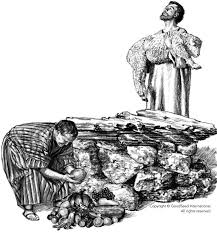
An altar of earth, a simple structure, or of stone (unhewn), was  to be constructed. God wanted them to build a plain altar of stone with no engraving. I’m sure many of the Israelites had seen the engraving of the statues and monuments in Egypt.  They may have even been engravers themselves.  But God required a higher yet simpler standard that would recognize who He was.   The moment a tool was put to the stone, it would be considered “polluted”.

It should be noted that the primary purpose of the altar was for worship.  That worship was to include specific offerings—a peace offering and a burnt offering.  There was no mention of presenting a sin and trespass offerings which were given to Israel later.

The peace offering revealed man’s need for  sacrifice that would reconcile him to God.  Jesus Christ accomplished that by His blood on the Cross.  The burnt offering speaks of God’s  worthiness and ability to save.  Christ was the perfect sacrifice and the only one able to satisfy the righteous requirements of God (2 Cor. 5:18)

Where’s my altar?

Everywhere Israel journeyed,  they made an altar of earth.  The altar was to be placed  in those places where  “God recorded His name.” One commentary states it this way:   “cause My name to be remembered”.

God would reward Israel’s offerings in those places where God was worshipped in sincerity.

Afterwards, God chose one particular place (Jerusalem) to record his name.  But now that has been taken away under the gospel, when men are encouraged to pray every where.  This promise revives in its full extent, that, wherever God’s people meet in his name to worship him, he will be in the midst of them, he will honour them with his presence, and reward them with the gifts of his grace; there he will come unto them, and will bless them.  More than this we need not desire for the beautifying of our solemn assemblies.[1]

This portion of the Exodus text caught my attention.  I then began to ask myself the following questions.

Where are my “altars of earth” to the Lord?

Where are the places in my life where God has caused me to “remember His name”?

Am I watchful and recognize when I am “out of fellowship” with Him?

Am I presenting offerings that worship God?

Do I bless God for all His benefits? His presence,  power, provision, and  protection?

Altars and offerings are no longer needed to be in right relationship with God.  Jesus’ death and resurrection eliminated that requirement.  However, it is important that we Christians spiritually create our personal altars to worship God in recognition of His love and gift of life through Jesus Christ.

I close with the following  scripture texts in the hope that they  will “cause His name to be remembered” by each of us.

I beseech you therefore, brethren, by the mercies of God, that you present your bodies a living sacrifice, holy, acceptable to God, which is your reasonable service.(Rom. 12:1) 

Therefore by Him let us continually offer the sacrifice of praise to God, that is, the fruit of our lips, giving thanks to His name. (Heb.13:15) 

Give to the LORD the glory due his name; Bring an offering, and come before him.  Oh, worship the LORD in the beauty of holiness!  (1 Chron. 16:29)

[1]  Matthew Thomas Commentary

Spiritual Sight: A Deeper Perspective, Part 2

Seeing with Spiritual Eyes, Part 2

Looking beyond what we can see

The ability to see has been associated with many things in the biblical record.  It has been linked to wisdom (Job 42:5), to salvation (Ephesians 1:18), and to discernment (John 7:24). This is by no means an exhaustive list, but it helps to expand our understanding of spiritual sight. Spiritual sight help us to “look beyond what we can see”.

To see or not to see

The prophet Jeremiah was a heartbroken prophet with a heartbreaking message. He labored for more than 40 years proclaiming a message of doom to the stiff-necked people of Judah.

Hear this now, O foolish people, Without understanding, Who have eyes and see not, And who have ears and hear not: (Jeremiah 5:21-29)

Despite Jeremiah’s many warnings, they did not see that their behavior was headed for a collision with the judgment of God. Judah continued to worship idols, disobey God’s covenant, and practice social injustice. Their lack of vision and refusal to surrender to God’s will resulted in exile to Babylon for 70 years. Judah’s loyalty had become divided and had blinded her to the things of God.

How would we evaluate our current world and the choices being made?  Who has eyes and sees not and ears yet hears not?

Barriers to seeing spiritually

The “usual suspects” stand as barriers to using our spiritual sight. They are our flesh, the world, and Satan.

Our flesh is the natural or “unredeemed” part of us that take us away from the purpose of God. Our flesh sees with natural eyes and refuses to obey the leading of the Holy Spirit. Paul the Apostle notes that it is impossible for the natural man to see with spiritual eyes (1 Corinthians. 2:13-16).

The world is that which is contrary to the things of God. It includes the lusts of the flesh, the lust of the eye, and the pride of life (1 John 2:16).  We are told by the Apostle John, that those who love the world do not love God (1 John 2:15). Divided loyalty ultimately leads to disobedience (Titus 1:16).

Satan does what Satan always does:  he discourages, he deceives, and he destroys. Of all the barriers, Satan is the greatest challenge. Why? Because most people don’t believe he exists. He remains the unseen “puppeteer behind the curtain”. But be assured he is very real. Look for him where there is conflict, confusion, and chaos (James 3:16). However, to see him, we will need our spiritual sight.

Our flesh, the world, and Satan keep us from viewing the world as it really exists.  In addition, the postmodern, 21st century worldview has created a “distorted” picture of what we see.  This is especially true with identifying sin.

Our “spiritual sensibilities” are slowly being dulled.  The ultimate goal, of course, is complete spiritual blindness.

How do we gain spiritual sight?

First and foremost, we need to follow the leading of the Holy Spirit.  Jesus shared with His Disciples the importance of the Holy Spirit in guiding them in all truth (John 16:13-14).  Each day it is important that we invite the Holy Spirit to join us through reading scripture, meditation, and prayer.  As we do, we train our spirit man to “listen for the Spirit’s voice” as He communicates with us.

Secondarily, we can practice the presence of the Holy Spirit.  Practicing the Holy Spirit’s presence acknowledges the fact that God, in all His fullness, is always with us (Psalm 139:7-12).  Because of that, we should not limit this practice to our devotion and prayer time only but also include it in our “normal rhythm of life.

Finally, we must be intentional in our pursuit of the knowledge of God and our growth in Jesus Christ (2 Peter 3:18). Seeing with spiritual sight is not a natural attribute for believers. Therefore, it must be developed.

Give all diligence

The Apostle Peter describes this process as “giving all diligence to add to our faith” (2 Peter 1:5-8). Diligence translated means earnestness in accomplishing, promoting, or striving after anything. Peter describes the results for believers who lack that diligence: “They are short-sighted, even to blindness…” (2 Peter 1:9)

Let us make a commitment today to develop our spiritual sight. While it’s been said that “the eyes are the windows of the soul”, it is more important to believe that spiritual sight will “keep your soul.”  (Matthew 6:22-24).

Spiritual Sight: A Deeper Perspective, Part 1

Seeing with Spiritual Eyes Part 1

An invitation

When I begin my daily devotions, I open with Psalm 119:18:  Open my eyes, that I may see wondrous things from Your law. My favorite teacher, Alistar Begg, often begins his bible study sessions with this prayer, “Make the book come alive to me.”

Our intent is the same though our approach may differ. We invite the Holy Spirit to join us as our Teacher, as we seek God’s instruction for our life.   Doing this, we are better able to navigate in this post-modern world where there are no absolutes nor acceptable standards of rightness.

As we examine our current society, it appears what is right or wrong is left to the judgment of the individual. In the absence of a common standard of right and wrong, anything goes.

The Heart wants what the Heart wants

People reject a standard for truth because of their greater desire to do “that which seems right in their own eyes”. But what is right?

A recent Barna Research study, The End of Absolutes: America’s New Moral Code, found no agreement on the definition of morality today.

What is it based on? Where does it come from? How can someone know what to do when making moral decisions? According to a majority of American adults (57%), knowing what is right or wrong is a matter of personal experience. This view is much more prevalent among younger generations than among older adults. Three-quarters of Millennials (74%) agree strongly or somewhat with the statement, “Whatever is right for your life or works best for you is the only truth you can know,” compared to only 38 percent of Elders. And Millennials (31%) are three times more likely than Elders (10%) and twice as likely as Boomers (16%) and Gen-Xers (16%) to strongly agree with the statement.  

People want “what they want” including freedom to choose what fits their preference and lifestyle, even if it means disobedience to God.  [1]

The need to see spiritually

What then are we to do? It is critical that we as followers of Jesus Christ, develop an “eye” for what is truth versus what is error (1 John 4:1).  We began this discussion in our series on spiritual discernment.  However, during these end times, we must be even more intentional, vigil, and alert by honing our “spiritual sight”.  (1 Pet. 1:13).

This 21st century challenge is similar to what the Disciples and the early Church faced. They encountered a society that was “hostile” to the things of God and where men “leaned to their own understanding” (Prov. 3:5).

The Disciples had to develop a “new view” of the world. Jesus taught them that view in the Sermon on the Mount (Matthew 5-7). It was the “Kingdom view”. Believers would have to “see” things differently than the rest of the world.  They would learn to develop their spiritual sight.

Through the leading of the Holy Spirit, the Disciples ultimately proclaimed the gospel of Jesus Christ. They participated in ushering in the Kingdom of God.  We have that same opportunity today.

Time to Practice

I invite you to “a deeper perspective” of God’s Word by using your spiritual sight. Following are (3) scriptures to read and meditate on this week. Feel free to use different translations and paraphrases. Get your journal out as you read and invite the Holy Spirit to join you.

Jeremiah 5:21-29

Matthew 6:22-23

1 Corinthians 2:13-16

Answer these questions for each scripture you read:

  1. How does this scripture relate to my personal walk with God?
  2. How does it influence my view of 21st century society?
  3. What “new” insight did the Holy Spirit reveal to me in this scripture?

[1] Spiritual Discernment:  Light for Darkened Eyes

In God We Trust: 2025

In God We Trust: 2025

“Whenever I am afraid, I will trust in You.”

In God we trust.  It’s printed on our coins, and we claim its truth as a nation.  But the question we must ask ourselves is this.  Do we REALLY trust in God?  Let’s do a quick “fact check” by looking at two areas we face daily.

Concerned about financial security?  We could direct our attention and efforts toward making sound business decisions which include debt reduction, savings, and sound business investments.  We depend on personal discipline and outside counsel to help us make the best decisions for ourselves and our family.

Nervous about the state of our nation and the world?  We might put our energy into supporting political parties and other platforms that support our views and belief systems.  We place our trust in people and agendas that can move forward viewpoints we support.

Where have we put our trust in the areas noted above? Do we trust our personal knowledge, tangibles we can count, people we vote for, or do we trust God?  In Psalm 56, King David shares his story to encourage us to look to a higher power, Eternal God, to help us realign our trust in 2025.

A Psalm of Trust

Psalm 56 is identified as a song for the distressed.  David was in distress.  Some would describe it as being “between a rock and a hard place.”   Like David, we sometimes find ourselves wedged between many rocks and brutally hard places.  Sometimes this happens because of others, like Saul, and other times it is the result of our own disobedience and waywardness.  In those times of distress and fear, we are to call out like David: “In God, I have put my trust.” (Psalm 56:4)

The background for today’s Psalm can be found in 1 Samuel 21:8-15, where we are told of David’s escape to Gath, the stronghold of the Philistines, arch enemies of Israel.   The Philistines were well acquainted with David who killed their champion, Goliath, when he was only a young shepherd boy (1 Samuel 17).   Now because of King Saul’s jealousy, this young man runs for fear of his life to a place of even greater peril and sure death.  He now stands captured by his worst enemy, the king of the Philistines.

Trust (batach) in Hebrew means “bold and confident”.  The description means to literally “throw oneself down, extended on the ground, upon his face.”  Can you imagine that picture?  David, literally throwing himself on the mercy of God, fully confident and bold; defiantly proclaiming, “What can flesh do to me?” (Psalm 56:4)   Did he recall the many times God intervened on his behalf as King Saul sought to capture and kill him?  His eye was not on the source of his fear but on the Deliverer of his soul. David’s spirit was humbled, cast down in full confidence and trusting in Almighty God for his life—not the Philistine king.

Trust in 2025

Perhaps we were sincere when we first inscribed on our coins, “In God we trust”.  However, our trust in “other things and people” has caused us to take our eye off God.   Question, have they increased our trust?

As we face the many challenges of life that shake the foundation of our faith, we must:

    • Put our trust in the One who can deliver us from all harm. (Psalm 46:1)
    • Remember those times that God stepped in to deliver us and brought us to a point of safety. (Psalm 91:1,2)
    • Exchange our fear for bold confidence in God. (Psalm 20:7)

What are the things that cause distress in our lives? Perhaps our stress is generated by things we have no control over; the state of the economy, unending political wrangling or social injustices that are currently in news headlines.  Maybe it’s our health or the changing needs of our immediate family.  Regardless of the “earthly” source of our fear, we can go to The “Eternal” Source, God.  Now is the time to write upon our hearts the Psalmist’s words, “I have put my trust in God.”

A Prayer of Trust

God of creation and God of salvation, I put my trust in You.  Though the earth may tremble, and the mountain be carried into the sea, I put my trust in You.  Though life may be hard and the challenges daunting, I put my trust in You.  I trust in You and You alone because You are MY GOD and MY FATHER. I am Your child.  These things I ask in the powerful name of Jesus Christ.

Jesus: The One for the 21st Century

Jesus: The One for the 21st Century

Is Jesus the One for the 21st century?

Yes, He is! I say that not based on my feelings or opinion but on what God has said about Who He is and how He operates in this fallen world.  I continue to use the phrase, “fallen world” to direct our attention to the condition that has led us to the pain and suffering we are experiencing in the world.  And that condition is sin.

It is easy to wonder why God isn’t more active in resolving the difficulties we face in our world.  Know this!  God cares and engages in every aspect of our lives (Matt. 10:29-31).  However, man’s “free will” allows him to choose those things that, many times, are outside God’s will and not in the best interest of others (which includes the world).

We often look to God to “zap the bad” and make it disappear.  Unfortunately, that isn’t how it works in a fallen world.  That’s why it is valuable to draw near to God (James 4:8) so that we can better understand His ways and His works.   When we do that, we can begin to understand why Jesus is the One for today.

What are our options?

So what have been our “options” to address the challenges of 21st century living?  We’ve tried to legislate, to mandate, and to regulate, just to name a few.  New beliefs, creeds, and convictions, offer no long-term solution to the various world crises we face.  No person, political platform, nor social movement has moved us closer to “the good life”, harmony or peace.  These are not the right solutions for our sin problem.

Why not choose Jesus?  Choose Him not for solving all the problems we experience during difficult time.  Nor for miracles Jesus can perform to address our human needs.  But choose Jesus because He is the One.  He is the One God has ordained to address the issue of sin and to give us life—life now and life in eternity.

Jesus knew.

Jesus knew He was the One.  As He arrived in Nazareth, He entered the synagogue on the sabbath day and stood up to read (Luke 4:16-21).  He read from the Old Testament book of Isaiah that prophesied of the abundant life that would be available to those who would believe and follow the promised Messiah (Isa. 61:1-2).

The Spirit of the Lord is upon Me, Because He has anointed Me to  preach the gospel to the poor; He has sent Me to heal the brokenhearted, To proclaim liberty to the captives and  recovery of sight to the blind,  To set at liberty those who are oppressed; to proclaim the acceptable year of the Lord.

Jesus concluded His reading with a statement meant to remove any doubt as to who He was (Luke 4:21). “Today this Scripture is fulfilled in your hearing.”  Jesus was the promised Messiah. Jesus was the One.

Recognizing The One

Are we poor in spirit?  Disappointed, distraught, and discouraged? Are we brokenhearted, blinded, and held captive by the world’s promise of a better life?

In our humanity, we are continually looking for someone or something to manage the challenges we face.  In God’s economy, believers understand that Jesus is The One.

  • Who better to guide us and to help us through the challenges that lie ahead than The One who is omniscient! The all-knowing One who can see today, tomorrow and into eternity.
  • Who better to protect us than the one who is omnipotent? All powerful. Not like the impotent idols we think will secure our life: wealth, status, or relationships.  All these and more, we foolishly depend on to make us feel safe and secure.
  • Who better to provide for both our spiritual and physical needs than the One who is omnipresent—”everywhere present”. Where can we go that Jesus is not with us? (Ps. 139:7-10)

Jesus is the great I Am.  Bread of life (John 6:35).  Light (John 8:12).  The Door (John 10:9).  The Good Shepherd (John 10:11, 14).  Resurrection and Life (John 11:25).  The Way, Truth, and Life (John 14:6). The Vine (John 15:1, 5).

Jesus is the One!  He is the One we need right now for the challenges we are facing.  Jesus is the Only One.

Throwback Wednesday: How Are You Holding Up?


How are you holding up?

How are you holding up?

In recounting the major events of this century, I better understand the severe damage they have had on us, and on our view of life.  Pandemics, wars, terrorism (domestic and foreign), social strife, natural disasters and so much more.  Our personal lives have also been affected as we navigate changes in responsibilities, relationships, and work life.

It has been exhausting!   These shifts, and dips of life, have required more than “pushing through”.  It has necessitated more than “hanging on”.  It requires that we cling even more closely to God.  God’s presence and power is the only true source of resiliency.

In John 16:33, Jesus shares this truth with His Disciples.  We can place our trust in this truth as we move into 2025 and beyond.

 In this world you will have tribulation but be of good cheer.  I HAVE OVERCOME THE WORLD. 

 The Amplified Version of Jesus’ words encourage us even more.

In the world you have tribulation and distress and suffering, but be courageous [be confident, be undaunted, be filled with joy]; I have overcome the world.” [My conquest is accomplished, My victory abiding.]

Because of “these times” in which we live, it is imperative that we holdfast our faith.  Our trust and belief in Sovereign God is essential not only for our physical and mental well-being, but also for our spiritual perseverance and endurance (Psalm 18:1-2).

To help us on our faith journey, I’d like to share for this Throwback Wednesday, a message that is important to remember when facing 21st century challenges and tribulation:  “Don’t Let Go Your Faith!”