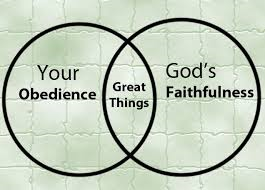

The Character of Obedience

The Character of Obedience

The nature of obedience

As we defined last week, obedience is submission to authority.  Is obedience an outcome of our faith walk or is it the means by which our spiritual maturity is accomplished?

Conversation about obedience seems especially appropriate as we enter the Lenten season.  As believers, we have committed to the lordship and authority of Jesus Christ.  How well are we doing?   Lenten season presents a “space in time” in which we can answer that question.  It is also a time to identify those things that keep us from our obedience to God.

Obedience actualized

Accounts of the apostles and other great propagators of the faith give evidence that obedience plays a major role in our faith walk.

Obedience is a constant theme in the writings of the Apostle Paul. He speaks of many relationships in which we are asked to offer our obedience.  These includes obedience exercised within a family (Eph. 6:1; 1 Cor. 14:34,35), between a master and their servant (Eph. 6:5), or to civil government (Titus 1:1, 3:1).

In his letter to Christians living in the first century, the Apostle John teaches on identifying genuine faith in Christ.  The test is linked to obedience.

“Now by this we know that we know Him if we keep His commandments. He who says, ‘I know Him,’ and does not keep His commandments, is a liar, and the truth is not in him. But whoever keeps His word, truly the love of God is perfected in him. By this we know that we are in Him.”  (1 John 2:3-5)

The great 17th century English preacher Charles Haddon Spurgeon had this to say about obedience:

  • Love is the chief jewel in the bracelet of obedience.
  • That obedience which is not voluntary is disobedience, for the Lord looketh at the heart, and if He seeth that we serve Him from force, and not because we love Him, He will reject our offering.
  • You and I must be willing to do what God tells us, as God tells us, when God tells us, because God tells us, but only strong faith will be equal to such complete obedience.

Though these views come at varying times in biblical and church history, their message is still the same.  Obedience is an expectation for all believers.  It is not an option.

Jesus the Model of Obedience

The hallmark of obedience is modeled by our Lord and Savior, Jesus Christ especially as He journeyed to the Cross.  Jesus modeled obedience by His humility, in His faithfulness, and in His submission to God’s will.

Jesus humbled Himself as Deity by shedding His blood for our sins.

Christ Jesus, who, being in the form of God, did not consider it robbery to be equal with God, but made Himself of no reputation, taking the form of a bondservant, and coming in the likeness of men.  And being found in appearance as a man, He humbled Himself and became obedient to the point of death, even the death of the cross.  Phil. 2:5-8

Jesus’ faithfulness is seen in His unflinching commitment to the Cross.

“(Jesus) who, in the days of His flesh, when He had offered up prayers and supplications, with vehement cries and tears to Him who was able to save Him from death, and was heard because of His godly fear, though He was a Son, yet He learned obedience by the things which He suffered.”  Heb. 5:7-8

Jesus submitted to the will of God.

“Therefore, as through one man’s offense judgment came to all men, resulting in condemnation, even so through one Man’s righteous act the free gift came to all men, resulting in justification of life.  For as by one man’s disobedience many were made sinners, so also by one Man’s obedience many will be made righteous.” Romans 5:18-19

Let us hear

The Greek word for obedience is hupakoe which means “attentive harkening, compliance or submission”.  It usually refers to obedience to God’s will in a “special sense”—of willing subjection.  Unlike the animals used in previous sacrifices, Christ came willingly to the Cross.  He expressed His submission to God’s will in the Garden of Gethsemane as He repeated “not My will but Your will be done” (Matt. 26:39, 42; Mark 14:32-36).

Acceptance of the Gospel requires acceptance of Christ as not only Savior but also as Lord of our lives.  We no longer live for ourselves but for Him (Gal. 2:20; 1 Peter 4:2).  Through obedience, we learn to have the “same mind of Christ”—obedience in our faithfulness, our humility, and our submission to God’s will.

While the world encourages defiance and applauds noncompliance, Christ offers a different model for living.  Through Christ’s obedience two-thousand years earlier, He changed the “eternal outcome” to “all who obey Him” (Heb. 5:9).  Once destined to an eternity in hell, we now are partakers of eternal life (John 3:16).  That’s worth our love, our devotion, and our obedience.

Remember our opening question: “Is obedience an outcome of our faith walk or is it the means by which our spiritual maturity is accomplished?”  The answer is, “it’s both”!

Obedience: An Invitation to Hear

Obedience: An Invitation to Hear

The Believer’s Struggle

In his book, “Think Like Jesus,” pollster George Barna tackles a formidable topic, “How do Christians develop a “biblical worldview” in a fallen world?  But more than that, why is it important to do so?  How is it possible to be “in this world but not of this world”?  (John 17:14-15)

Our struggle with this dilemma is demonstrated by the world’s inability to see believers as being different from them.  The world labels Christian beliefs as intolerant and antiquated.  Because of that, we believers are often silent about our faith.  The result?  It is easier to “go along to get along.” The salt is no longer salty.  The light has grown dim (Matt. 5:13-16).

Obedience and the Christian’s worldview

Barna offers several scriptural principles to guide us as we create a biblical worldview for our life.  One of these principles is the importance of obedience to God.  “Obedience is more than just following the letter of the law.  It is discerning what God wants and choosing to seek that outcome.

Today is Ash Wednesday, the beginning of the Lenten season.  It is a time when we can focus on self-examination and self-denial.  It is also a great time to study this topic of obedience and answer the following questions:

What is obedience?

Why is it important in my faith walk?

How does obedience affect my “worldview”?

WIFM (What’s in it for me)?

What is obedience?

When you read or hear the word obedience, what comes to mind?  If you are like me, you may instantly think of its opposite—disobedience.  According to Webster, obedience is defined as submission to authority.

Operating with that definition, people immediately view obedience as harsh and demanding.  Their response is understandably, resistance.  Resistance is anchored in our human desire to control our destiny.  For the unbeliever (and believer, too) this desire includes living independent of God’s rule in their life.  This response, unfortunately, misses the true intent of godly obedience.  That is why we need a biblical view of obedience.

In the Old Testament, obey is interpreted as to hear.  It stresses not only hearing but also understanding. As God spoke through His revelation (His ways and works), His people were able to hear and understand His desire for them. (Jer. 29:11).

In the New Testament, obey is not only connected with hearing but also means to convince or to persuade.  Obedience is described as an attitude (2 Cor. 2:9) and a faith-rooted disposition (Phil. 2:12).

We hear, we are persuaded, and in an attitude of faith, we obey.  When we hear God speak to us (through His Spirit), our response should be to obey His instruction.  “My sheep hear my voice, and I know them, and they follow me.” (John 10:27)

Obedience flows from the heart

The obedience of Jesus is held as the ultimate example for believers.  Jesus heard God’s instruction and “humbled himself and became obedient to death—even death on a cross!” (Phil. 2:8) His obedience flowed out of His personal relationship with God—He heard and knew the Father.  More  importantly, Jesus’ obedience was connected to and motivated by love.

Obedience is the outward response of a heart that loves God.  God’s call for obedience is a loving invitation to experience His best. Man’s response to God’s invitation is a heart that hears and turns to Him (Ps. 14:2).

Obedience, properly understood, is never a cold or impersonal command that arouses resentment. Our response of obedience should flow from a heart that hears God’s voice, feels God’s love, and turns to Him.  

Teach me knowledge and good judgment, for I believe in your commands.

Before I was afflicted, I went astray,

but now I obey your word.

Psalm 119:66-67 (NIV)

Listening Prayer: Engaging in a Prayer-filled Life

Listening Prayer: Engagaing in a Prayer-Filled Life

The Needful Thing

Last week, we discussed the prayer-filled, contemplative life.  The contemplative life acknowledges the importance of a personal relationship with God and the intimacy gained through focused attention on Him.  Fulfillment of this life involves both love for God and the desire to be in His presence continually.

For many believers, such a pursuit necessitates a return to our First Love (Rev. 2:4) and the desire for “the needful thing” (Luke 10:42).  Both can only be found in fellowship with Infinite God.  So today we will spend time looking at a key practice in the prayer-filled life—listening prayer.

Listening Prayer

Listening prayer is about joining with God at the “heart”.   By heart, I’m not speaking about the emotions only, but that “intuitive part” which instructs the mind and the will.  It is a place of union with God.

In listening prayer, we exchange our “intermittent” requests for “continuous” dialogue with the all wise, all-powerful God. Through the eyes and the ears of the heart we see and “hear” God—who He is and how He operates.

Listening prayer was a new experience for me.  I admit my prayer life was one-sided—asking, seeking, and knocking (Matt. 7:7).  I invested much time in learning what I thought was the “right way” to pray.  I followed the PAPA prayer formula.  I prayed the Scriptures.  I employed the ACTS model (adoration-confession-thanksgiving-supplications).  While I wanted to better communicate with God, I failed to realize what God wanted.  God was not concerned with “correct communications” but God did desire “attentive conversation” with me.

Barriers to Listening Prayer

Hindrances to listening prayer are generally found in two areas:  the desire for an “experience” versus the “presence” of God and the modern split between “head and heart” knowledge of God.

In our society, we are accustomed to being “stimulated” by what we are doing. Unfortunately, that is how we judge whether something has really happened.  We expect to hear God speak in a loud, audible voice.  That is not necessarily how God may choose to communicate.  Remember Elijah (1 Kings 19:11-12).

Most Christians today suffer to one extent or another from “post-enlightenment” mindset—the split between thought and experience.  This split in most Christians is characterized by an acceptance of their conceptual knowledge about God as reality while they simultaneously deny the primary ways of knowing, loving, and walking with God. This is more intuitive than rational. As a result of this split, even committed Christians, do not believe in Christ’s real presence with and within them.[1]

We must be careful to guard against these hinderances to true intimacy with God.

Where to begin?

How do we begin to incorporate listening prayer into our life?

First, we must believe that God desires to communicate with us (Gen. 35:13).  God is not some distant deity disinterested in His children.  We cry “Abba Father” (Gal. 4:6) knowing He hears our every word.  `

Secondly, we must know that God wishes to be in relationship with you (James 4:8a).  By instituting His plan of salvation, He created the means to restore that which was loss in the Garden of Eden—fellowship with mankind.

Thirdly, we must declare our intentions and ask to hear His voice. Hearing God is not natural (remember we loss that in the Garden), so we must be intentional (Matt. 11:15).  Initially, we may need to set aside time, to listen for His voice, perhaps during our morning or evening devotional time.

Finally, we must invite God into time with us and expect to hear (1 John 5:14).  We may receive a fleeting impression, an image, even a scripture or a song.  Don’t ignore it!  Write it down, then ask God to explain what we experienced.  This is where our journal comes in handy.

Time to begin!

Listening prayer is not a method, but a walk with God where we intentionally listen for His voice.  It’s more than “doing”, it is about “being” aware of His presence.   Listening prayer is about inviting God into the daily rhythm of our life knowing that He speaks to us continuously.  It is an exciting time of fellowship and discovery.  It is what God has always wanted.

[1] Listening Prayer:  Learning to Hear God’s Voice and Keep a Prayer Journal, Leanne Payne


Desperately Seeking God: A Prayer-filled Life


Desperately Seeking God

“Desperately seeking God”

What would we think if we saw this request in the personal column of our local paper?  Desperately seeking God for ___.   We can fill in the blank with those things that reflect the needs of the human heart—financial security or emotional wholeness, food and lodging or creature comforts, our daily bread or deliverance from evil.

All these qualify as valid requests we can make known to God (Phil. 4:6).  Today, however, we are invited to move from our “needs-based” method of prayer to a more robust and satisfying “prayer-filled life” that will lead to greater intimacy with God (James 4:8).  What exactly is the prayer-filled life?

The Contemplative Tradition and the Prayer-filled Life

In Streams of Living Water by Richard Foster, the prayer-filled life is called the Contemplative Tradition.  Foster describes it as “a life of loving attention to God.”  Imagine, “loving attention to God.”

It includes not only the activity of prayer but also periods of solitude and meditation in which the presence and fellowship with the Lord is nurtured.

It can be likened to the Lord’s encouragement to His disciples to “abide” in Him (John 15: 4, 8).  Jesus describes His intimacy with the Father through the image of the “vine and the husbandman”.  It was through Jesus’ union with His Father that He was able to do all things (John 5:30).  Jesus desperately sought God.

Practicing the Presence and the Prayer-filled Life

Father Lawrence described the prayer-filled life in Practicing the Presence of God.  “Practicing” is the recognition of God intimately present with us and addressing ourselves to Him every moment.

Prayer is considered “divine conversation” that occurs throughout the day—not exercised as an isolated activity or relegated to a specific place.  Prayer is continuous and never ceases (1 Thess. 5:17).   Father Lawrence desperately sought God.

David and the Prayer-filled Life

David serves as our biblical example of one who sought the prayer-filled life.  Throughout the Psalms we can experience the passion and appreciation David had for his private time with the God of Creation (Psalm 19).

As a shepherd boy, he experienced extended periods of solitude and fellowship with the Great Shepherd (Psalm 23).  In the wilderness of Judah, David’s soul “thirsted” for the Lord and longed for the time he could return to the Temple to reunite with Him (Psalm 63).   David desperately sought God.

Which description is right?

Descriptions of the prayer-filled life differ in method and experience.  “Loving attention to God”. “Divine Conversation”. “The soul’s thirst for the Lord”.

However, what these descriptions do have in common is the results—greater intimacy with the Lord.  This is the offer of a prayer-filled life; one that is more relational and less transactional.

Unfortunately, the distractions of this life, our weakened flesh, and the deceitfulness of Satan continually draw us away from a prayer-filled life.  Left unchanged, we will continue our intermittent prayer routine while Jesus invites us to return to our First Love (Rev. 2:4).

Psalm 42:1-3a offers an excellent illustration of what the prayer-filled life looks like.

“As the deer pants for the water brooks, So pants my soul for You, O God.  My soul thirsts for God, for the living God. When shall I come and appear before God? My tears have been my food day and night.” 

Let us learn from the deer and seek God. It is in pursuing and lingering in God’s presence that the prayer-filled life is experienced. It is in Him, that our desperate seeking ends.

Life as a Sponge

My Curiosity

In What I Learned in 2021, I shared a quote from one of my favorite writers, F.B. Meyer, about the privilege of being one in Christ and the intimacy that comes with that relationship.  Meyers offered the comparison of that relationship in Christ as that of the life of a sponge.

We must be one with Christ:

we must be in Him as the sponge is in the ocean.”  

A sponge!  I must admit, I had failed to remember that a sponge at one time was a living being.  So with that reminder in hand, I decided to dig deeper. What I discovered and with the Spirit’s enlightenment is our WordBytes today.

Life as a sponge

There are two basic forms in the life cycle of a sponge. Most sponges live their lives attached to a reef. They don’t move around. There was a time in their lives when they were little larvae swimming around the water all by themselves.

Sponges have unspecialized cells.  Sponges do not have nervous, digestive, or circulatory systems. Instead, most rely on maintaining a constant water flow through their bodies to obtain food and oxygen and to remove wastes.

Interesting?  Yes, but where is the connection between our being in Christ and a sponge?

In John 15:1-8, Jesus uses the vine and the branch analogy to describe what an intimate relationship with Him would look like.  In Christ, we would abide in Him. The branch apart from the vine, the source of life and nutrients, could do nothing (v. 5).

So what’s with the sponge?

In Christ Recap

In Christ is the present experience of the risen Christ indwelling our heart by the Holy Spirit.  This results in incorporating the personality of Christ into our life.   It is more than an imitation of the life and teachings of Jesus.  It is our union with Christ as a result of the divine action of grace by God. The result of that action:  we are transformed into a new creation.

In Christ describes our identity with Christ and our position before God the Father. We (in position) can now begin the process of being conformed to the image of Christ (in practice)—righteous and holy. (Romans 12:2)

In Christ, God makes his superabundant blessings available to us by faith in Christ.  What Christ has is ours!  We are able to draw upon the wealth of Christ to accomplish God ‘s purpose and will.

Striving for Oneness

Meyer’s sponge analogy can be described even more accurately in the Apostle Paul’s statement to the Athenians: “For in him we live and move and have our being.”  (Acts 17:28)

It is this oneness with Christ that Meyer’s was describing.    Our oneness is not only our connection by faith alone (Gal. 3:26).  But it is also our life lived in singleness of thought.  And that thought is the glory of God—His will and His purpose.

What do I mean?  What does that look like?   The best example I can give is the relationship Jesus had with God the Father.[1]

John 14:10

Do you not believe that I am in the Father and the Father in me? The words that I say to you I do not speak on my own authority; but the Father who dwells in me does his works.

John 17:21-23 

That they may all be one; even as thou, Father, art in me, and I in thee, that they also may be in us, so that the world may believe that thou hast sent me.  The glory which thou hast given me I have given to them, that they may be one even as we are one, I in them and thou in me, that they may become perfectly one, so that the world may know that thou hast sent me and hast loved them even as thou hast loved me.

Like Jesus and the Father, our oneness in Christ recognizes both our dependency AND celebrates our interdependency.

Live like a Sponge

In our study of the sponge, there are similarities we may note as we strive for oneness in Christ.

The sponge relies on maintaining a constant water flow through its body to obtain food and oxygen and to remove wastes

The first is constancy.  Constancy is defined as the quality of being faithful and dependable.  The sponge attaches itself to the reef, a place that will supply the flowing water current needed to live.  As believers, we must seek out those places where we can “attach ourselves” and “grow in faith” (2 Pet. 3:18; Heb. 6:1).  Communities of faith strengthen our spiritual endurance and maturity, so that we can stand fast in the midst of trials and persecution.

The second is discernment. Water flows through the sponge’s simple systems.  It doesn’t hold on to everything but only keeps what is needed to continue its life cycle.  It removes waste.  In our spiritual life, everything we’re exposed to isn’t “necessary” (1 Cor. 6:12-15).  We must be diligent to carefully filter what flows into our eyes, ear, and mind.

As we seek oneness in Christ our constancy and discernment keep us focused on what really is important for living.  It recognizes our dependency and interdependency with both the Father and Jesus.

Like the sponge, we live life knowing “Christ is the center “of our existence and acknowledge that apart from Him we can do nothing.  Therefore, let us strive moment by moment to live the life of a sponge— “one with Him.” (John 14:20)

[1]  I encourage you to read these in your personal Bible study.  They are amazing spiritual “nuggets” for meditation and prayer.  Ask the Holy Spirit to “open your eyes to see” (Ps. 119:18) what God will share with you on pursuing oneness with Him.

What I Learned in 2021

Where to Begin

In past years when I did this exercise, I would go to several sources for input.  This includes my daily journal, and scripture memorization cards.  They were reminders of the paths I walked with Jesus throughout the year.

My journal included my thoughts during my time of inquiry of the Lord.  Bits and pieces of this and that:  theologian quotes, bible study notes and miscellaneous thoughts about life and the world I live in. Topics that caught my attention, would later become personal studies, WordBytes or Morning Reflections.

My scripture memorization cards, with date recorded at the top, would remind me of how the Spirit renews my mind with God’s Word.  His Word would prove to either strengthen my heart or tell again of God’s inexhaustible grace: grace that covers my human weakness and brokenness.  It most often than not encouraged me to be more patient and longsuffering.

As I reviewed my information, I came to this realization.  It is vital that believers continually develop a personal relationship with God.  Not religion but relationship.  It should be our goal to be “intimately connected” with the Lord.

Relationship with God

God has always desired to be in relationship with man.  Adam was first to experience the joy and freedom of an intimate connection with God.  Imagine daily walking and talking with God about the events of the day, your hopes, and fears, and hearing His plan for your life.  Guess what?  We can experience that in our life right now!

Today we, as believers in Christ, have continuous access to that same intimacy Adam experienced in the Garden but with even greater privilege.  We have His Presence, through the Holy Spirit living within us (John 14:16-17).

As I read God’s Word, pray, and exercise the different spiritual disciplines, I become one with Him.  Jesus invited His disciples to abide in Him (John 15:4).  That invitation is extended to us today.

F.B. Meyer writes about the privilege of being one in Christ and the intimacy that comes with that relationship.

We must be one with Christ: we must be in Him as the sponge is in the ocean.  We must be in Him, not only in our standing, but also in our daily walk.  We must be in Him as the branch is in the vine and the vine-sap in the branch.  This must not only be in theory, but an hourly experience.

My 2021 Epiphany

I became a Christian when I was nine-years old.  I bought the “fire insurance” and knew I wasn’t going to hell.  However, as I grew older, I still didn’t feel the connection I thought believers were supposed to have.  Although I went to church weekly and served in various church functions, something was missing.

I was a carnal Christian until I was 40.  Then something happened.  I rededicated my life to Christ.  No more “hooky pokey” Christian life for me.  What happened?  Why the change?

A student from my Senior High Sunday School class had chosen to become a minister.  We were excited to welcome him back to his home church where he was to bring the Sunday morning message.

This was especially exciting for me in that, as a teenager, he hated to review the lesson on behalf of our class.  He would grumble and groan and swear never to come back to Sunday School if I made him do it.  He eventually agreed to my request.

In his morning sermon, he shared his personal witness of how his intimacy with God led him into ministry.  It had nothing to do with my teaching or my coaxing him to review.  He found what it meant to be IN RELATIONSHIP WITH JESUS.  It wasn’t religion.  It was relationship.

That was it for me.  My Sunday School student helped me understand what it meant to have a “personal relationship” with God.  So even today I seek a deeper and closer relationship with Jesus.  And every day with Jesus is “sweeter than the day before”.

Go deeper in 2022

Most interesting about my epiphany is that Jesus just recently revealed this memory to me.  Why now?  I don’t know.  Maybe He felt it was time to share it with you.

Daily we have the opportunity to practice His presence as we daily address the challenges of 21st century living.  In God’s presence we experience His love, power, and wisdom.   As we go deeper in our relationship with God, we can better understand His ways and see with spiritual eyes.

Let us deepen our trust in Him.  When we do, we aren’t shaken by the latest news stories or the challenges we face in 2022 and beyond.  We know whose in control!

As members of God’s family there is nothing that can separate us from His love.  And we have the blessed assurance that our relationship with God will extend into and throughout eternity.

I invite you this year to go deeper in your relationship with God.  Become “like the sponge in the ocean”.  Live and abide in Him.

No extra reading this week so please share with us what you learned in 2021.  Thanks for reading.

Throwback Wednesday for the New Year

Throwback Wednesday for a New Year

It’s that time again.  Throwback Wednesday.  It’s the time when we choose  a favorite WordBytes from the past.  It’s also a time for remembering  that God never changes (Mal. 3:6).   It doesn’t  matter the year, God’s message is still one of hope, promise,  and possibility for  everyone who will hear it.

To align with the New Year, we’ve chosen a WordBytes that will encourage us to lay hold in 2022 to our rich inheritance in Christ.

Let’s begin this year knowing that we have everything we need to be successful in addressing the challenges we face (2 Pet. 1:3-4).  May this “blast from the past” move us confidently through the year.

Our Inheritance with Christ

The Expectancy of Advent

The Expectancy of Advent

Prophecy:  good news/bad news

The first arrival of Jesus Christ was foretold by many of the Old Testament prophets.

The earliest prophecy of Jesus Christ’s birth occurred about 4000 B.C. and is recorded in Genesis 3:15. The most significant prediction is found in Daniel 9:25-26. It was written somewhere around 538 B.C. and gives the exact year, A.D. 33, in which Jesus Christ would die. From that prophecy one can estimate the earliest year in which Jesus could have been born. That prophecy and six other prophecies are given about His birth.[1]

While Jesus Christ’s birth was good news, sometimes the prophets were chosen by God to deliver difficult messages.  Prophets were not fortune tellers (as many people mistakenly believe) but “forth tellers”.  Forth tellers proclaimed what “thus says the LORD God”.  Their prophecies outline what we can expect from God in the future.

During the final days of Israel and Judah, God communicated through the prophets a message of judgment.  The divided kingdoms were to be sent into captivity in Assyria and in Babylon for 70 years.  Why?  Because of their disobedience and their divided allegiance to Yahweh.  Put more simply, they were under God’s judgment because of their sins.   There is always a natural consequence of sin.  In this case, the consequence was captivity (1 Kings 14:15).

Expecting something better

The prophets were not only responsible for proclaiming a message of judgment.  With that judgment message God also included a message of restoration.  God in always merciful and faithful.  Even in our faithlessness He remains faithful (2 Tim. 2:13).

Israel’s story would not end in captivity in a distant land.  They would ultimately return to the land that God promised to the Patriarchs (Gen. 17:8).  God would sovereignly orchestrate Israel’s physical return to Jerusalem.

God would also sovereignly send His Son Jesus to arrange Israel’s spiritual return to Himself.  God sent His Son to be the Savior of the world (1 John 4:14).  The promise of a savior would create an “expectancy” of something better for their future.

“I’ll be back”

While Christ’s first arrival marked the offering of salvation and deliverance to all mankind, His second coming will be ”very different” (Rev.19:11-16).   The child that we celebrate at Christmas will return as the “Righteous Judge” (2Tim. 4:8).

Jesus spoke openly about the certainty of His return (Matt. 24:27-31; Mark 13:24-27; Luke 21:25-28).   The disciples pressed Jesus for the “day and hour” (Matt. 24:36).  Instead Jesus emphasized expectancy.  Expectancy requires that we be both faithful and watchful until He returns.

Our expectancy allows us to anticipate and plan for events that could potentially impact our life. We rise early to watch the morning traffic report and weather forecast for the day. Why? Because we want to be prepared–no surprises!

Expectancy influences preparation

Christ is coming again. He will first return for His Church at a time called the Rapture and take us back to heaven to be with Him (1Thess. 4:13-18).  Nonbelievers, however, will be “left behind” to enter a seven-year period of trouble and desolation known as The Great Tribulation.  At the end of the Tribulation, Christ will return to the earth to judge mankind for their unbelief and their sins (Rev. 20: 11-15).

We expect Jesus Christ to return.  It is a certainty (Acts 1:11). With His arrival the world, as we know it today, will change forever. That being the case, should we not give special attention to prepare for His return?

It is important that we fully expect and embrace the reality of Christ’s Second Coming. It is equally important that we prepare for it!  For nonbelievers, the reality of Christ’s return is an invitation to repent and turn to Him TODAY. For believers, it reinforces our need to share the Good News of Jesus Christ EVERYDAY to EVERYONE God places in our path.

Just as we prepare for Christmas morning, we would be wise to expect and prepare for Jesus Christ’s return.  The prophets were 100% accurate with their prophecies of Jesus’ first arrival.  You can be sure, they’re also correct about His second return.

[1] NeverThirsty.org


Hearing God at Advent


Hearing God at Advent

Who has an ear to hear?

In Isaiah 30:21, the prophet shares with his readers how God would in the future speak   directly to His followers.

And your ears shall hear a word behind you, saying, ‘This is the way,walk in it, when you turn to the right or when you turn to the left.’

This method of speaking directly to us would happen much later at Jesus’ first advent. After Pentecost (Acts 2), the Holy Spirit would be available to permanently dwell within us (John 16:13-15).  The author of Hebrews captures in the opening verses of this epistle the change in how God communicates with us (Heb. 1:1-2).

Long ago God spoke to our ancestors in many and various ways by the prophets, but in these last days he has spoken to us by a Son, whom he appointed heir of all things, through whom he also created the worlds.

Our position in Christ gives us not only direct access to the Father and Jesus but also gives us the Holy Spirit to live within us (John 14:16). It is through this “gift” of the Holy Spirit that we hear God speak to us.

Are our ears burning?

We would do well to make every effort to listen for God’s voice.  This involves being spiritually attentive to Him through prayer, fasting and meditating on His Word.

It helps to silence our own voice to hear Him speak.  This requires eliminating the demanding cry of our soul—our mind (“I need to know!”), our will (“I want it my way and I want it now!”) and our emotions (“I need to feel something!”).  God hears our every call (Ps. 91:15) but do we hear Him?

What do we expect God to say?

This requires spiritual honesty.  Are we open to what He may say to us?  Many times, we only listen for responses from God we want to hear versus what He has on His heart for us.

Most often than not we come to God with a particular issue or request.  Are we open to the possibility that God may have a very different agenda. “Oh, the depth of the riches and wisdom and knowledge of God! How unsearchable are his judgments and how inscrutable his ways!   For who has known the mind of the Lord, or who has been his counselor?” (Rom. 11:33-34)

Believers’ desire to be obedient to the Lord will help greatly in hearing God’s voice.  The issue many times is not whether God is speaking or whether we are hearing.  The real question is, are we willing to obey what He has already revealed to us through His Word and through our circumstances?

This dilemma may require us to identify intentions that conflict with the godly purpose the Father has designed for our lives.  “For all that is in the world- the desires of the flesh and the desires of the eyes and pride in possessions- is not from the Father but is from the world.”  (1 John 2:16)

Are we willing to wait to hear God speak?

If we are eager to hear God’s voice, we must be willing (and content) to wait.

Waiting is not easy in a world that operates at warp speed.  We are told that “Time waits for no man”, “Lost time results in lost opportunity”, and “Time is money”.

However, our Infinite God does not operate within the finite boundary of time but in eternity.  Hearing His voice requires that we patiently keep our eye on Him.  As we wait, there is an expectancy that we will hear Him speak.  “Behold, as the eyes of servants look to the hand of their master, as the eyes of a maidservant to the hand of her mistress, so our eyes look to the LORD our God, till he has mercy upon us.” (Ps. 123:2)

Are we “present” to hear?

The best way for believers to hear from God, is simply to abide in His presence.  Abide means “to remain or to continue to be present.” We are never our of God’s presence.  He is everywhere.  He is always present.  (Read Psalms 139)

It is up to us to sensitize ourselves to hearing God.  As we become more aware His presence, we are able to maintain continual, unbroken connection with Him. It is here that we can experience continual dialogue with God the Spirit versus straining for an occasional “word from the Lord.”  (Read John 15)

The greater our intimacy with God, the easier it is to hear His voice.    “I am the good shepherd.  I know my own and my own know me; My sheep hear my voice, and I know them, and they follow me.” (John 10:14, 27)    

Advent is a great time for us to discover or rediscover hearing from God. God speaks not only through His Creation, but God also speaks directly to us.  Do not neglect such a great opportunity to hear from God.

Looking beyond what we can see

Looking Beyond what we can see

Anatomy of the human eye

As we consider looking beyond what we can see, it might be helpful to review how we see physically.

The human eyes work very similarly to a camera. When you look at an object, the light it generates enters your eyes. The light first passes through the corneas, which begin focusing the light. It then passes through to the pupils. The size of the pupils changes to regulate the amount of light entering the eyes.

 The light is then focused through the lenses and onto the retinas. The retina is a light-sensitive layer in the back of the eye that contains highly evolved cells called rods and cones. The retina then changes the image into electrical and chemical impulses, which are transmitted along the optic nerves and into the visual center of the brain. It is when the image reaches your brain that vision occurs.[1]

Man is a remarkable creation of God. He is made physically perfect for the lifetime God has designated for him (Ps. 90:10).   However, as remarkable as Creation is, God’s work of salvation has resulted in our ability to see spiritually, the things we would normally overlook.

Seeing supernaturally

I love the Old Testament because of its value in capturing the wonders and works of God.  As I prepared for this series, the scripture text that came quickly to mind was the account of the prophet Elisha in 2 Kings 6:8-23.  This passage shares the incident in which the King of Syria, enemy of Israel, sent raiders to capture Elisha.  You will enjoy reading the entire text as it shows the confidence of Elisha as he prepares to meet this great army that surrounded the city of Dothan.

2 Kings 6:15-17 is most relevant to our discussion on seeing with spiritual eyes.  We may find the advice Elisha offered his servant relevant to us as we face the challenges of 21st century living.

And when the servant of the man of God arose early and went out, there was an army, surrounding the city with horses and chariots. And his servant said to him, “Alas, my master! What shall we do?”  So he answered, “Do not fear, for those who are with us are more than those who are with them.”  And Elisha prayed, and said, “LORD, I pray, open his eyes that he may see.” Then the LORD opened the eyes of the young man, and he saw. And behold, the mountain was full of horses and chariots of fire all around Elisha.

The chariots of fire that the servant saw were heavenly hosts primed to do battle with the Syrian army on behalf of Elisha.  Elisha saw the heavenly army and recognized that there was no need to fear.  He saw past the potential danger and saw God at work. After Elisha’s prayer, the servant, through God’s enablement, saw that the mountain was full of God’s presence.  He looked beyond what he could see.  He looked from God’s perspective.

Kingdom reality

Seeing with spiritual eyes begins with understanding who God is and our position in the Kingdom of God.

Broadly speaking, the kingdom of God is the rule of an eternal, sovereign God over all the universe. Every authority that exists has been established by God (Romans 13:1). So, in one sense, the kingdom of God incorporates everything that is.  More narrowly, the kingdom of God is a spiritual rule over the hearts and lives of those who willingly submit to God’s authority.[2]

 God is the Almighty Sovereign who manages the affairs of the world from heaven. Through His providential will, God orchestrates every event in our lives. Our position in Christ elevates us to God’s children and joint heirs with Christ (Rom. 8:16-17). We are the recipients of His promises, His privileges, and His presence (Eph. 1:3-5).

Kingdom reality does not deny the presence of sin and its outcomes on the world.  We are sadly aware that we live in a fallen world.  However, we know three things.  First, Jesus Christ has overcome the world (John 16:33).  Secondly, we are overcomers, too. (Rom. 8:37; 1 John 5:4).  Finally, we know how history will end.  WE WIN! (Rev. 21:1-8)

Looking beyond what we can see

Looking beyond what we can see allows us to “reframe” our experiences through the lens of kingdom reality. Closed doors are seen as God’s protection.  Waiting is seen as God’s time of preparation—either of us or our desired end.

Seeing this way equips us to move forward in the midst of trouble versus being overwhelmed.  We do not lose hope.  Instead we look past what we see physically.  We see God (2 Cor. 4: 17-18).

It’s not that we spiritualize everything that happens to us, but we truly believe what the Apostle Paul wrote in his letter to the church in Rome: “All things work together for the good of those who love the Lord who are called according to His purpose.”  (Rom. 8:28)

Seeing with spiritual eyes is not “mystical” like a third eye.  Nor is it “recreational” like fortune telling or a Ouija board.  It is “relational”. Just as the light helps the physical eye to focus, so our focus on kingdom reality helps the spiritual eye to see from God’s perspective and power (Luke 1:37; Jer. 32:17,27).  Just as the retina physically changes the image we see into sight, the Holy Spirit informs us as to what is truth and what is error (Acts 26:18).  Bottom-line is this.  Looking beyond what we can see is dependent on the Source of Light who is Jesus Christ.  “In His light we see light” (Ps. 36:9)

[1] www.ceenta.com/

[2] Gotquestions.com, “The Kingdom of God”