Category Archives: Victorious Living

A Better New Year’s Resolution, Part 2

A Better New Year's Resolution, Part 2

A better new year

As we previously shared, new year’s resolutions are not the best way to create change in our life.  Strength of character and self-will, often fall short in taking us where we really want to be.  We determined that “the best way” to introduce real change in our lives is through our relationship with Jesus Christ.  We must put on our “new man”.  In Christ we have a new identity.

Embrace our identity in Christ

When I began my Christian walk, the meaning of “in Christ” was a mystery to me.  I tried to understand it based on those things I was familiar with.  For example, I established membership in the local church.  I was in fellowship with its members to serve and glorify God in my life.  But “in Christ”, what did it mean?

In Christ is the present experience of the risen Christ indwelling the believer’s heart.  Through the Holy Spirit we take on the personality of Christ.  It is more than an imitation of the life and teaching of Jesus.  It describes the believer’s union with Christ as a result of the divine action of grace by God.  The result of that action is the believer is transformed into a “new man.”  (2 Corinthians 5:17).

Renewed in knowledge

Knowledge is defined as general awareness or familiarity gained by experience of a fact or situation.

However, in Colossians 3:10 knowledge means “precise and correct knowledge”.  It is used in the New Testament of the knowledge of things ethical and divine.  It is this type of knowledge that is needed today to navigate the challenges of our times.

Paul tells the church at Colosse to “put on the new man” who is renewed in knowledge according to the image of Him who created him.  “New man” and “old man” were terms introduced by Paul to contrast the believer’s new versus old behaviors and lifestyle (Romans 6:6; Ephesians 2:15; 4:22-24; Colossians 3:9-11).

So why did Paul tell the church to put on the new man? Because the new man has access to the “precise and correct” knowledge needed for righteous living (living in right relations with God and with mankind).  This knowledge is provided through the Holy Spirit living within the new man (John 16:13).  This is where transformation takes place.

In addition, this new man’s knowledge is further strengthened as a result of being created in the image of God.  In Christ we possess God’s divine nature—His DNA.  DNA (deoxyribonucleic acid) is a self-replicating material present in nearly all living organisms.  It is the unique string of characteristics that make us who we are—physically and mentally.  In Christ, we have been given a new spiritual DNA that equips us for the purpose and plan God has created for our lives.

True Knowledge

In Christ, we not only have renewed knowledge but also “true” knowledge.  Paul describes this in 2 Peter 1:2-4.

Grace and peace be multiplied to you in the knowledge of God and of Jesus our Lord, as His divine power has given to us all things that pertain to life and godliness, through the knowledge of Him who called us by glory and virtue, by which have been given to us exceedingly great and precious promises, that through these you may be partakers of the divine nature, having escaped the corruption that is in the world through lust.

Knowledge (of God) protects us against error and deception, regardless of its source.  It helps us discern and use God’s truth to guide our life.  True knowledge sharpens our spiritual eyes to see not only potential dangers but also the possibilities that God has in store for us.

Promise of a better year

If we want a better new year, we must be intentional.  Our aim should not be wasted on things that never work.  Our focus must continue to be on the Person who has the authority and power to “make all things work together for our good.”  (Romans 8:28).   That person is Almighty God (Psalm 97:1-2).

Our divine truth is this.  Being in Christ and knowledge of God will provide us with everything we need to be successful not only this new year, but also all the way to glory. Let us diligently seek the Lord more this year than last.  This is the best way to a better new year.

God’s Compassion: A Study in Contrast

God's Compassion: A Study in Contrast

Our Emotional Response (ER)

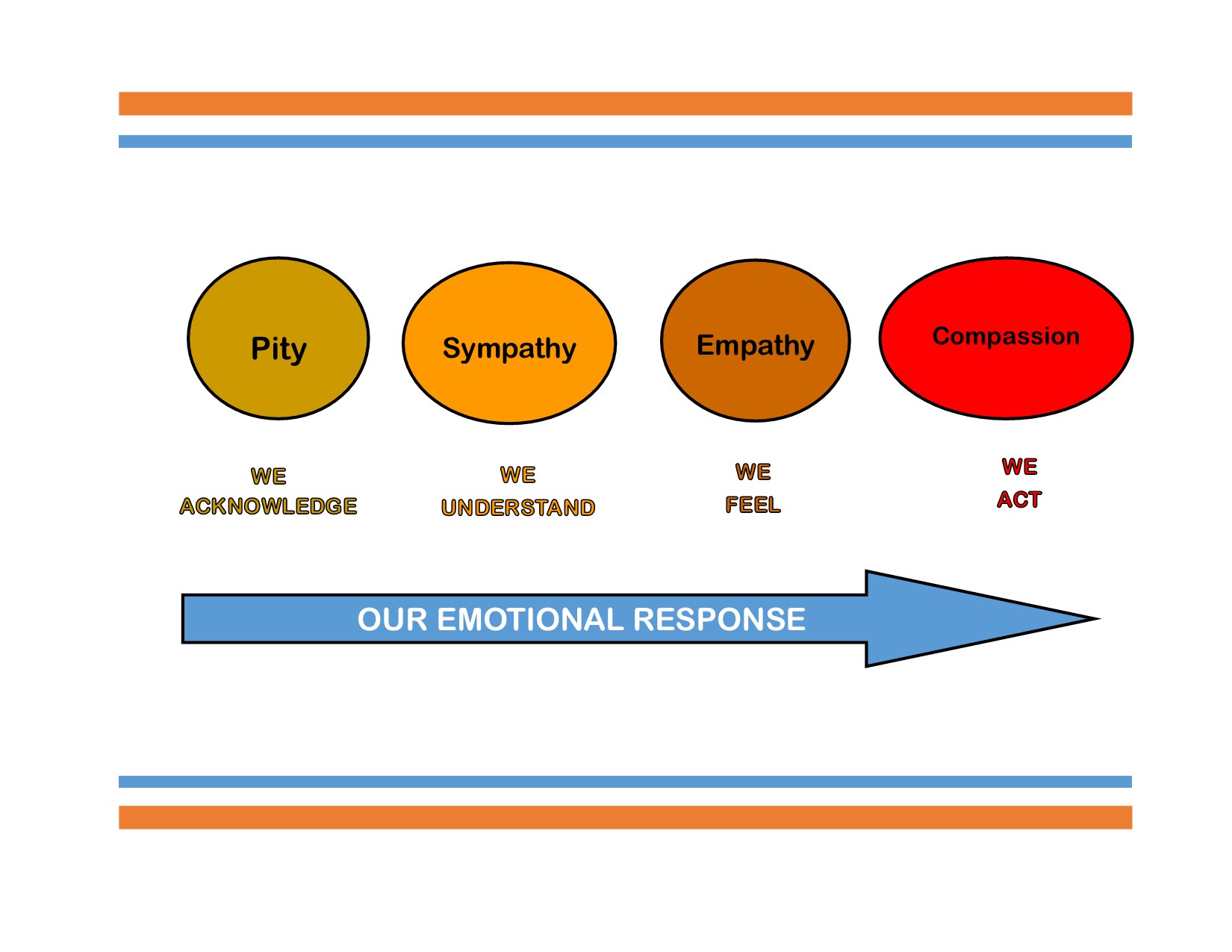
We’ve described compassion as a willingness to relieve the suffering of another.  With that definition we introduced a series of emotional responses (ERs) to the pain and suffering we experience. The intent was to help us better understand the differences in our emotional response to the anguish and distress of others.

Our ERs can fall on a continuum ranging from pity to compassion.  This is summarized below:

As we survey our cities, nation, and the world, we appear to be more jaded in our feelings concerning the plight of others.  This cynical view has begun to infiltrate, not only our personal response but has become reflected in our reaction to the growing social issues and “human problems” we face each day.  For example, can we honestly say that our education, health, and social systems reflect compassion for the people they are to serve?  Are we REALLY our brother’s keeper (Genesis 4:9)?

I wonder what God has to say about our ERs to the conditions of our world.  Does God view compassion in the same way we do?  How does our view of compassion differs from God’s view.

Will the compassionate people please stand?

How would you describe a compassionate person?  Would you describe yourself as compassionate?  You may be sometimes and then at other times, not compassionate at all?   Why the difference in ER?

The Greater Good of Berkeley University define compassion as a mental state or orientation toward suffering (your own or others) and includes four components:

    • Bringing attention or awareness to recognizing that there is suffering (cognitive)
    • Feeling emotionally moved by that suffering (affective)
    • Wishing there to be relief from that suffering (intentional)
    • A readiness to take action to relieve that suffering (motivational)

This explanation does not consider other factors that may also impact our ability to respond with compassion, such as understanding the nature of the situation and the effort required to resolve the situation.

Where’s the compassion?

If we look at Jesus’ parable of the Good Samaritan (Luke 10:31-37), what were the orientations or mental states of the travelers, as described by The Greater Good.

Now by chance a certain priest came down that road. And when he saw him, he passed by on the other side. Likewise, a Levite, when he arrived at the place, came, and looked, and passed by on the other side.  But a certain Samaritan, as he journeyed, came where he was. And when he saw him, he had compassion.

Where did the train go off the rails?  The priest “saw”.  The Levite “came and looked.”  Only the Samaritan moved passed the cognitive response and moved directly to motivational.  “The Samaritan came where he was and when he saw him, he had compassion”.

So, he went to him and bandaged his wounds, pouring on oil and wine; and he set him on his own animal, brought him to an inn, and took care of him.

More like God

The Hebrew and Greek words sometimes translate “compassion” to have a broader meaning such as “to love” and “to show mercy.” Synonyms for compassion in English are “to be loved by,” “to show concern for,” to be tenderhearted,” and “to act kindly.”  Do these words describe you?

Compassion is an inherent part of God’s very being (Exodus 34:6).  In the Old Testament, God’s compassion was rooted in His covenant relationship with His people (2 Kings 13:23).

In the New Testament, God’s compassion is demonstrated in His Son’s ministry and among His people.  Jesus’ messianic compassion was extended to the helpless crowds (Matthew 9:36), the sickly masses (Matthew 14:24), the hungry people (Mark 8:2), the demon possessed (Mark 5:90), the unclean lepers (Luke 5:12-16), and to all in need of “love and mercy” (Isaiah 61:1-3).

In our generation, Jesus has extended compassion to each of us—the hopeless sinner (Romans 5:8).  While compassion is not a uniquely Christian response to suffering (Luke 10:33), Christians have unique reasons for nurturing our compassionate disposition.  God compassionately and truly cares what happens to us. Developing a more compassionate disposition is critical as we navigate 21st century living.

Have a Heart!


Have a Heart!

Here’s how it all began

A businessman was called away to attend a critical meeting in a neighboring city. Because it was not very far away, he decided to drive versus fly.  As often is the case in car travel, he decided to stop at a familiar rest area along the way.  Unfortunately, during that stop, he was robbed and brutally beaten while exiting his car.

As he laid on the concrete, two travelers like himself stopped, but when they noticed him bleeding on the ground, retreated back into their cars and quickly drove away.  Finally, a traveler pulled alongside him and seeing his situation, came to his aid.  This last traveler loaded the businessman into his car and took him to the nearest hospital.

Does this story sound familiar? This is my 21st century version of the Good Samaritan found in Luke 10:25-37.  The context for Jesus’ teaching was the question posed to Him concerning loving others and defining who is one’s neighbor?   Who are we to love or have a heart for?

I will use this familiar text to begin our discussion on compassion.  What is compassion and why is it important for us to express it to others?

What’s it all about?

Dr. Luke’s story, sad to say, is not unfamiliar in our society today.  We’ve heard stories about crowds who witnessed harm to another person right in front of them but chose to turn their head or back on the situation.

On a broader scope, we see social injustices and human needs accelerate in our cities.  Homelessness, food insecurities, and economic disparities, are all too familiar examples of where society has figuratively, turned their back.  Why?  What are we missing?  Do we have a heart? Where is our compassion?

Compassion by any other name

There is much confusion as to the difference between pity, empathy, sympathy, and compassion. Perhaps because we tend to use these nouns to describe our reaction to pain and suffering.  While these words are close cousins, they are not, however, synonymous with one another.

While there are broader details around the meaning of these emotions, I will try to be as simple as I can, for the purpose of this teaching.

    • Pity. We acknowledge a person’s suffering.  “I really feel sorry for those who loss their life in the earthquake.”
    • Empathy. We understand what the person is feeling. “I felt the same way when I loss my job.”
    • Sympathy. We feel what a person is feeling. “I was also harassed during high school.”
    • Compassion. We are willing to relieve the suffering of another. “I will help you end your pain.”

Authors studying these emotions, find that placing them on a continuum helps us better understand their differences including the key factors that affect our response to human suffering and pain, i.e., effort, understanding, and engagement.

Compassion is the feeling of sorrow or pity excited by the suffering or misfortunes of another.

Compassion is made up of two words: “com” which means with or together; “pati” which means to suffer.  Together one suffers with another.

What’s our response?

When we view the misfortune of others on social media, are we moved to sorrow or pity?  As we look at famines and wars in countries thousands of miles from us, what is our emotional response?  Sympathy?  Does your response change, based on the specific situation or person?  What moves us from pity to compassion?

I close with a few quotes on compassion to help us understand it is needed more than ever for what afflicts us in the 21st century. What does it take for us to have a heart?

True compassion is more than flinging a coin to a beggar; it comes to see that an edifice which produces beggars needs restructuring.  Martin Luther King, Jr.

I would rather make mistakes in kindness and compassion than work miracles in unkindness and hardness. Mother Teresa

When we focus on ourselves, our world contracts as our problems and preoccupations loom large. But when we focus on others, our world expands. Our own problems drift to the periphery of the mind and so seem smaller, and we increase our capacity for connection or compassionate action.  Daniel Goleman

Compassion is an action word with no boundaries. Prince

The LORD is gracious and full of compassion. Psalm 111:4

Remember to Press In!

Remember to Press In

Feeling fatigued?

I’m sure many of you, like myself, are fatigued.

We  must deal with the continual bombardment of bad news.  Airplane crashes, natural disasters, domestic  terrorism.   And what are we to do with our “personal life challenges”?  Family drama, health issues, and “creative” economics,  just to name a few.

But regardless of the circumstances and events of the day, I invite you to “press in”.  Press into God and feel His presence which will help us continue with hope and renewed energy.

I have always shared with friends and family, that God has purposed our lives for times such as this.  Our resiliency and our ability to move forward need to be connected with the power, presence, and promise of God.  He will not leave us nor forsake us.  We need only “press in!

“You will find me when you seek Me.”  Jeremiah 29:13

We have explored on many occasions the biblical truth that God is in and among us—continually, without interruption, 7 by 24.  We experience God through our personal fellowship with Him and through the indwelling presence of the Holy Spirit.

However, there may be times when we don’t “feel” God.  We feel estranged from Him, alone, and unable to hear His voice.  Be assured, this is a common experience for believers.  The resolution for this spiritual occurrence, however, is not to curb our prayer life or cease in reading His Word.  During those times, it is imperative that we “press in.”

Disturbing Quietness

There are seasons in my life when it is extremely difficult to hear God’s voice.  I’m not talking about unanswered prayer but times of “disturbing quietness” when l must strain to hear Him—if I hear Him at all.

As I shared this experience, I found other believers had been through similar seasons of silence.  Interestingly, we all described it as a period when we “didn’t hear His voice.”  

In Search of an Answer

When I first experienced this quietness, I began to the search my heart for sins I might have committed yet failed to confess.  It was the sin of Adam that separated him from fellowship with God in the Garden of Eden.  Later Adam and Eve would experience the physical death of their body—the final separation from the world God had created for them.  I asked God to forgive me of my sins, yet I still felt disconnected from my First Love (Rev. 2:4).

My next effort was to examine my devotion time with Him.  I would increase my time of reading His Word.  Psalm 119 became my “song book” as I sought to hear His voice.

    • I delight in your decrees; I will not neglect your word. (v. 16)
    • I recounted my ways and you answered me; teach me your decrees. (v. 26)
    • Yet you are near, O LORD, and all your commands are true. (v. 151)
    • May my cry come before you, O LORD; give me understanding according to your word. (v. 169)

I would rise early to pray—leaving more time to “listen” and less to speak.  I would “draw near” with a sincere heart with expectations that He would do likewise (James 4:8; Heb. 10:22).  I would dedicate my day to praise and worship.  If God inhabits the praises of His people (Ps. 22:3), He will surely respond to me as I emptied myself to Him.  Yet with all the modifications to my devotional time, I couldn’t hear Him.  After many days of silence, I finally experienced a breakthrough.

Learning to Press in

In Secrets of the Secret Place, Bob Sorge shared his insight into my situation.

Many of us feel like we move in and out of God’s throne room. We have times of great connectedness, and then we suffer periods of disconnectedness. We can’t always analyze exactly why a distance has developed in our hearts toward the Lord, but most of us feel like our relationship with Christ is a roller coaster ride of feeling close, then far, then close, then far, then close again. In and out.  And we hate it. We were created for constant intimacy, and anything less drives us crazy on the inside. It is at those times that we need to press into God like you never have in your life! Allow the desperation of your soul to help you pursue God with absolute abandonment. 

God’s periods of quietness were an invitation to draw closer to Him—to “press in.”  More than proximity, He desires to establish an intimate friendship with us that is walked out through the course of our everyday lives. He is not looking for a segment of our day nor a day of the week.  He desires unbroken communion with us.

So on those occasions when it appears that “you can’t hear God”, press in!  Be of good courage for He is ever near (Ps. 73:28).  Press in!  Eagerly and unabashedly pursue Him, the Pearl of Great Price (Matt. 13:46). Press in!

Practicing Pressing in

Read Psalm 63:1-8.  Write in your journal the ways that David “pressed in” to God during his time in the wilderness.  Read the text again using a different translation or paraphrase.  Then ask the Holy Spirit how He wants you to “press in”.     

On the Road to God’s New Thing

The Road to New Things

A road by any other name

A road is literally defined as a wide way leading from one place to another. We often think of roads as access to new opportunities of commerce or development, such as the road to success.

A road can also describe a series of events or a course of action that will lead to a particular outcome. In the book, The Road Less Traveled, M. Scott Peck uses “road” figuratively to describe the sometimes hard and often painful process of change. Peck uses the “road less traveled” as a illustration of the journey this requires.

Jeremiah’s  road

In Jeremiah 31, the prophet speaks to the people of God in Babylon to prepare them for a “road”—both literally and figuratively—that would return them to their own land after their 70-year exile.

Jeremiah’s message is clear. They are not to be afraid or lose heart. They are to be focused with a firm resolution to rebuild the nation of Israel.

In Jeremiah 31:22,  Israel is called to refrain from falling back into their old rebellious habits as God creates “a new road”  to their salvation—a “new thing” that had never been done before (or since).

How long wilt thou go about, O thou backsliding daughter? for the LORD hath created a new thing in the earth, A woman shall compass a man.  

Failure on the road

Israel is warned against potential backsliding which is interpreted as “faithless”. In the past both Israel and Judah had consistently failed to “holdfast” to God and depend solely on Him for their every need. (Job 27:6) The results was always disastrous as proven by the conquest of both nations.

Where are we placing our faith? Is it in people—elected officials, family members, or friends?  Are we dependent on things—bank accounts, social status, or professional affiliations? Do we believe only in ourselves—our intellect, looks, or personality? When Jesus returns, will He find  us faithfully following Him on the new road? (Luke 18:8)

With God on the road to new things

Israel is encouraged to trust God, Who would create a “new thing”—interpreted as strange and surprising—in the earth. God would create a woman who would “compass” or protect man.

Many interpreters understand this “new thing” to be the incarnation of Jesus Christ.  A woman, the Virgin Mary, enclosed in her womb the Might One. This was to be their incentive.

They would know that with their return from exile came the promise of not only their physical restoration but also the spiritual blessing of the Mighty God (Is. 9:6). God would not cast off His people but bless them. This was to be their assurance.

What is the road for us today?

How do we  to live in the knowledge of this “new thing”?  Knowing the blessings of being in Christ (Ephesians 1:3-14).

We live attentively in God’s presence. God is creating new opportunities for us.  However, we must listen for His voice and watch where He is working. (2 Chronicles 16:9)

We live expectantly in God’s provision. God has provided all that we need to live godly lives and to accomplish His purpose in our lives. (2 Peter 1:3-8)

We live faithfully in God’s purpose. As the elect of God we live by faith. We do not backslide or “draw back unto perdition” but trust that He who began this “good work in us” is able to complete it. (Philippians 1:6)

Our journey to understanding “new things” has hopefully provided incentive and inspiration to walk in the divine purpose God has created for our lives. When we as believers trust God and understand God’s reason for “new things”, we can move forward joyfully in faith and confidence.

God’s Reason for New Things

God's Reason for New Things

Why change?

Last week we invited you to new things in 2025.  Maybe your life is going great and you have no need to change.  Great!  But for the rest of us, we realize that as the world changes, we too, must make sure that the way we are operating is within the will of God and His purpose for our lives.

Why resist?

It is human nature to resist doing new things even if new things offer more than the status quo.  The Book of Numbers takes us to where we observe the impact of a nation’s resistance to “new things” with respect to God and His divine purpose for their life.

But if the LORD make a new thing and the earth open her mouth, and swallow them up, with all that appertain unto them, and they go down quick into the pit; then ye shall understand that these men have provoked the LORD.  Num. 16:30 (KJV) 

What should have been an eleven-day journey resulted in a forty year “funeral procession” (Num. 14:28-29; 32-35).  Regardless of Israel’s opposition, God would show them a reason for His new thing.

Resistant and rebellious until the end!

From the time of their departure, Israel complained and was rebellious against not only the leadership of Moses and Aaron but also against God Himself.  Israel had seen the many miracles of God yet  in their hearts, regardless of what God did for them, “Israel had Egypt in their hearts. ” [1]

Where is your heart?  When God attempts to move you to your divine purpose, do you complain and murmur?  Is your affection set on the things of this world when God’s plan offers much more? (Col. 3:2-4)

New things may come with a price.

Read Numbers 15:1-20:13

Motivated by jealousy and envy, Korah, Dathan, and Abiram attempted to seize the priesthood from Aaron and his sons. In so doing, they also challenged the sovereignty and authority of God.

In the wilderness, God would teach Israel a painful lesson about the reason for “new things”—about sacrifice, authority, and responsibility.

That “new thing” would come with a price—it would cost Korah, Dathan, and Abiram their life, their families’ lives plus the lives of 14,700 people within Israel’s camp.

One of the reasons for God’s severity in punishing Israel was to prepare the way for His new thing—a people who would accept the “new beginning” He had readied for them in the Promised Land.  It would be there that Israel would experience new victories, a new priest (Eleazar), a new leader (Joshua), and a new generation.

How does God use “new things” in our life?
    • God might need to reset or reboot our current efforts. Stalled plans, ungodly influences or fleshly lusts can often take us off the path God sovereignly chooses for us.  God’s intervention will guarantee success. (Phil. 1:6)
    • God may desire to take us out of our comfort zone. He may even allow “trials and tribulations” into our life to move us forward.  In trusting and waiting on the Lord, we find courage to persevere as we pursue God’s plan for our life.  (1 Pet. 1:6-7)
    • God could choose to introduce us to an opportunity that may not have been on our radar screen. It is in those moments we can depend wholly on God to bring prospects into our life that will result in our good and His glory.   (Matt. 7:11)
God always has a reason for introducing new things into our life.

They may not be easy but they are always worth it.  We may not understand “why” but we can trust “Who” (God).

In the past when faced with new things, I was like Israel, guilty of complaining and murmuring.  Out of fear and frustration, I would cry, “Lord, why me?” I now choose God’s path for my life and when faced with “new things” I sigh in faith and confidence, “Lord, it’s YOU and me!”

[1]   Wiersbe Bible Commentary

What I Learned in 2024: What Time is it?


What time is it?

A New Year Begins.

Welcome to 2025!  As is my habit with WordBytes in January, I’d like to share with you my key learnings from 2024.

I am a learner by nature.  I especially LOVE to read and study God’s Word.  Through writing WordBytes and daily journaling, I capture my thoughts and share my emotions with the Lord.  I write, scribble, cut and paste; highlight,  and redline.  I use many symbols to capture what God is revealing to me in our time together.  My journal is my personal creative mess!

As I read my quarterly journals for 2024, there emerged several key themes that I’d like to share in this year’s learning.  All revolved around the idea of “time”.   Not the time we use to calculate intervals of a day (chronos time), but the appointed time in the purpose of God (karios time).

2024 was the “karios time” to receive the message God wanted to share with me, not only for my spiritual growth and development, but also to build my resilience for 21st century living (Esther 4:14).

A Time for examination.

2024 was a time to examine myself and see if I was still in the faith (2 Corinthians 13:5). Was my heart “divided”?  Was I attempting to serve God AND the world?  Who and what dominated my time and my resources?  Was I being conformed to the image of Christ? (Romans 8:29)

In his book, Resilient: Restoring Your Weary Soul in these Turbulent Times, John Eldredge reminded me of this fact.

Maturity is no longer optional, dear ones; wholeheartedness is no longer something we can go without.  Those vulnerabilities in us prove treacherous in this world, like a faulty bridge or a bow that is not properly strung.

With all the distractions and competition for my attention, was I still faithfully following Christ? I needed to daily acknowledge Jesus as Lord of my life and totally commit to follow Him.

A Time to surrender.

Surrender is an unpopular word usually associated with defeat.  But with God, surrender takes on a new meaning.  Surrendering to God, makes possible, what is impossible without Him.

I foolishly believed that my efforts shaped me into the person God created me to be.  It is the Holy Spirit within me that does the work (Philippians 2:13).

In his book, Absolute Surrender, A.W. Tozer, shares this thought about my role in surrendering.

A life of absolute surrender has its difficulties.  I do not deny that.  Yes, it has something far more than difficulties: it is a life that with man is absolutely impossible.  But by the grace of God, by the power of God, by the power of the Holy Spirit dwelling in us, it is a life to which we are destined, and a life that is possible for us, praise God!

It is my honor to surrender “everything and everyone” to the Lord.  I have come to the reality that without Jesus, I can do nothing (John 15:5).  God alone knows where I am, where I need to be, and what it will take to get me to where He wants me to be.  It is my job to surrender.

A Time to go deeper into God’s love.

As a child, I was taught the song, “Jesus loves me”.  However, I did not fully understand the depth of that love until I experienced the joy and pain of living in this fallen world.  Through both good and bad times, I have experienced the love of the Good Shepherd, Jesus Christ (Ephesians 3:16-20)

As I read W. Phillip Keller’s book, A Shepherd Looks at Psalm 23, I was amazed at the uncanny similarities between the work of the shepherd and Jesus’ work in the life of human sheep.

It is a tragic truth, that many people who really have never come under God’s direction and management claim that “The Lord is my shepherd”.  They hope that by merely admitting that he is their Shepherd, they might somehow enjoy the benefits of His care and management without paying the price of forfeiting their own fickle and foolish way of life.

Jesus is my Good Shepherd (John 10:14) who loves me and cares for me even in my disobedience, and my foolishness. Jesus makes me lie down, restores my soul, and leads me. His love for me is extraordinary.

MOMENTS OF MINDFULNESS

Time to reflect on today’s session.  Feel free to share your remarks at https://www.itwministries.org.

What have you learned in 2024?   What things will you leave behind that won’t be helpful in your 2025 journey?  What things has God revealed that will help you achieve a richer life in Christ in 2025? 

Living the Beatitude Life: A Heart to See God

A Heart to See God

Intentional teaching

“Blessed are the pure in heart, for they shall see God.”  As a little girl, Matthew 5:8 was one of the first memory verses I was taught.  I can’t explain the reason for the choice of this verse.  Perhaps my mother felt it would help tame my mischievous spirit.  She was very intentional when it came to her children.  Little did I realize that my mother’s guidance would lead to a fuller vision of God and His Kingdom.

Jesus was also intentional in His teachings.  The Beatitudes, both in unity and individually, radically flew in the face of how the world defined happiness, satisfaction, and success: poor in spirit, mourners, meek, merciful, hungry and thirsty.

Jesus’ purposefulness is seen in His presentation of each of the beatitudes, especially with the placement of this sixth beatitude, “Blessed are the pure in heart.”  Today’s beatitude is no exception to this teaching pattern.  It redefines purity and the resulting blessedness of “seeing God.”

Jesus knows what’s needed.

Jesus has to this point shared with His Disciples key behaviors of those who enjoy the “happiness and satisfaction” of living by kingdom rules.

In reading this beatitude today, one might comment on its simplicity in meaning and presentation.  However, in the context of the 1st century, Jesus’ statement was revolutionary.  Jesus presented it to a nation literally obsessed with purification laws and procedures (Leviticus 11-15).

Imagine the shock of hearing Jesus.  “No one, not even Moses, has ever seen Jehovah God!”    “Purity of heart and nothing else?”   This alone was sufficient reason for the scribes and the Pharisees (who benefited from the current religious system) to desire Jesus’ death.

The heart’s role in purity.

The heart is key in sustaining a faithful walk with God.  Its condition (pure or unpure) affects our thoughts, behaviors, and actions.   In the Old Testament, the Lord described the heart, the seat of man’s affection, as “deceitful above all things and desperately wicked” (Jeremiah 17:9).  David understood the importance of purity of heart as he pleaded with God to create a clean heart and renew a right spirit within him (Psalms 51:10).

Who are the “pure in heart”?

  • Those who mourn the impurity of their hearts to the extent that they do what is needed to cleanse and purify it (Matthew 4:17; 1 John 1:9).  When standing in the presence of Holy God, we understand our personal depravity and the need for forgiveness (Romans 3:23).
  • Those who accept God’s lordship in their lives. They place Jesus as the center of their life.  The pure in heart “see” God spiritually.  They operate in His presence, under His authority, and to His honor and glory (Coram Deo).

“Seeing God” in this beatitude allows us to recognize and acknowledge God’s sovereign acts of mercy and grace in this fallen world we live in (Matthew 5:45).  We are able to see “His Hand” both physically (Acts 17:28) and spiritually (Romans 6:6-9).

Our 21st century challenge

Seeing God is a challenge for people living in the 21st century.  Nonbelievers are blinded by Satan who keeps them from seeing the possibilities that Christ offers (John 3:3; 2 Corinthians 4:4).    Beatitude living is at enmity with a world that neither recognizes nor accepts the authority of God, the lordship of Christ, or the leading of the Holy Spirit.

Unfortunately, we believers aren’t always the best witnesses for Beatitude living.  Satan convinces many of us that purity of the heart is impossible.  Again, a trick by Satan to frustrate and discourage our efforts to live holy. We fail to understand that it is the work of the Holy Spirit who will always lead us to purity.  God is not seeking perfection but progress:  a sincere effort to grow and love others.

As children of God, we have everything we need to live pure and holy lives (2 Peter 1:3; 1 John 3:2-3).  Our pursuit of purity can become “second nature”.    How?   By spending more time with God:  reading His Word, meditating, and prayer.  The more we do this, the more we will see God.

“Blessed [anticipating God’s presence, spiritually mature]

are the pure in heart [those with integrity, moral courage, and godly character],

for they will see God.” (Amplified)


Living the Beatitude Life: In Search of Righteousness

Living the Beatitude Life: Seeking Righteousness

The search for something better.

In the movie The Pursuit of Happyness, Will Smith plays Chris Gardner, a desperate individual endeavoring to save his family from dire circumstances created by his lack of employment and subsequent homelessness.

Chris is given the opportunity for a job on Wall Street by a benevolent mentor who sees in him, not only hidden talent, but a “hunger and thirst” for a better life.

When Jesus spoke of hungering and thirsting for righteousness, He knew the impact “kingdom living” would have on individuals in search of a “better life”.  Jesus saw individuals who were spiritually hungry, starved by the empty promises of this world.  The result was emaciated spirits and dry souls.

Blessed are those who hunger and thirst after righteousness for they shall be filled. Matthew 5:6   (NRS)

To be righteous (dikaios), in a broad sense, describes man as God had originally created him to be—one whose way of thinking, feeling, and acting is wholly conformed to the will of God.

As believers, our righteousness is not from us but is the imputed (credited) righteousness of Jesus Christ (Rom. 5:1).  The desire to live  righteously before God is only possible by Jesus Christ’s presence within believers through the Holy Spirit.  It is the Holy Spirit that gives us the ability to live right and to do right (Ezekiel 36:25-27; Phil. 2:13).

Seek first the kingdom of God. Matthew 6:33 (NKJV)

To “seek first God’s kingdom and righteousness” establishes the right priority for the believer.

With the many enticements and distractions offered by the world, it is easy to understand the lukewarm commitment to the things of God—even within the church.  But God demands our love and our loyalty as we seek to live for the furtherance of the kingdom of God.

The Apostle Peter reminded persecuted believers of their “new priority” as a result of Christ’s sacrificial death.

He himself bore our sins in his body on the tree, that we might die to sin and live to righteousness. By his wounds you have been healed.  (1 Peter 2:24)

Since therefore Christ suffered in the flesh, arm yourselves with the same thought, for whoever has suffered in the flesh has ceased from sin,  so as to live for the rest of the time in the flesh no longer by human passions but by the will of God.  (1 Peter 4:1-2)

An Invitation.

Jesus’ invitation to righteousness was an opportunity for a new way of living for 1st century believers.  Believers’ lives were no longer marked by hypocrisy and corruption as seen in the lives of the ruling religious leaders.  Instead, Jesus invited those who sought God’s righteousness to simply “Come” (Matt. 11:28-30).  This invitation would resonate with individuals in familiar terms they could easily understand—hunger and thirst.

To “hunger and thirst” for God’s righteousness indicates a strong craving that becomes the driving force in our life.  The Psalmist captured this fervent yearning in Psalms 42:1-3:

As a deer longs for flowing streams, so my soul longs for you, O God.  My soul thirsts for God, for the living God. When shall I come and behold the face of God?  My tears have been my food day and night, while people say to me continually, “Where is your God?”

Hunger and Thirst.

While hunger and thirst are terms typically used to express basic human needs, the hunger and thirst that Jesus describes is different.  This beatitude depicts a “spiritual hunger and thirst” that finds no satisfaction in the physical realm.  And what is the effect of this yearning?  “It is filled!”

The world is at enmity with those seeking the righteousness of God.  In spite of the persecution we may encounter or the rejection we may face, it is imperative that we stand firm and give the world the reason for our hope—a living hope that is realized both now and in eternity future (1 Pet. 3:15).

Our culture continues to seek answers to the moral and social problems of our day using man’s wisdom.   Such efforts are “senseless striving” without first desperately seeking God’s righteousness.

Living the Beatitude Life: Meekness and Kingdom Living

Living the Beatitude Life: Meekness and Kingdom Living

Counterculture thinking.

The Beatitudes illustrate the behaviors and resulting “blessedness” that belongs to believers living by kingdom rules.  These behaviors were “counterculture”, not only in the first century, but even more so today.

Last week we explored the blessedness in “mourning and comforting”.  Mourning is the “sincere sorrow” we experience when we realize the impact of sin in our life.  Comfort is the result of knowing that Jesus Christ has delivered us not only from the penalty of sin (death) but also provided the means for ongoing cleansing (1 John 1:9).

We continue our exploration into the Beatitudes with the third proclamation by Jesus from his Sermon on the Mount.  “Blessed are the meek; for they shall inherit the earth.”  (Matthew 5:5)

What is meekness?

Meekness (praus) is typically used to describe one whose disposition is gentle or mild. It has also been described as “power under control”.

Jesus described Himself as “gentle and lowly” (Matthew 11:29) yet He was the Creator of the universe.  John Killinger in his classic, Letting God Bless You, describes how Jesus’ life truly depicted “power under control”.

When folks got the idea of starting a movement that would make Him an earthly king, Jesus slipped away to be alone and to pray. While he commended the use of riches to help the poor, he himself never had much in the way of earthly goods-apparently not even a home to call his own or an extra change of raiment.

When he was preparing to leave his closest friends, he took a bowl of water and a towel and got down on his knees to wash their feet, insisting that they learn to live through serving one another, not by sitting in the places of honor. Betrayed by a follower who led the police to his prayer spot in Gethsemane, he kissed the follower and bade his friends not to raise their swords.

Brought before Pilate and Caiaphas, he saw the uselessness of protest and fell into creative silence. Crucified between two criminals, he spoke kindly to the one with an open heart and forgave the soldiers who had followed orders in carrying out his execution. He didn’t have to be this way. He didn’t have to submit to such mistreatment.

Meekness rewarded.

Jesus stated that meekness would result in inheriting the earth.  “A land” was promised to the people of Israel.  What earth or land was to be inherited? Some scholars believe the land refers to the Promised Land originally pledged to the patriarchs of the Old Testament (Genesis 12:7; 24:7; 26:3; 28:13). Others say it is the future Millennial Kingdom described in Revelations 20:1-10.

But acquiring a land signified much more than a possession.  It implied a sense of place, security, and an inheritance from God.  These promises will be realized with the second coming of the Messiah, when there will be a new heaven and a new earth (Revelations 21:1).  The new earth will not be possessed by the powerful despots, the ruthless tyrants, or the manipulative schemers. It will be possessed by the meek.

This promise of a land is also for us believers who are benefiting from the New Covenant.  It will be fulfilled in a far more glorious way than anyone could imagine.  This is our living hope for today (1 Timothy 4:10; Titus 2:13).

How does one become meek?

Meekness and gentleness and goodness are part of the fruit of the Spirit.  They are produced in the Christian by the Holy Spirit.

To cultivate a spirit of meekness, we are encouraged to walk by the Spirit (Galatians 5:24-25).  That means we are controlled by the Spirit of God This will result in our being conformed to the image of Christ including His meekness.

The Gospel narratives of Jesus’ life shared what meekness in action looks like. Jesus could have called down angels to take his side in Gethsemane (Matthew 26:53). But, for all of this, he was a meek man, a man after the heart of God, a man from the heart of God. Let us follow Jesus’ glorious example. Let us seek meekness.