
Have you got good religion?

Have you got good religion?

Do we have it?

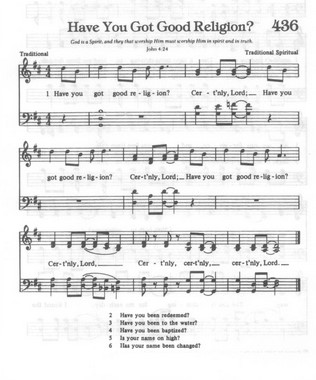
“Have You Got Good Religion?” is an African American gospel song which imagines a series of questions Jesus might ask believers.

After the opening query, “Have you got GOOD RELIGION?”, there are five (5) additional questions which Jesus asks.  The individual then answers with an emphatic response, “Certainly Lord!”  As there have been many renditions of this song, there also have been many modifications to the “original” questions.

For this teaching, I’d like to share the original verses:

  • Have you been redeemed?
  • Have you been to the water?
  • Have you been baptized?
  • Is your name on high?
  • Has your name been changed?

The occasion or background for this dialogue is not given nor is it even important.  But as I purview the Church in the 21st century and the role of each of us as believers, I find the questions very appropriate.

Do we have good religion?

What is religion?

The origin of the word religion is from Latin religio or religare which means “obligation, bond, or to bind”.   Modern classification describes religion as a particular system of faith and worship.  It is also belief in and worship of a superhuman controlling power especially a personal God or gods. 

I’m sure one time or another our faith walk has been described in terms of how we pursue our “religion.”  As we share our beliefs as it relates to world events, we might be told, “you are taking this religious thing too far!” Or as we refuse to acquiesce to some immoral or dishonest act, we may be accused as being “too religious”.

So what is good religion?

I concur with both definitions of religion put forth earlier.  I worship only One God, the Creator and Sustainer of all life (Ps. 104).  He is the ruling authority in my life.  My Lord and Savior Jesus the Christ redeemed me and translated me from darkness into light (1 Pet. 2:9).  Jesus lives in me through His Holy Spirit who empowers and guides me in all things.  I am a Christian and I worship God in spirit and in truth (John 4:24).

We must be careful however, not to allow man-made rituals and practices to keep us from true righteousness—being in right relationship with God AND with each other.  Such was often the case with the Pharisees who often mistaken religious activities for true worship and love for God (Matt. 15:1-20). Sadly, we see this in our churches who cling to history and tradition.  These often result in the quenching of the Holy Spirit.

What’s in a song?

I think the questions put forth in the song, help us to define what “good religion” looks like.  Then we can begin to examine ourselves to see if we are still of the faith (2 Cor. 13:5).

    • Have you been redeemed? To be redeemed means we have accepted Jesus as our Lord and Savior.  We no longer belong to Satan but are now part of God’s family. (Titus 2:11-14)
    • Have you been to the water? Have you been baptized? Baptism is our public testimony to our willingness to follow Jesus.  It is our external witness to our allegiance to Him. (Rom. 6:3-4)
    • Is your name on high? “On high” refers to “heaven” where the Book of Life is kept until Judgment Day (Rev. 20:11-15).  In it are the records of all people considered righteous before God.  Our name is in the Book because we have Christ’s imputed righteousness. (2 Cor. 5:19).
    • Has your name been changed? Our name is the source of our identity.  Biblical name changes were the result of spiritual identity changes in the life of those who have been with God, i.e., Abram to Abraham, Sari to Sarah, Jacob to Israel.  Our spiritual identities are changed when we become new creatures in Christ (2 Cor. 5:17).
How would we respond?

If God were to pose the six questions contained in our song today, can we say emphatically. “Certainly Lord?” What would be our proof?

F.B. Meyer, noted theologian shared this description on religion—I offer it as my definition of “good religion.”

In Matthew 15:16, our Lord teaches that true religion is certainly not a matter of eating and drinking or outward ceremony.  It is the intention of the soul, the continual drawing from Christ the life power needed for our work and ministry to others.  

Is our life a witness to God’s power and love?  Have we joined Jesus in His work to serve in this fallen world?   If we can say, “Certainly Lord!” then our life and works become a testimony of our “good religion.”  (2 Cor. 5:14-15).

Losing Our Mind

Losing Our Mind

Losing our Mind

In the 90’s there was a commercial that declared “a mind is a terrible thing to waste.” Its intent was to encourage the pursuit of higher education.

Unfortunately, a politician, hoping to win “kudos” and votes with potential constituents misquoted this saying resulting in the statement, “a mind is a terrible thing to lose.” That politician was not re-elected.

Mind management

In his letter to the church at Philippi, the Apostle Paul gives advice as to the best use of one’s mind. “Let this mind be in you, which was also in Christ Jesus” (Phil. 2:5).  In other words, we are to set aside our way of thinking and replace it with the same type of thinking as Jesus.  And what is the results of doing this? Victorious living.

Victorious according to Webster is defined as having won a victory or characterized by victory. I’m not suggesting that our life will be perfect nor problem free.    Our victory comes in the knowledge that Jesus has already overcome every situation we now face in our life (Heb. 4:15; 1 John 5:5).  In Christ, we have everything we need to overcome the challenges of 21st century living (2 Pet. 1:3-4, RSV).

His divine power has granted to us all things that pertain to life and godliness, through the knowledge of him who called us to his own glory and excellence, by which he has granted to us his precious and very great promises, that through these you may escape from the corruption that is in the world because of passion and become partakers of the divine nature.

How do we obtain the mind of Christ?

To have a mind of Christ we must…

Be willing to exchange our position and our plans, for the purpose God has designed for our life. Christ willingly joined God in His plan of salvation for mankind (Eph. 1: 4-6).

Trust in God and believe that all things work together for good to those called according to His purpose (Rom. 8:28).

Humble ourselves like Christ.  Our intents and actions should seek “no personal reputation” nor gain (Phil. 2:6-8).  Christ voluntarily set aside His privileges (“being in the form of God”) and accepted a lower status (“took on the form of a bondservant and made in the likeness of man”). Why? For us.  That we might be released from the bonds of sin and have eternal life.

Our victory

Finally, to have the mind of Christ, we must be obedient.   Obedience is the highest form of love. Because of our love for God, we must be willing to sacrifice our thoughts and actions to follow the instructions He has set before us (1 Sam. 15:22). Christ’s obedience was love of the highest caliber.  Jesus was obedient even if it meant death by the worst possible punishment, death on the cross (Phil. 2:8).

Paul shares with the Philippians God’s reward for Jesus Christ’s “mind” (Phil. 2:9-10):

Therefore, God has highly exalted him and bestowed on him the name which is above every name, that at the name of Jesus every knee should bow, in heaven and on earth and under the earth, and every tongue confess that Jesus Christ is Lord, to the glory of God the Father.

Possessing the mind of Christ will empower us to “pull down strongholds and cast down obstacles that hold themselves up above the knowledge of God.  We can do this by bring into captivity every thought to the obedience of Christ.” (2 Cor. 10:4-5)

A mind may be a terrible thing to lose” unless you replace it with the mind of Christ.  There is an old axiom that states, “You can’t lose what you never had.” Read the Gospel account of the Madman of Gadarenes (Mark 5:1-19) and see how losing your mind can change your life.

Opportunities in Uncertainty

Opportunities in Uncertainty


Josh’s opportunity

Josh had experienced much turmoil and strife during his current job assignment.  There was frequent upheaval among his peers against current management.  Those efforts, fortunately, had been squelched.  As a result of that effort, many of his team members suffered great loss and were not allowed to move forward with the organization.

Earlier in his career, Josh was chosen to be part of a special team to evaluate next steps for his organization.  Because of Josh’s loyalty and his credentials, he was now a candidate for a new opportunity.

Because of the earlier “coup attempt”, many of the older, seasoned members were no longer there.  What remained was a young and inexperienced group, who needed guidance and support in moving the organization to new heights that had been promised to them.

And now, he was being offered a promotion as head of the organization.  But was he ready?  What did he need to move forward?  Was there an opportunity in this uncertainty?  These were possible  questions asked by Moses’ replacement, Joshua (Deut. 31:7).

Ready for an opportunity?

How would we respond if offered the opportunity set before Joshua?  That was the question I asked myself during my morning devotion as I read Deuteronomy 31:1-8 and Joshua 1:1-18.  In both scripture texts, Joshua is repeatedly told several things that would prepare him for his new leadership role.

The first dealt specifically with his reaction to the opportunity.  What were the emotions he felt knowing what lie ahead of him?  Joshua was told to “be strong, fear not, and be of good courage” (Joshua 1:6-9).   But how was he to do that?

He had seen Moses as he dealt with this group of stiff-necked and disobedient people.  He remembered the frustration that Moses often felt in trying to keep them faithful to God and His commandments.  Moses was the great mediator between these people and Yahweh, Almighty God.  Would he be able to do the same?

Fear or dismay?

As I studied these texts, I asked myself (and my husband) this question.  Which is worst—fear or dismay (discouragement)? Is there a difference? Fear is anxiety caused by approaching danger—real or imagined.  Discouragement is described as depression of one’s spirit.  It can be caused by a heavy burden, defeat, an apparent failure, or even sickness.

Both fear and discouragement would be unique challenges that Joshua would need to manage as he moved forward.  Both could potentially lead to failure in Joshua’s assignment to take the Israelites into the Promise Land.  And not only entrance into the land that God promised, but to also conquer the current inhabitants.

Fear or discouragement?  Which one is our biggest threat as we face the challenges of living in these times of uncertainty?  How are we to manage the stresses of life that come both rapidly, continuously, and often violently?

Fear and discouragement are Satan’s “weapons of choice” to hinder and even stop us as we move into God’s purpose for our life.  Satan will often focus on the largeness of the problem and/or the smallness of our ability to stop us in our tracks.

That’s why we need the intervention of Someone who is bigger than the problem and able to do exceedingly above all that we can ask or need (Eph. 3:20).  That Someone is God our Father, made available through His Son Jesus the Christ, and made manifest in our lives through the Holy Spirit.

God’s Promise

In his new leadership role, it was critical that Joshua remembered what God had promised:  It is the Lord who goes before you; He will be with you, He will not fail you or forsake you (Deut. 31:8). 

Despite the difficult times experienced living in the Wilderness, Joshua saw firsthand God’s love and faithfulness to His people.  God had chosen Israel to be His treasure (Deut. 7:6) and He would make good on every promise He made to them (Joshua 1:5-7).

Joshua had seen God’s great power as evidenced through His miracles and works:  The ten plagues in Egypt, the parting of the Red Sea, and God’s provision during Israel’s 40 years in the wilderness (Deut. 8:3-4). God’s promise to Moses was the same promise He now made to Joshua:  God would go before him and with him.  God would not fail nor forsake him.     

We daily face changes and challenges, turmoil, and threats.  They are as great and as real, for us, as Joshua’s new leadership opportunity.  But like Joshua, we can rest assured that we can depend on and trust in the promises of God.  God goes before us and with us, wherever the circumstances of life may lead us (Heb. 13:5).

God is more than able to handle whatever may come our way.  He is “Alpha and Omega, the beginning, and the ending…which is, and which was, and which is to come, the Almighty” (Rev. 1:8).  It is in His presence, and under His authority that all things are possible (Matt. 19:26).   So be not afraid nor be dismayed, we are not alone.  There is always opportunity even amid uncertainty when God is with us.

How’s your joy capacity?

Joy Capacity

Joy and strength

Upon returning from exile, Nehemiah told the builders of the new wall of Jerusalem that “the joy of the Lord would be their strength.” (Nehemiah 8:10) The type of joy Nehemiah was alluding to was only possible from our Almighty God Who would sustain them through the direst of circumstances.

What sustains you?  In the midst of all our challenges as a nation, in our communities, and in our families, how are you holding up?  How is your joy capacity?  Is the joy of the Lord still our strength today?  Yes!  The principle of joy still resonates even in the 21st century (James 1:2-3; Phil. 4:4).

What exactly is joy?

Joy is defined by Webster as a feeling of great pleasure and happiness.  This definition, however, fails to explain the importance of joy in building resiliency, or our ability to “bounce back” from the challenges of life.  It is joy that increases our emotional capacity to handle the difficulties we face while we live in this fallen world.

Joy nuggets

Although we may feel like we have little or no joy left, we must be diligent to “refill” our joy tanks.  I’d like to share just a few “joy nuggets” nuggets so you too can increase your JQ–joy quotient.

We increase our joy when we are in relationship.  I’m not talking about sexual relationship (although that is important) but I mean when we are in fellowship with others.  God said it is not “good for man to be alone.” In response, God created woman to be in relationship with Him. (Gen. 2:18) God Himself was in relationship with the first married couple.

In relationship, joy comes from knowing that the person you are with is happy to see and be with you.  Relationship was key to Christ as we observe His relationship with His disciples and His close circle which included Peter, James, and John

We increase joy when we are in community.  Social restraints and changing technology have made archaic the idea of a physical community.  Remember Mrs. Branch who taught the girls how to play the piano?  Or Mr. Johnson’s “show and tell” sessions about his adventures in the Army.  Or Mrs. Mott’s homemade cider and gingerbread at Halloween.

Community offered familiarity, authenticity, and validation.  Joy was found in acceptance and genuine interest in the individual.   Join a community that can offer these benefits.  Remember the television sitcom, “Cheers”.  At Cheers “everybody knows your name and their all so glad you came.  We want to go where everybody knows your name!”

 We increase joy when we reflect on moments of appreciation.  Think about a person that you appreciate and a time you felt especially grateful to be with that person.

Describe the emotion you felt when you were with them.  Describe what your body felt like when that person was present.  Doing this exercise regularly will raise your joy level.  

Let your joy flow

Although joy might appear to be a fleeting emotion, it really requires that we be intentional in our pursuit of it.

My joy begins first with God, my most important relationship.  It is in time of prayer, reading His Word, and fellowship through worship that I feel my greatest joy.   With Him, I feel safe, calm, and connected.  I feel joy.

Next, I find great joy with family and friends.  It is in sharing meals, recounting stories, and in creating new memories that I find joy.  These times together help me put into perspective what is important and “joyful.”  I share joy.

How is your joy capacity?

What is fellowship with God?

What is Fellowship with God?

God in and among us

There are two (2) biblical truths that should motivate us to live our  lives “more fully and abundantly” (John 10:10).

The first truth is that the Holy Spirit, the Spirit of Truth, presently lives within us.  Jesus promised this to us who “believeth on and in Him” (John 14:16-17).

The second is that we live continuously in the presence of God (Ps. 139:7).  There is never a time nor is there any circumstance in our life where we will find ourselves outside God’s love and purview.

Both truths are “spiritual blessings” gifted to us from our heavenly Father (Eph. 1:3).   But even with God’s commitment to be in and among us, we have a responsibility to draw “near to God” (James 4:8) by entering into intentional fellowship with Him.  God will not force His presence upon us.  He will, however, invite us into fellowship with Him.

What is fellowship?

What does “fellowship with God” look like in our life?  Fellowship has been described as the sharing of experiences with likeminded people.

However, fellowship with God is much more, because “who has known the mind of God?” (Romans 11:34) Our fellowship with the Father is dependent upon accepting His Son as Lord and Savior.  It is through Jesus Christ that we begin to “know by experience” God’s heart and mind.

Such was the case with the Apostle John and the disciples who were uniquely privileged to witness, first hand, the person and works of Christ.

“That which we have seen and heard we declare to you, that you also may have fellowship with us; and truly our fellowship is with the Father and with His Son Jesus Christ.   And these things we write to you that your joy may be full.”    1 John 1:3-4

Can I get a witness?

  • “That which was seen” included the many miracles of Christ; miracles that would attest to the coming of the promised Messiah (Matt. 11:2-5). 
  • “That which was heard” were truths that Christ declared concerning the kingdom of God and His offer of eternal life (Luke 4:43; 9:11).
  • “That which was looked upon and our hands handed” recounted the disciples’ examination of Christ’s glorified body after the resurrection (John 20:27).

All of the disciples’ senses were engaged as Christ manifested (revealed) Himself and the Father.  Since Father and Son are one (John 17:11, 22), the disciples concurrently experienced fellowship with the Father (v. 3).  The disciple’s experience with Christ was not viewed from a distance but up close and personal.

Unending communion

Fellowship (koinonia or koy-nohn-ee’-ah) is translated as “communion” and “joint participation in a common life.”   John’s personal witness was an invitation to the early church to participate in a lifestyle that centered on relationship–an unending communion with God the Father and the Son.    Therein is the basis for John’s reason for sharing about fellowship with God:  so that their “joy may be full” (1 John 1:3-4).

Joy (pleroo or play-ro’o) means “to fill to the top so nothing is wanting; to complete”.  Joy can also be explained as “God’s will obeyed” and “God’s promises fulfilled”.   Joy begins and ends with fellowship with the Father and the Son (Luke 4:21).

Fellowship with God as a lifestyle

Ask yourself these questions.  How would I describe my fellowship with God?  Have I seen, heard, and looked upon Christ’s presence in my daily walk of faith?  Do I have joy and is it full?

Many times, we miss opportunities to fellowship with God. Perhaps we have become distracted by competing priorities and the busyness of life. Have our sinful behavior patterns and unhealthy influences interrupted our fellowship with God?

We are to walk daily in fellowship with God, armed with the knowledge that we are no longer “slaves to sin”.  Instead we are to be “servants of righteousness” producing fruit of holiness (Rom. 6: 22).

Get up close and personal!

Though John’s letter was written thousands of years ago, its message is still relevant for us today.  Therefore, it is an invitation for us to participate with the only true Source of joy.

Jesus invites us to draw near with faith (Heb. 10:22) and learn of Him (Matt. 11:29). In return, we can enjoy glorious fellowship with Him.  Let us be faithful witnesses to what it means to live in fellowship with God.

In the Presence of God


“Where can I go from your spirit? Or where can I flee from your presence? If I ascend to heaven, you are there; if I make my bed in Sheol, you are there.”

Psalm 139:7-8 (NRS)

Unseen influences

Our life consists of more than “flesh and blood”.  It includes our assumptions, beliefs and behaviors that regulate our personal preferences and pursuits.  These can be “of the world” or “of God.”

These assumptions, beliefs and behaviors eventually influence the choices we make daily and are ultimately reflected in our life style.

It is important that God’s influence is evident in our lives.  This begins by our acknowledging His glorious presence.  In Psalm 139 David shares the effect such knowledge can have in the life of the believer.

Where can I go?

In Psalm 139, God’s presence is demonstrated through several of His key attributes.

In verses 7-12, from which our text for today is found, David speaks specifically of God’s omnipresence.  God is everywhere all the time.

In Jeremiah 23:23-24 this characteristic is spoken of by God Himself.  “Am I a God near by, says the LORD, and not a God far off?   Who can hide in secret places so that I cannot see them? says the LORD. Do I not fill heaven and earth? says the LORD.”

Acknowledging God’s Presence

The impact of living in God’s presence offers extraordinary benefit for the believer.

First, knowing God is everywhere offers us great comfort.  The new norm for living in the 21st century requires us to be ever vigilant—watching for potential risks and dangers that may threaten us physically, financially, and/or socially. To know that we are never out of the presence of God should settle the faint-hearted.  God alone can make good on His promise that He will “never leave nor forsake us” (Gen. 28:15).

Secondarily, believers living in the presence of God possess great confidence knowing that God is ever-present. Even in the most routine of transactions, recognizing that the “only wise God” (Rom. 16:27) is there to guide and direct our steps, releases us from unnecessary stress and concern (Phil. 4:6-7).

Finally, living in God’s presence provides us great clarity as to how we are to live in this present age (Titus 2:11-13).  This acknowledgment requires that we live obediently according to His Word and under the direction of the Holy Spirit.

Living in God’s Presence

God’s Word, especially the New Testament, describes God’s expectation of our conduct in light of living in a fallen world. Our  behavior is different from the world’s view (Rom. 12:2; 1 Pet. 1:13-16; 1 John 2: 16-17)

As believers in Christ, our reality recognizes that God is the center of our universe and it is God who sustains us and keeps us (Ps. 3:5; Heb. 1:3).  We joyfully seek His will—the divine purpose of the ever-present God.  Our life and reality is derived from knowing we live continuously in the presence of God.

The Promise, Presence, and Glory of Pentecost


A Foretaste of Glory

The Promise

On Sunday we celebrated Pentecost Sunday.  This marked the end of Eastertide and introduce the arrival of the Holy Spirit, the Spirit of Promise (Acts 1:4; Luke 24:49; John 14:16).

Many churches dressed their altars in red to symbolize the fire of Pentecost.  This fire, the Holy Spirit, fell upon the apostles and early followers of Jesus who were gathered in the Upper Room (Acts 2:3).  This fire would empower the apostles then and believers now to proclaim the Gospel throughout the world.

Pentecost marks the availability of the Holy Spirit to everyone who would “call upon the name of Jesus” (Rom. 10:13; Acts 2:38).  Collectively, individuals responding in faith would form the Church promised by Jesus to His disciples (Matt. 16:18).

The Presence

While we may know about the various ministries of the Holy Spirit, it is even more important to fully grasp the enormity of His Presence within us.  I love the way Jesus described this phenomenon in John 17:23 (NLT).

I in them and you in me—so that they may be brought to complete unity. Then the world will know that you sent me and have loved them even as you have loved me.

Imagine.  We have deity living within us!  Jesus in believers and God in Jesus.  Why?  So that we will be in complete agreement.  Our will, our thoughts, and our lives operating together.   And when the world sees us, they will see God and know how much He loves us.

Like the disciples on the day of Pentecost, we need the Holy Spirit’s power and direction as we live for God’s glory.  Pentecost is not only a day on the church calendar, but it is also an invitation to join God in His ministry of deliverance, wholeness, and grace (Eph. 2:10).

Stormie Omartian, bestselling American Christian author, describes our partnership with the Holy Spirit this way:

God wants to lead you to places you cannot get to without Him, and He does that by the power of His Spirit. He can bring you into the realm of the miraculous—not as a show, but as a demonstration of His love and compassion for the lost, hurting, or needy. Who among us doesn’t want or need that?

The Glory

In meditating on the glory of Pentecost, the words of the hymn, “Blessed Assurance” echoes within my heart and mind:

Blessed assurance Jesus is mine

Oh, what a foretaste of glory divine

Heir of salvation, purchase of God

Born of His Spirit, Lost in His love. 

This song captures in totality the work of salvation.  It describes in its opening lines the work specifically of the Holy Spirit who gives us a foretaste of the glory that belongs to those who are in Christ.

“Foretaste” is made up of two Latin words:  ante which means “ahead, before or previously” and gustus meaning “flavor, zeal” (this is where we get our word gusto).  Foretaste is described as a taste before possession; a limited awareness of something to occur.

This is a good illustration of what the sealing of the Holy Spirit accomplishes.  The Holy Spirit whets the spiritual appetite for those things which God has reserved for believers until the day we all shall see Jesus for ourselves (1 John 3:2).  Paul referred to this time as the “redemption of the purchased possession” (Eph. 1:4).

In celebrating Pentecost Sunday, let us look forward to the time when we will be fully in the presence of God.  While we wait, let God’s Spirit lead us to where we might witness and serve.

Let us not squander the promise, the presence, and the glory within us—the  Holy Spirit.  “This is my story, this is my song.  Praising my Savior all the day long.”

The foolish message of the Cross?


The foolish message of the Cross

Am I foolish?

Have you ever been accused of being foolish?  I remember as a child when I would do something that rejected what I knew was the right action, my mother would ask me, “why would you be so foolish?”  It was my mother’s responsibility to correct and redirect me, especially if my choices were leading me in the wrong direction.  That was the Apostle Paul’s intent when he pinned 1 Corinthians 1:18.

For the message of the cross is foolishness to those who are perishing, but to us who are being saved it is the power of God.

My paraphrase is this:

Unbelievers think that the belief that Jesus Christ died and rose again is stupid and irrational.  But to us, who are believers and followers of Christ, it shows the awesome power of God.

The definition of foolish is to lack good sense or judgmentIt is something that is unwise. My question to you is this.  Is the message of the Cross foolishness?

What is the Message of the Cross?

As we read our bibles, it’s important to know that in most contexts, the “message of the Cross” is the same as “the gospel”.  Last week, I shared a description of the gospel message.

We believe Christ has paid the price and penalty for our sins.  Jesus was crucified, dead and buried.  He rose from the grave victorious over sin and death.  Jesus the Christ is now ascended to heaven and sits exalted at the right hand of God the Father.  We too have been raised with Him and will spend eternity with Him. 

Do we really understand what the gospel message means?  If we relate to it only on Easter/Resurrection Sunday, we are missing “the power” of the Cross.  It is more than a story about a piece of wood on which Christ was crucified.  It is the power to save (Rom. 1:16).   In addition, it represents the power behind the Cross, God Himself.

Why is the message seen as foolishness?

The Apostle Paul’s letter to the church at Corinth responds to several doctrinal questions about their new faith.  In 1 Cor. 1:18-2:5, he takes time to address what the Cross (the gospel message) means.

Christ’s resurrection is the demonstration of God’s power and wisdom.  This power is revealed in His victory over both sin and death.  His wisdom is seen in His eternal plan of redemption for lost man.

Who considers the message of the Cross as foolishness in the 21st century?  Those “who are perishing”.  These are individuals who seek pleasure in the things of this world versus the things of God.  The current worldview is grounded in the message of self:  self-indulgence and self-gratification.  Media and marketing entice them to satisfy (versus abstain from) their fleshly lusts (1 John 2:16,17).  These individuals are unwilling to give up lifestyles and habits that conflict with living a Christ-centered life.

At the heart of this disbelief is Satan.  He blinds people from seeing the glorious blessings and promises available to them through the Cross (2 Cor. 4:3,4).  Furthermore, without the presence of the Holy Spirit, unbelievers are unable to understand the truth revealed in the message (1 Cor. 2:14-16).

Without Jesus, unbelievers remain in their sin and spiritual blindness.  However, their disbelief does not nullify the reality and the truth of the Cross (The Gospel).   The message of the Cross silences Satan.

The believer’s view of the message

Belief in the message begins at the Cross (Eph. 1:11-13).  We are those “who are being saved”.  The verb “saved” is in the present passive tense, which means this.

“Present” means that the work of salvation is continuous.  We were initially saved when we first accepted Jesus as our Savior.  We are now being saved as we daily walk in submission to the Holy Spirit.  This enables us to resist sin’s presence as we live in our fleshly bodies.  As we do this, we become conformed to the image of Christ (Rom. 8:29).  We will celebrate our glorified salvation when we transition to heaven.

“Passive” means that we are recipients (versus participants) of the work of salvation.  This “heavy lifting” is accomplished only by the Triune God—God the Father, Jesus Christ the Son, and the Holy Spirit.   “To us who are being saved it (the Cross-the message of the Cross-the Gospel) is the power of God to them that believe.”

When we accept Jesus as our Lord and Savior, we become new creatures (2 Cor. 5:17).  Our focus shifts from what we want, to what God wants (1 Pet. 4:1,2).  We live “in the presence of, under the authority of, and to the honor and glory of God.”

Moving forward

It is the gospel message, the message of the Cross, that gives us both confidence and boldness, to operate in this fallen world.  When we are challenged for our beliefs, we know who we are and whose we are (Rom. 8:16-17).  “We are a chosen people. We are royal priests, a holy nation, God’s very own possession. As a result, we can show others the goodness of God, for he called us out of the darkness into his wonderful light.” (1 Pet. 2:9, NLT).

Whenever I read 1 Corinthians 1:18, my mind returns to my mother’s chastisement and her intent to guide me in the “right direction”.  It reminds me that I must continuously remember my identity in the message of the Cross (Rom. 10:9-11).

Though opposed by the current worldview, I will choose to follow Jesus Christ.  I am ready to share the reason for my hope (1 Pet. 3:15).   I will witness to the power and reality of the message of the Cross.  Christ crucified, died, but now alive and ascended in victory.  That’s not foolishness, it’s a fact.

The Resurrection

Resurrection

Resurrection every day

We have celebrated Resurrection Sunday 2022.  However, we must never limit our understanding of the power that is ours in Christ’s resurrection that extends beyond the “one day” commemoration.  Daily we are invited to live out our lives in resurrection power.

To increase our understanding what that really means, I’d like to spend the next few weeks exploring the resurrection experience so that we might gain new knowledge as to its impact on our faith walk.

Since resurrection is more than a singular event that occurred in the past, “how does Christ’s resurrection affect my daily life?”

What emotion do you feel?

The discussion of the resurrection can produce a wide range of responses from people.  For those outside the family of Christ, it can be a point of disbelief or irritation.

What do you think when you read scripture concerning the resurrection? What emotions rise within you?  Confidence or confusion?  Gratefulness or embarrassment?

The historical “event” of Christ’s resurrection occurred over 2,000 years ago.  Yet it still exerts an unprecedented and recurring influence in the hearts and lives of believers around the world.  It offers us exuberate hope, embolden witness, and empowered service.

The power of the Resurrection message

We believe Christ has paid the price and penalty for our sins.  Jesus was crucified, dead and buried.  He rose from the grave victorious over sin and death.  Jesus the Christ is now ascended to heaven and sits exalted at the right hand of God the Father.  We too have been raised with Him (Ep. 2:6) and will spend eternity with Him.  That is the gospel message.  Hallelujah!

Jesus said to her, “I am the resurrection and the life. Those who believe in me, even though they die, will live, and everyone who lives and believes in me will never die. Do you believe this?”  (John 11:25-26, NRSV)

Therefore, we have been buried with him by baptism into death, so that, just as Christ was raised from the dead by the glory of the Father, so we too might walk in newness of life.  For if we have been united with him in a death like his, we will certainly be united with him in a resurrection like his.  (Rom. 6:4-5)

When you came to Christ, you were “circumcised,” but not by a physical procedure. Christ performed a spiritual circumcision—the cutting away of your sinful nature.  For you were buried with Christ when you were baptized. And with him you were raised to new life because you trusted the mighty power of God, who raised Christ from the dead. (Col. 2:11-12, NLT)

Resurrection power is that supernatural force God used to raise Jesus from the grave (Eph. 1:19-20).  It is that same power that has delivered us from sin and its penalty.  It still offers salvation and deliverance to those who would believe.  It will continue to save us until we are glorified with Jesus in heaven (1 Cor. 1:18).   We are renewed and risen with Christ.

What does the Cross mean to Me?


What does the Cross mean to Me?

A time for reflection

The week before Easter is designated as Holy Week.  We join Jesus as He journeys to the Cross.  We experience His “human nature”, up close and personal.  The Gospel writers invite us to listen in on the conversations and vicariously join the activities that will ultimately end on Good Friday on a cross.

Hopefully this week, we will engage in activities that expand our understanding of the sacrifice and suffering that Jesus experienced (Is. 53:5).  It is also a time in which we can examine our obedience in following God’s will. Are we willing to sacrifice our life on the cross that lay before us?  What does the Cross mean to me?

The Cross and I

What does the Cross mean to me?  Is it an object on which Christ was crucified? Or is it a piece of jewelry that you wear? Our view of the Cross is critical in that it establishes the basis of our Christian belief and personal walk of faith.

In the routine of daily living, we often forget Christ’s work of grace on the Cross.  Unfortunately, some believers are only superficially drawn to the Cross.  We give attention to it only during the sacrament of communion or at Easter.  It is critical that we clearly define the Cross’ significance so that we might re-engage its purpose and power in our life.

At the Cross

Christian doctrine is founded on “the Cross.”  Our belief about sin and salvation begin and end at the Cross (Rom. 3:23; 6:23).  Our identity as children and heirs of God are established by our knowledge of what Christ accomplished on the Cross (Eph. 1:7; Rom. 8:17).

To Jesus Christ, the Cross signified lordship and commitment to Him.  He told those who would follow Him that unless they were willing to bear His cross, they could not be His disciple (Luke 14:27). Christ has not altered His requirement for discipleship in the twenty-first century. The Cross demands commitment. 

To Paul and other New Testament writers, the Cross represented the Good News (Gospel) of Jesus Christ.  This gospel was to be clearly articulated to those identified in the Great Commission (Matt. 28:19-20).  Jesus Christ died for sin, He rose from the dead, and “whosoever believeth in Him” shall have everlasting life.  The gospel message remains the same in the twenty-first century.  The Cross is salvation.     

To Christians, the Cross recounts God’s extraordinary act of love.  “Behold the Lamb of God who takes away the sin of the world” (John 1:29).  George Matherson penned in his hymn these words:

O Love that will not let me go,

I rest my weary soul in thee;

I give thee back the life I owe,

That in thine ocean depths its flow

May richer, fuller be.

God’s plan of salvation did not come as an “after thought” but was formed in eternity (Eph. 1:4-7).  Before the Fall, God set in motion His plan of salvation to return beloved man to Himself.   

Return to the Cross

Jesus was the decided Victor on Resurrection Sunday.  He disarmed and shamed Satan by His victory over death and over sin (Heb. 2:14-17).  Knowledge of this strengthens our faith and confidence in Him.

As believers in Christ, let us reverence the Cross, not as a material object seen in isolation, but as the instrument of Christ’s triumph and love (Col. 2:13-15).

Return to the Cross and Christ’s life-transforming love.  Re-discover its power that will never pass away.

Jesus, keep me near the cross

There’s a precious fountain

Free to all a healing stream

Flows from Calvary’s mountain

In the Cross,

In the Cross,

Be my glory ever,

‘Til my raptured soul shall find

Rest beyond the river.

Have a blessed Easter.  Hallelujah, He is Risen!